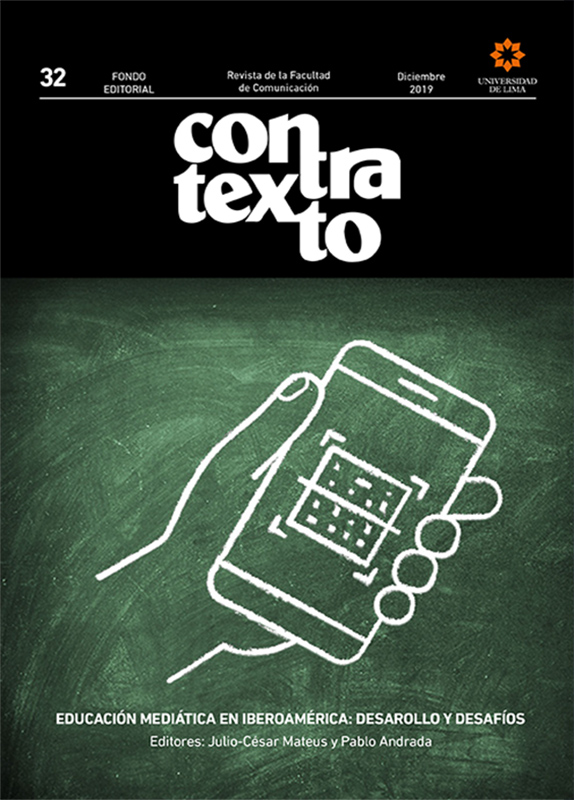
“TV should exhibit the image of an active, curious and competent child”
DOI:
https://doi.org/10.26439/contratexto2019.n032.4622Abstract
Valerio Fuenzalida is one of the most important researchers of media education in Latin America. From his first experiences on television channels, in the 1970s, to his current interest in children’s audiences, there are some constants: not being afraid of new things, distrusting paradigms, and asking and researching in order to have a grounded argument. In this interview, he told us how he developed the ideas that led him to propose an active reception while working at the Center for Research on Cultural and Artistic Expression (Ceneca). In addition, he showed us how he has delved into the importance of emotions in the relationship that people establish with the audiovisual. Valerio remains intellectually restless, with a desire to continue building thought and transmitting it directly or through the possibilities of technology.
Downloads
Downloads
Published
Issue
Section
License
All of the works published are licensed under a CC BY 4.0 Creative Commons Attribution license. (updated on March 1st 2021)
The content of the journal may be shared in any material or format. The content may be adapted, contributed upon and transformed. Both possibilities are only permitted in so far as they complete the following conditions:
- Attribution: Credit must be given where it is due, a link to the license must be provided and changes, if made, must be indicated. This should be done in the manner deemed appropriate, without suggesting that the licensor promotes you or your use of the material.
Ownership rights
The patrimonial rights for Contratexto are published under a Creative Commons BY 4.0 license, allowing authors to keep the patrimonial rights to their work without restrictions.
If a work published in Contratexto were to be copied, distributed, spread, or any other activities contemplated in the aforementioned license, the author(s) and the journal must be mentioned visibly and expressly.
Self-archive
This journal allows and encourages authors to post items submitted to the journal on personal websites or institutional repositories both prior to and after publication, while providing bibliographic details that credit, if applicable, its publication in this journal.