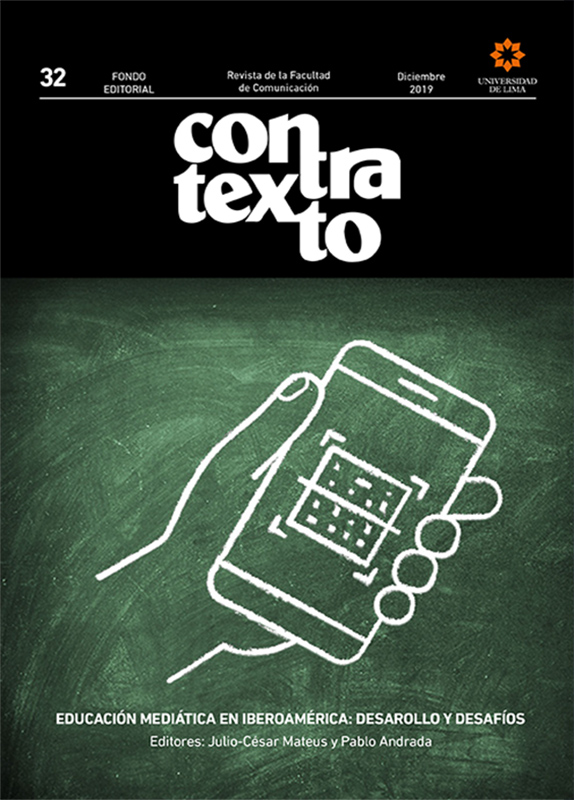
Media education and use of technological resources in Ibero-American classrooms
DOI:
https://doi.org/10.26439/contratexto2019.n032.4604Keywords:
Educación mediática, Recursos tecnológicos, Contexto iberoamericanoAbstract
Abstract. The present article aims to present a reflection, within the Ibero-American context, on the use of digital resources in the classroom and its relationship with media education to highlight common points and diverse strategies in addressing both aspects in education systems, as well as to establish the main challenges for a real media education that could take advantage of new technologies in the classroom. The methodology used for this purpose is mainly based on a systematic review of the literature on the subject performed between the years 2012 and 2018. Moreover, the article addresses some of the results of the “Citizen’s media competencies in emerging digital media in university environments” project (2016-2019) from the National Research, Development and Innovation (I+D+I) Plan of the Spanish Government. Additionally, it presents reflections from experts in media competency of the Euro-American inter-university research network Alfamed. The main conclusions include specific initiatives and particular experiences, but they do not imply an integral and innovative use of information and communication technologies. Beyond the inequality in access opportunities, Ibero-American countries make instrumental use of technological resources in the classroom and their potential is not used for a real media education based on innovation in methodologies that could address the challenges that current education system is facing. This article, more than providing new results, entails a systematization and a comparative framework on the evolution, innovative experiences and current situation of the use of technologies in education in different Ibero-American countries.
Downloads
References
Andrada, P. (2018). La educación mediática en la formación de profesionales de la educación infantil en Chile. Evaluación de planes de estudio, creencias y percepción de la competencia mediática. Tesis doctoral, Barcelona, Universitat Pompeu Fabra (inédita).
Barón, L., Acevedo, F. y Luque, G. (2002). Internet, guerra y paz en Colombia. Bogotá: Antropos.
Blïnk Learning (2018). IV Estudio sobre el uso de la tecnología en la educación: España, Colombia, México, Perú y Chile. Blïnk Learning, (6), 34-52. Recuperado
de https://www.realinfluencers.es/2018/11/13/iv-estudio-sobre-el-uso-de-la -tecnologia-en-la-educacion/
Cuban, L. (2003). Oversold and Underused. Computers in the Classroom. Cambridge: Harvard University Press
Ferrés, J., Aguaded-Gómez, I. y García-Matilla, A. (2012). La competencia mediática de la ciudadanía española: dificultades y retos. Revista ICONO14 Revista Científica de Comunicación y Tecnologías Emergentes, 10(3), 23-42. https://doi.org/10.7195/ ri14.v10i3.201
Ferrés, J. y Masanet, M.J. (2015). La educación mediática en la universidad española. Barcelona: Gedisa, S.A.
Ferrés, J. y Piscitelli, A. (2012). Media competence. Articulated proposal of dimensions and indicators. Comunicar, 19(3), 75–82. https://doi.org/10.3916/C38-2012-02-08.
Figueras-Maz, M., Masanet, M.J. y Ferrés, J. (2017). Mobile devices in higher education: A pending issue in multidimensional media literacy. Catalan Journal of Communication & Cultural Studies, 1(9), 125-144, https://doi.org/10.1386/ cjcs.9.1.135_1
Frau-Meigs, D. (2012). Transliteracy as the new research horizon for media and information literacy. Media Studies, 3(6), 14–26. Recuperado de https://hrcak. srce.hr/index.php?id_clanak_jezik=141821&show=clanak
Fueyo, A., Rodríguez-Hoyos, C. y Linares, C. (2015). La formación en educación mediática de los profesionales de la educación. En Fueyo, A., Rodríguez-Hoyos, C. y Tornero, J. M. (Editores). Los territorios de la Educación Mediática: experiencias en contextos educativos. Barcelona: UOC Press.
Fundación Telefónica Vivo (2016). Experiencias Evaluativas de Tecnologías Digitales en la Educación. Sao Paulo. Recuperado de http://disde.minedu.gob.pe/ bitstream/handle/MINEDU/5288/Experiencias%20evaluativas%20de%20 tecnolog%C3%ADas%20digitales%20en%20la%20educaci%C3%B3n. pdf?sequence=1&isAllowed=y
García-Valcárcel, A., Basilotta, V. y López Salamanca, C. (2014). Las TIC en el aprendizaje colaborativo en el aula de primaria y secundaria. Comunicar, 42, 65-74.http:// dx.doi.org/10.3916/C42-2014-06
Hernández, H. y Bautista, S. (2017). Las TIC en el sistema educativo mexicano. Revista Electrónica sobre Tecnología, Educación y Sociedad, 4(7), 1-13. Recuperado de http://www.ctes.org.mx/index.php/ctes/article/view/65638
Jenkins, el gurú de la Cultura Participativa, en la UAH. (23 de mayo del 2012). Portal de Comunicación de la Universidad de Alcalá. Recuperado de http:// portalcomunicacion.uah.es/diario-digital/archivo/24-archivo-entrevistas-reportajes/6181-jenkins-el-guru-de-la-cultura-participativa-en-la-uah.html
Lévy, P. (2004). Inteligencia colectiva. Por una antropología del ciberespacio. Washington. Recuperado dehttp://inteligenciacolectiva.bvsalud.org/public/docu ments/pdf/es/inteligenciaColectiva.pdf
López, L. y Aguaded, M. C. (2015). Teaching media literacy in colleges of education and communication, Comunicar, 22(44), 187–95. https://doi.org/ 10.3916/ C44-2015-20.
Lugo, M.T. (2010). Las políticas TIC en la educación de América Latina. Tendencias y experiencias. Revista Fuentes, 10, 52-68.
Marta-Lazo, C., Grandío, M. M. y Gabelas, J. A. (2014). La educación mediática en las titulaciones de Educación y Comunicación de las universidades españolas. Análisis de los recursos recomendados en las guías docentes. Vivat Academia, 126, 63–78. Recuperado de http://www.vivatacademia.net/index.php/vivat/ article/view/554
Martín-Barbero, J. y Téllez, P. (2006). Los estudios de recepción y consumo en Colombia. Diálogos de la Comunicación, 73, 57-69. Recuperado de http://goo.gl/J1Xa5e
Masanet, M. J., Contreras, P. y Ferrés, J. (2013), High qualified students? Research into the media competence level of Spanish youth, Communication and Society, 26(4), 217–34. Recuperado de http://dadun.unav.edu/bitstream/10171 /35569/1/20131028165913.pdf
Morduchowicz, R. (2017). Media Literacy in Latin America. En De Abreu, B. International Handbook of Media Literacy Education. New York: Routledge. Recuperado de https://www.routledgehandbooks.com/doi/10.4324/9781315628110.ch3
OCDE (2012). Resultados de PISA 2012 en foco. Recuperado de https://www.oecd.org/ pisa/keyfindings/PISA2012_Overview_ESP-FINAL.pdf
OCDE (2015). Students, Computers and Learning: Making the Connection. Recuperado de http://www.oecd.org/publications/students-computers-and-learning-97892 64239555-en.htm
Organización de Estados Iberoamericanos para la Educación, la Ciencia y la Cultura (OEI) y Fundación Telefónica (2018). Estudio sobre la inclusión de las TIC en los centros educativos de aulas de Fundación Telefónica. Recuperado de: https://www.fundaciontelefonica.com/arte_cultura/publicaciones-listado/ pagina-item-publicaciones/itempubli/635/39
Organización de las Naciones Unidas para la Educación, la Ciencia y la Cultura [Unesco] (2014). Enfoques estratégicos sobre las TIC en educación en América Latina y el Caribe. Recuperado de https://unesdoc.unesco.org/ark:/48223/pf0000223251
Pedró, F. (2017). Tecnologías para la transformación de la educación. España: Fundación Santillana. Recuperado de http://www.fundacionsantillana.com/PDFs/ Tecnologias%20para%20la%20transformacion%20de%20la%20educacion.pdf
Pegurer, M. y Martínez-Cerdá, J.F. (2016). Media Literacy in Brazil: Experiences and Models in Non-Formal Education. Comunicar, 24(49), 39-48. http://dx.doi. org/10.3916/C49-2016-04
Prensky, M. (2001) Digital natives, Digital Immigrants. On the Horizon 9(5), 1-6. Recuperado de https://marcprensky.com/writing/Prensky%20-%20Digital%20Natives,%20 Digital%20Immigrants%20-%20Part1.pdf
Sandoval-Romero, Y. y Arenas, H. (2010). Mirando cómo miramos: una propuesta desde la comunicación y la educación para multiplicar miradas. Cali: USC.
Scolari, C. A. (2016). Alfabetismos transmedia. Estrategias de aprendizaje informal y competencias mediáticas en la nueva ecología de la comunicación. Telos, 193, 13-23. Recuperado de https://repositori.upf.edu/ handle/10230/27788?locale-attribute=es
Tucho, F., Fernández-Planells, A., Lozano, M. y Figueras-Maz, M. (2015). La educación mediática, una asignatura pendiente en la formación de periodistas, publicitarios y comunicadores audiovisuales. Revista Latina de Comunicación Social, 70, 689–702, https://doi.org/10.4185/RLCS-2015-1066.
Vega, J. y Lafaurie, A. (2013). A Children’s Observatory of Television: “Observar TV”, a Space for Dialogue between Children. Comunicar, 40, 145-153http://dx.doi. org/10.3916/C40-2013-03-05
Downloads
Published
Issue
Section
License
All of the works published are licensed under a CC BY 4.0 Creative Commons Attribution license. (updated on March 1st 2021)
The content of the journal may be shared in any material or format. The content may be adapted, contributed upon and transformed. Both possibilities are only permitted in so far as they complete the following conditions:
- Attribution: Credit must be given where it is due, a link to the license must be provided and changes, if made, must be indicated. This should be done in the manner deemed appropriate, without suggesting that the licensor promotes you or your use of the material.
Ownership rights
The patrimonial rights for Contratexto are published under a Creative Commons BY 4.0 license, allowing authors to keep the patrimonial rights to their work without restrictions.
If a work published in Contratexto were to be copied, distributed, spread, or any other activities contemplated in the aforementioned license, the author(s) and the journal must be mentioned visibly and expressly.
Self-archive
This journal allows and encourages authors to post items submitted to the journal on personal websites or institutional repositories both prior to and after publication, while providing bibliographic details that credit, if applicable, its publication in this journal.