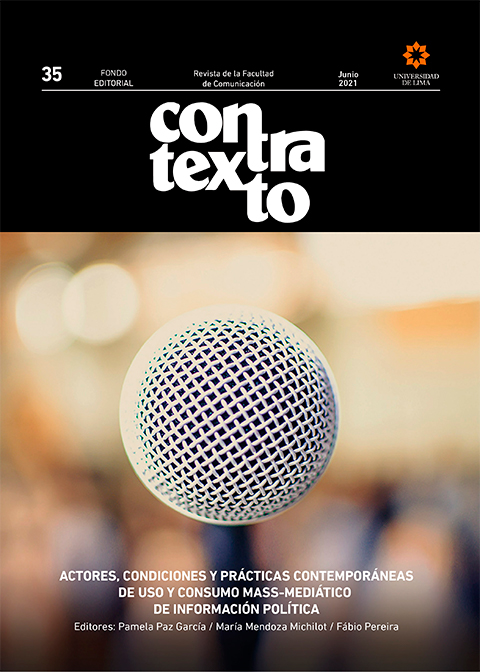
Actores, condiciones y prácticas contemporáneas de uso y consumo mass-mediático de información política: experiencias y procesos de selectividad, personalización, desmasificación y autocomunicación
DOI:
https://doi.org/10.26439/contratexto2021.n035.5139Downloads
References
Arboccó, M. (14 de marzo del 2021). La pandemia ha venido a sumarle más miedo a una sociedad ya asustada. El Comercio, p. 12.
Bastard, I. (2019). Coder/décoder/decoder. La construction sociale de la réception des informations sur Facebook. Terminal, 124, 125-126. http://dx.doi.org/10.4000/terminal.5292
Cavero, G. (2013). Reseña: La mentira os hará libres. Realidad y ficción en la democracia, de Fernando Vallespín Oña. REIS. Revista Española de Investigaciones Sociológicas, 143, 136-139.
Corbella, J. M. (2010). La nueva ecología del audiovisual: nuevos actores, viejos y nuevos problemas. Quaderns del CAC 34, 13(1), 37-45. Recuperado de https://www.cac.cat/sites/default/files/2019-04/Q34_Corbella_ES.pdf
Djakouane, A., y Segré, G. (2017). La réception du spectacle vivant: un défi pour les sciences sociales. Terrains/Théories, 7. https://doi.org/10.4000/teth.970
Eliasoph, N. (2003). Publics fragiles: une ethnographie de la citoyenneté dans la vie associative. En D. Cefaï y D. Pasquier (Eds.), Le sens du public. Publics politiques, publics médiatiques (pp. 225-268). París: PUF.
Hernández, N. (2020). Narrativas transmedia: fantasías animadas de ayer y hoy. Indivisa, 20, 211-233.
Martínez, F. (2020). Mirando pantallas: estudio sobre las audiencias en televisión e internet en tiempos de coronavirus. Textual & Visual Media, 13, 74-90. Recuperado de https://textualvisualmedia.com/index.php/txtvmedia/article/view/268/192
Méadel, C. (2004). Public, cher inconnu! Le Temps des Médias, 3, 1836-1918.
Neira, E., Clares-Gavilán, J., y Sánchez-Navarro, J. (2021). New audience dimensions in streaming platforms: the second life of Money heist on Netflix as a case study. Profesional de la Información, 30(1), e300113. https://doi.org/10.3145/epi.2021.ene.13.
Robinson, S. (2010). Traditionalists vs. convergers: textual privilege, boundary work, and the journalist-audience relationship in the commenting policies of online news sites. Convergence, 16(1), 125-143.
Singer, J. B., Domingo, D., Heinonen, A., Hermida, A., Paulussen, S., Quandt, T., ... Vujnovic, M. (2011). Participatory journalism: guarding open gates at online newspapers. John Wiley & Sons.
Downloads
Published
Issue
Section
License
All of the works published are licensed under a CC BY 4.0 Creative Commons Attribution license. (updated on March 1st 2021)
The content of the journal may be shared in any material or format. The content may be adapted, contributed upon and transformed. Both possibilities are only permitted in so far as they complete the following conditions:
- Attribution: Credit must be given where it is due, a link to the license must be provided and changes, if made, must be indicated. This should be done in the manner deemed appropriate, without suggesting that the licensor promotes you or your use of the material.
Ownership rights
The patrimonial rights for Contratexto are published under a Creative Commons BY 4.0 license, allowing authors to keep the patrimonial rights to their work without restrictions.
If a work published in Contratexto were to be copied, distributed, spread, or any other activities contemplated in the aforementioned license, the author(s) and the journal must be mentioned visibly and expressly.
Self-archive
This journal allows and encourages authors to post items submitted to the journal on personal websites or institutional repositories both prior to and after publication, while providing bibliographic details that credit, if applicable, its publication in this journal.