Thematic Call "Industrial tectonics"
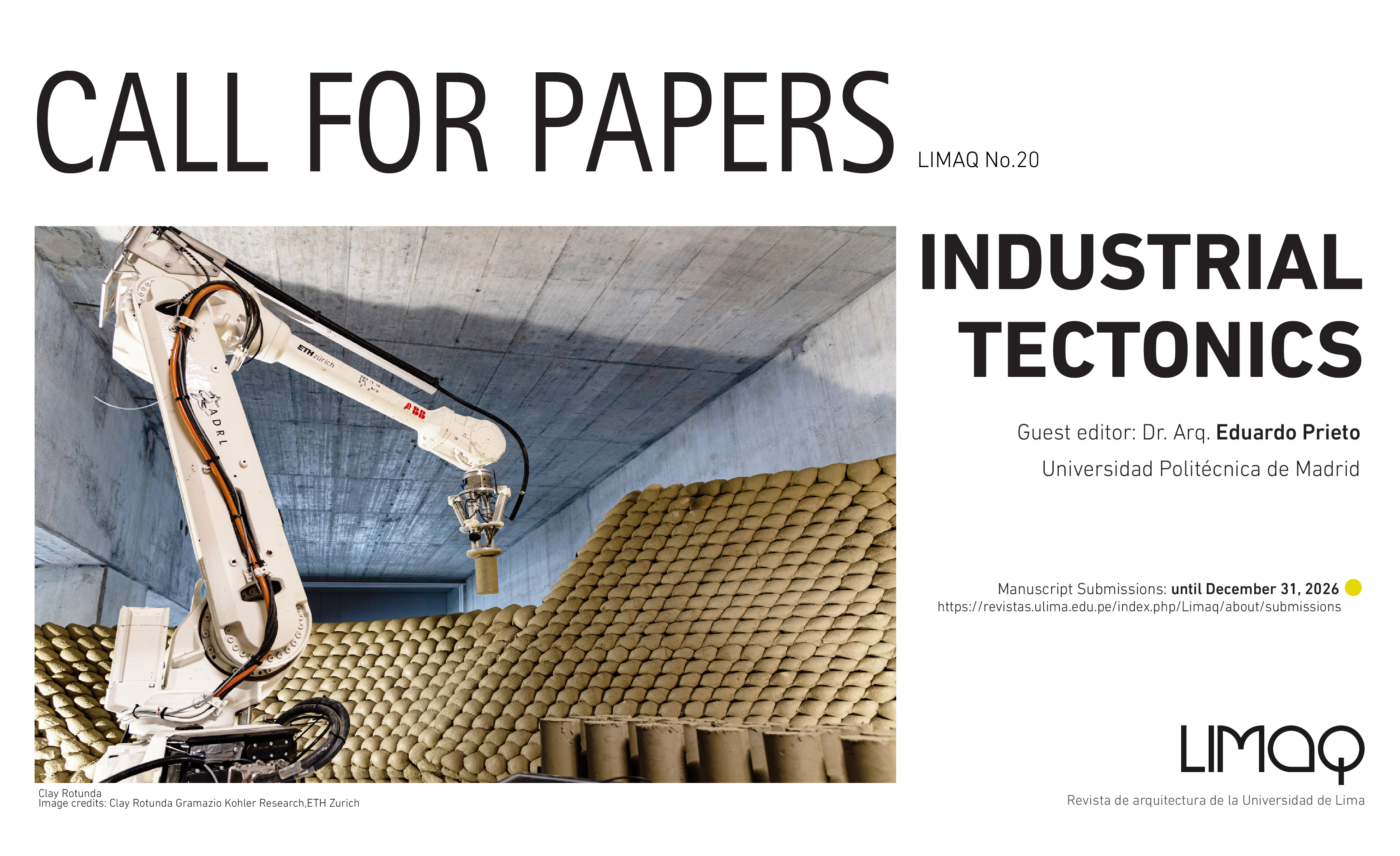 Deadline December 31, 2026 — Limaq No. 20
Thematic Section: “Industrial Tectonics”
Guest Editor: Dr. Arch. Eduardo Prieto
Universidad Politécnica de Madrid
A dilemma, in the broadest sense, is simply a crossroads, a moment of crisis in which we are compelled to make fundamental decisions, one way or another. Today, architecture faces dilemmas, crossroads, and alternatives that stand out against an equally complex backdrop of crises and uncertainties affecting the teaching and practice of the discipline, as well as society’s expectations regarding the role of architecture and architects. Many of these dilemmas—sustainability, artificial intelligence, industrialization—are related to the profound, accelerated, and intertwined technological changes, ethical demands, social idiosyncrasies, and political instruments associated with construction and the environment. Beyond the “recipe-driven” approaches and commonplaces of “sustainability,” these changes, demands, idiosyncrasies, and instruments could, or should, constitute an extraordinary field of opportunities for architecture and society, both culturally and aesthetically.
In this context, industrialization presents a dilemma that tends to resurface and become critical with each generation, at least since the emergence of modernity: the dilemma between surrendering to the siren songs of technology (today, digital technologies and crafts) or remaining immobile in their face, like Ulysses tied to the mast of his ship. While the first option may lead to technological determinism and the uncritical use of technology—turning architects into mere formal processors of construction systems driven by the market—the second entails the risk of becoming detached from the world and reducing the profession to that of pure designers or “façade decorators”; that is, to social irrelevance. The answer may lie in finding an Aristotelian middle ground that nurtures the idea of an architecture imbued with the construction systems of its time—which will increasingly be industrial, or else cease to be—and of a domesticated industry, that is, one etymologically transformed into a home, into architecture.
At this point, and as a complement to an earlier issue of this journal devoted to “Environmental Tectonics,” we propose reflecting on three fundamental questions concerning industrialization: what can we know, what can we do, and what can we expect? The first refers to the with what: the materials and systems offered by the construction industry, as well as the need to adapt architects’ education to this new reality. The second focuses on the how: how to design and build so that both design and its materialization respond to a logic of industrialization that goes far beyond prefabrication and that, in any case, can turn the architect into an indispensable mediator between design, industry, and on-site assembly—in other words, into both a designer and, at the same time, a project manager. The third question concerns the what for. Its purpose should be none other than to improve the quality of architecture in a context marked by two opposing trends: on the one hand, the shortage of skilled labor and the consequent weakening of traditional construction systems; on the other, the growing demand for architecture, particularly in housing, whose typological condition makes it particularly compatible with the various forms of contemporary industrialization.
With the aim of addressing these questions, we invite contributions in the form of articles that approach the subject from two complementary perspectives: a historical perspective, intended to reveal examples in which industrialization has given rise to formal metamorphoses and to high-quality architecture; and a contemporary technical perspective, intended to present architectural experiences that have addressed the challenges of industrialization through technology, but also through humanism and beauty. Industrialization is already a reality of architecture; the challenge is for it to give rise to a different reality—more efficient and coherent, more human: a reality that is viable for architects, manufacturers, and users.
Eduardo Prieto, Universidad Politécnica de Madrid
.jpg)