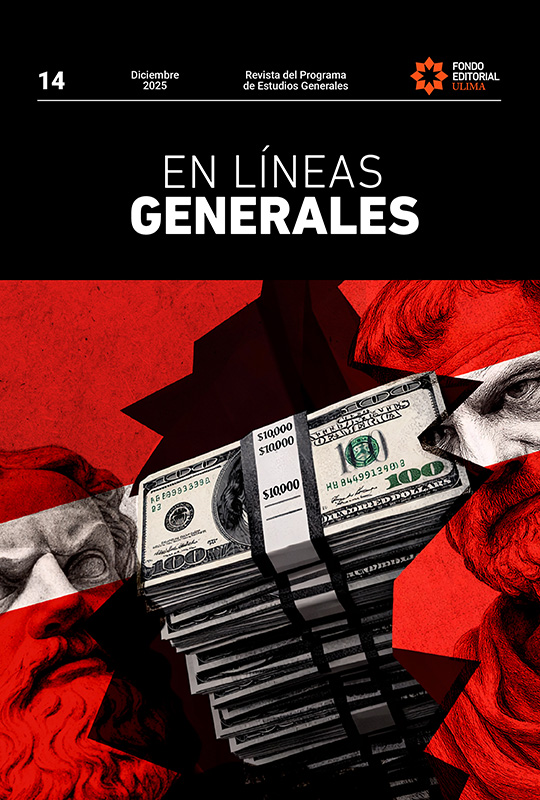
Adam Smith and the corruption of moral sentiments: tensions between ethics and economics
DOI:
https://doi.org/10.26439/en.lineas.generales2025.n014.8162Keywords:
Adam Smith, market, corruption of moral sentiments, moral judgment, impartial spectatorAbstract
This article focuses on Adam Smith’s notion of the corruption of moral sentiments, understood as the deterioration of moral judgment and sympathy caused by the imitation and admiration of wealth. This perspective allows us to understand how, within commercial society, self-interest can erode the ethical foundations of social life. The aim is not to provide an empirical diagnosis of contemporary corruption, nor an account of the political role of the private sector in state corruption —aspects to which Smith was not entirely indifferent—, but rather to offer a conceptual reconstruction of the phenomenon, considering primarily The Theory of Moral Sentiments. In this sense, the article questions whether the market may entail degrading or corruptive effects on social relations and, against interpretations that present Smith as a mere defender of liberalism, argues that although Smith was a proponent of the free market, he also recognized its possible degrading effects on social dynamics, drawing on both the aforementioned ethical work and The Wealth of Nations.
Downloads
References
Boyd, R. (2013). Adam Smith on civility and civil society. En C. J. Berry, M. P. Paganelli & C. Smith (Eds.), The Oxford handbook of Adam Smith (pp. 443-463). Oxford University Press. https://doi.org/10.1093/oxfordhb/9780199605064.001.0001
Butler, E. (2013). Fundamentos de la sociedad libre. Institute of Economic Affairs. https://iea.org.uk/wp-content/uploads/2016/07/FPP_Fundamentos_Sociedad_Libre_0.pdf
Chandler, J. (2013). Adam Smith as critic. En C. J. Berry, M. P. Paganelli & C. Smith (Eds.), The Oxford handbook of Adam Smith (pp. 126-142). Oxford University Press. https://doi.org/10.1093/oxfordhb/9780199605064.001.0001
Del Hierro Carrillo, P. (2019). La invisible “mano invisible” de Adam Smith. Revista de Economía Institucional, 21(40), 143-161. https://doi.org/10.18601/01245996.v21n40.05
García Martínez, J. (2018). Hayek: una reconstrucción de su teoría de la justicia [Trabajo de fin de grado, Universidad de Salamanca]. Repositorio documental Gredos de la Universidad de Salamanca. https://gredos.usal.es/handle/10366/139108
Gómez, M. (2011). Crítica al concepto de “orden espontáneo” de Hayek. Realidad. Revista de Ciencias Sociales y Humanidades, (127), 163-176. https://revistas.uca.edu.sv/index.php/realidad/article/view/4620https://dialnet.unirioja.es/descarga/articulo/6520945.pdf
Fleischacker, S. (2004). On Adam Smith’s Wealth of Nations. A philosophical companion. Princeton University Press.
Fricke, C. (2013). Adam Smith: The sympathetic process and the origin and function of conscience. En C. J. Berry, M. P. Paganelli & C. Smith (Eds.), The Oxford handbook of Adam Smith (pp. 177-200). Oxford University Press. https://doi.org/10.1093/oxfordhb/9780199605064.001.0001
Hayek, F. von. (2006). El espejismo de la justicia social. En Derecho, legislación y libertad (pp. 183-360). Unión Editorial. (Obra original publicada en 1979)
Montes, L. (2017). Adam Smith en contexto. Una revaluación crítica de algunos aspectos centrales de su pensamiento (S. Cifuentes Dowling, Trad.). Tecnos.
Pulcini, E. (2012). The individual without passions: Modern individualism and the loss of the social bond. Lexington Books.
Rodríguez, C. (2017). Otro problema de Adam Smith: el liberalismo. En J. H. Cole (Ed.), A companion to Adam Smith (pp. 195-224). Universidad Francisco Marroquín.
Seoane, J. (2022). Al hilo de la idea de corrupción en Bernard Mandeville, David Hume y Adam Smith. En I. Wences, P. de la Nuez & J. Seoane (Coords.), La idea de corrupción en los siglos xviii y xix: forjas y resignificaciones (pp. 21-40). Marcial Pons.
Smith, A. (1996). La riqueza de las naciones (C. Rodríguez Braun, Trad.). Alianza Editorial. (Obra original publicada en 1776)
Smith, A. (1997). La teoría de los sentimientos morales (C. Rodríguez Braun, Trad.). Alianza Editorial. (Obra original publicada en 1759)
Sparling, R. A. (2018). Impartiality and the definition of corruption. Political Studies, 66(2), 376-391. https://doi.org/10.1177/0032321717722360
Tegos, S. (2013). Adam Smith: Theorist of corruption. En C. J. Berry, M. P. Paganelli & C. Smith (Eds.), The Oxford handbook of Adam Smith (pp. 353-371). Oxford University Press. https://doi.org/10.1093/oxfordhb/9780199605064.001.0001