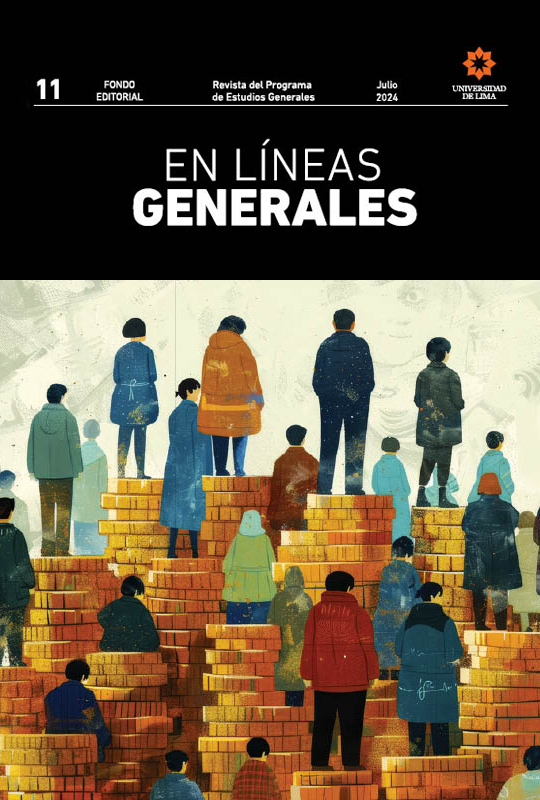
The need for effective democracy and an efficient state
DOI:
https://doi.org/10.26439/en.lineas.generales2024.n011.7368Keywords:
democracy, electoral legislation, social cohesion, effective governments, self-governmentAbstract
In the social construction process of democracy, humans have attempted to establish a set of rules (institutions) that help preserve our existence as a collective. This process constitutes continuous learning, allowing us to identify the set of norms that generate appropriate incentives to achieve a self-governance architecture with positive outcomes for social cohesion and well-being. In this essay, we emphasize the importance of establishing appropriate electoral legislation that promotes the formation of effective governments (results) and turns democracy into a robust political platform. This approach is particularly relevant in the Peruvian context, where a deep understanding and interpretation of the complex social, political, and economic processes of the 21st century, such as economic growth, the institutionalization of political parties, the development of a democratic culture, and a high-level bureaucracy, are required.
Downloads
References
Achen, C., & Bartels, L. (2017). Democracy for realists: Why elections do not produce responsive government. Princeton University Press.
Banco Mundial. (1997). Informe sobre el desarrollo mundial 1997. El Estado en un mundo en transformación. Banco Internacional de Reconstrucción y Fomento, Banco Mundial. https://documents1.worldbank.org/curated/en/701691468153541519/pdf/173000WDR0SPANISH0Box128708B00PUBLIC0.pdf
Benzecry, C., Krause, M., & Redd, I. (2019). La teoría social, ahora. Nuevas corrientes, nuevas discusiones. Siglo Veintiuno Editores.
Berlin, I. (2001). Dos conceptos de libertad. Alianza Editorial. (Obra original publicada en 1958)
Cohen, G. A. (2014). Por una vuelta al socialismo o cómo el capitalismo nos hace menos libres. Siglo Veintiuno Editores.
Collier, P. (2019). El futuro del capitalismo: cómo afrontar las nuevas ansiedades. Debate.
Corporación Latinobarómetro. (2023, 21 de julio). Informe 2023. https://hoy.com.do/wp-content/uploads/2023/07/Latinobarometro_Informe_2023_230721.pdf
Douglass, C. N. (1990). Institutions, institutional change and economic performance. Cambridge University Press.
Fukuyama, F. (2004). La construcción del Estado. Hacia un nuevo orden mundial en el siglo xxi. Ediciones B.
Goodin, R., & Klingmann, H.-D. (Eds.). (2013). Nuevo manual de ciencia política. Istmo.
Lijphart, A. (2012). Patterns of democracy: Government forms and performance in thirty-six countries. Yale University Press.
Lipset, S. M. (1988). El hombre político. Las bases sociales de la política. Tecnos.
López Zamorano, J. (2021, 18 de marzo). México ‘ingobernable’: narco controla hasta 35% del país, dice EU. El Financiero. https://www.elfinanciero.com.mx/nacional/controla-el-narco-hasta-35-del-territorio-en-mexico-alerta-eu/
Marey, M. (2021). Teorías de la república y prácticas republicanas. Herder.
Pettit, P. N. (1997). Republicanism: A theory of freedom and government. Oxford University Press.
Pettit, P. N. (2023). En los términos del pueblo. Teoría y modelo republicanos de democracia. Trotta.
Queen, M. (Ed.). (2001). The collected works of Jeremy Bentham: Writings on the poor laws (vol. 1). Oxford University Press.
Reid, G., & Chapman, H. (1995). The social construction of democracy, 1870-1990. New York University Press.
Rosanvallon, P. (2007). La contrademocracia. La política en la era de la desconfianza. Manantial.
Rosanvallon, P. (2011). La sociedad de iguales. Manantial.
Rosanvallon, P. (2015). El buen gobierno. Manantial.
Sartori, G. (2003). ¿Qué es la democracia? Taurus.
Stasavage, D. (2021). Caída y ascenso de la democracia. Una historia del mundo desde la antigüedad hasta hoy. Turner.