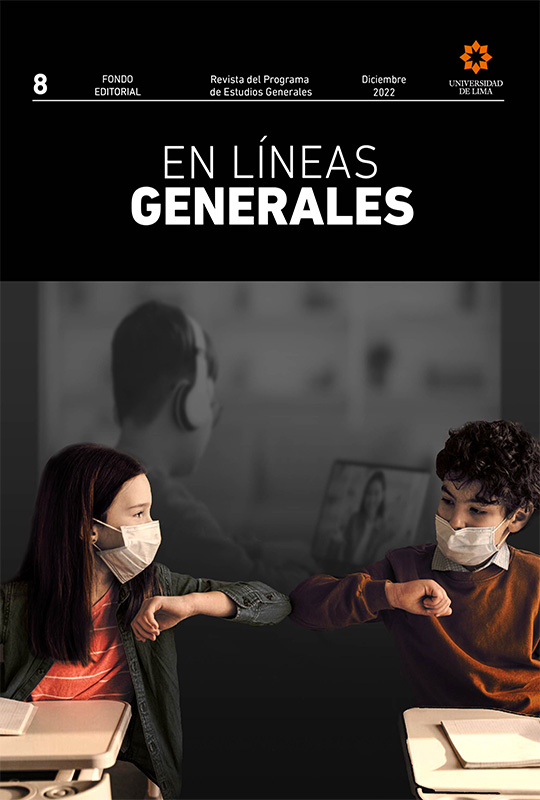
Prospects for post-pandemic higher education
DOI:
https://doi.org/10.26439/en.lineas.generales2022.n008.5993Keywords:
higher education, flipped classes, videos, virtual and augmented reality, motivation, pandemic, TICAbstract
This article addresses the positive effects of the coronavirus pandemic on higher education. The pandemic has wreaked havoc on the world’s economies, but new opportunities have arisen for education. Among the outstanding achievements of recent years, we note the increase in the use of information and communication technologies (ICT) and a greater approach to flipped learning. In addition, as students were affected by the pandemic, teachers had to reinforce their soft skills to motivate and guide them. Including virtual and augmented reality as teaching material in higher education has also sparked teachers’ interest. Based on this experience, we consider that many of these changes will be maintained in the future. The projects evaluated so far conclude that this benefits the learning process.
Downloads
References
Allcoat, D. & von Mühlenen, A. (2018). Learning in virtual reality: effects on performance, emotion and engagement. Research in Learning Technology, 26. https://doi.org/10.25304/rlt.v26.2140
Barcos Arias, I. F. B., Ochoa, N. V. V. & Farías, G. K. A. (2021). Perfil del docente del siglo xxi y sus desafíos. Revista Conrado, 17(S2) (pp. 410-420). https://conrado.ucf.edu.cu/index.php/conrado/article/view/2034
Bax, S. (2011) Digital education: beyond the ‘wow’ factor in digital education in Thomas, M. Digital education: opportunities for social collaboration. Palgrave Macmillan. https://doi.org/10.1057/9780230118003_12
Boyles, B. (2017). Virtual reality and augmented reality in education. Center For Teaching Excellence, United States Military Academy, West Point, Ny. https://www.westpoint.edu/sites/default/files/inline-images/centers_research/center_for_teching_excellence/PDFs/mtp_project_papers/Boyles_17.pdf
Domínguez, L. C., Vega, N. V., Espitia, E. L., Sanabria, Á. E., Corso, C., Serna, A. M. & Osorio, C. (2015). Impacto de la estrategia de aula invertida en el ambiente de aprendizaje en cirugía: una comparación con la clase magistral. Biomédica, 35(4) (pp. 513-521). https://doi.org/10.7705/biomedica.v35i4.2640
Fernández-Berrocal, P. & Ruiz, D. (2008). Emotional intelligence in education. http://repositorio.ual.es/bitstream/handle/10835/538/Art_15_256_eng.pdf?sequence=1
López-Torres, A. M., Mancho de la Iglesia, A. C. & Sein-Echaluce Lacleta, M. L. (2021, October). Teachers’ expectations regarding the creation and use of audiovisuals materials. In Ninth International Conference on Technological Ecosystems for Enhancing Multiculturality (TEEM’21) (pp. 243-247). https://doi.org/10.1145/3486011.3486454
Maddox, T. & Fitzpatrick, T. (2019). The promise of virtual reality in health-care education and training: it’s all in the neuroscience. Digital Medicine, 5(4), (p. 133). https://doi.org/10.4103/digm.digm_26_19
Meier, C., Saorín, J., de León, A. B. & Cobos, A. G. (2020). Using the roblox video game engine for creating virtual tours and learning about the sculptural heritage. International Journal of Emerging Technologies in Learning (iJET), 15(20) (pp. 268-280). https://doi.org/10.3991/ijet.v15i20.16535
Neuwirth, L. S., Jović, S. & Mukherji, B. R. (2021). Reimagining higher education during and post-COVID-19: Challenges and opportunities. Journal of Adult and Continuing Education, 27(2) (pp. 141-156). https://doi.org/10.1177/14779714209477
Pericles ‘asher’ Rospigliosi (2022) Metaverse or Simulacra? Roblox, Minecraft, Meta and the turn to virtual reality for education, socialisation and work. Interactive Learning Environments, 30(1) (pp. 1-3). https://doi.org/10.1080/10494820.2022.2022899
Roda-Segarra, J., Mengual Andrés, S. & Martínez-Roig, R. (2022). Using virtual reality in education: a bibliometric analysis. http://dx.doi.org/10.54988/cv.2022.1.1006
Teliz, E. G. & Ramírez, A. S. (2020). Experiencias tecnopedagógicas en la gestión de cursos en línea durante la COVID-19. Transdigital, 1(2). https://doi.org/10.56162/transdigital41
UNESCO (2019) Marco de competencias de los docentes en materia de TIC. https://es.unesco.org/themes/tic-educacion/marco-competencias-docentes