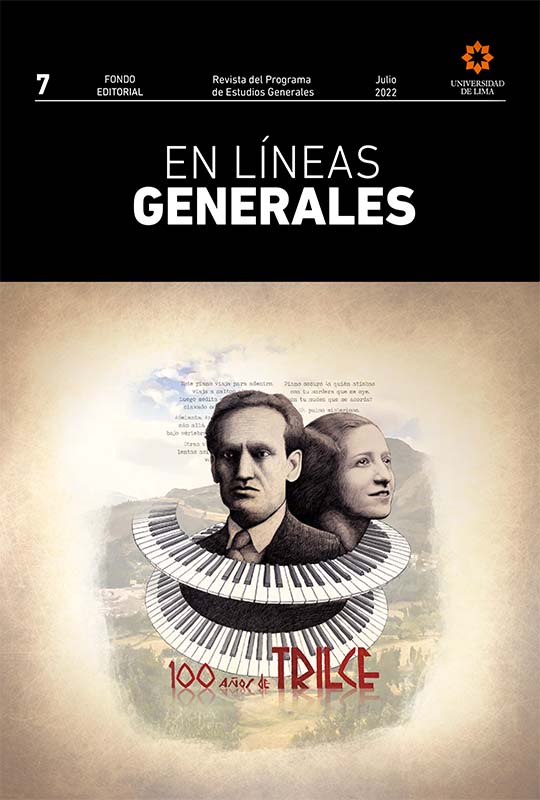
“This piano travels inward” (On the Form of Content and the Content of Form in Trilce)
DOI:
https://doi.org/10.26439/en.lineas.generales2022.n007.5924Keywords:
Trilce, Vallejo, poetry, poem, subject, meaning, form, content, modernismAbstract
Trilce has been read by a significant number of critics as a book that resists interpretation, pushing against the boundaries of the Spanish language and poetic form to place them outside themselves. In that process, it is said, Trilce fragments and dissolves the subject of writing, signaling its emptiness and its impossibility. Explicitly or otherwise, critics often imbue these operations with an emancipatory valence since interrupting hermeneutic closure is a way of resisting the power that circulates in established discourses, including those of poetry and its interpretive apparatuses. Ultimately, such refusal to signify is posited as the direction in which Trilce moves; i.e., its meaning. Leaning on emblematic versions of this reading and revisiting how Trilce operates with such dialectical pairs as open/closed and inside/outside, among others, this essay wants to suggest a different possibility: reading Trilce’s formal gesture as a passage towards the construction, not the dissolution, of a plural subject —one whose writing moves not towards emptiness but towards plenitude and, in the process, affirming the capacity of poetic language to signify the new—.
Downloads
References
Agamben, G. (2019). Creación y anarquía. La obra en la época de la religión capitalista. Adriana Hidalgo Editora.
Casado, M. (2019). Un discurso republicano. Ensayos sobre poesía. Libros de la resistencia.
Casanova, C. (2017). Comunismo de los sentidos. Una lectura de Marx. Catálogo Libros.
Deleuze, G. (1986). Foucault. Paidós Ibérica.
Foucault, M. (1997). El pensamiento del afuera. Pre-Textos.
Jameson, F. (2007). The Modernist Papers. Verso
Meschonnic, H. (2007). La poética como crítica del sentido. Mármol Izquierdo Editores.
Montalbetti, M. (2014). En defensa del poema como aberración significante. En Cualquier hombre es una isla (pp. 47-61). Fondo de Cultura Económica.
Montalbetti, M. (2018). Notas para un seminario sobre Foucault. Fondo de Cultura Económica; Sur Librería Anticuaria.
Montalbetti, M. (2019). El pensamiento del poema. Variaciones sobre un tema de Badiou. Marginalia Editores.
Vich, V. (2021). César Vallejo: Un poeta del acontecimiento. Editorial Horizonte.
Vallejo, C. (2015). Obra poética completa (E. Ballón Aguirre, Ed.). Biblioteca Ayacucho. (Obra orginal publicada en 1979).