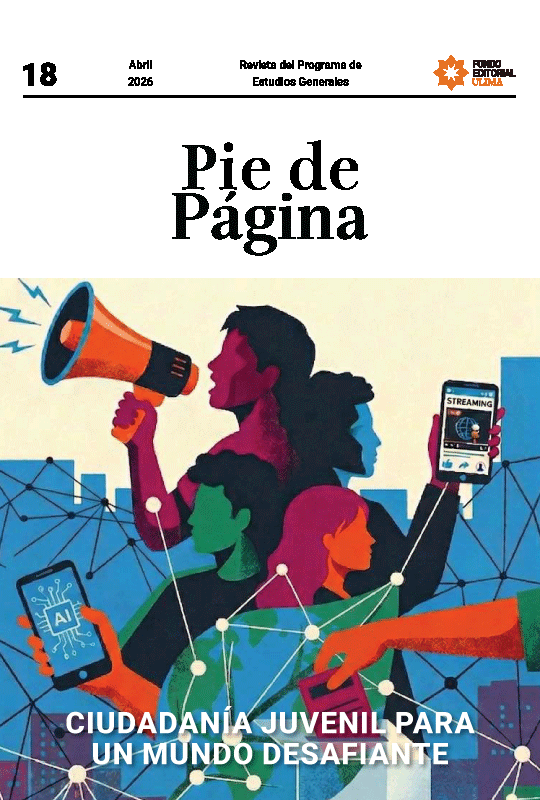
Ética en redes sociales e inteligencia artificial durante campañas políticas: libertad de información versus desinformación y bots
DOI:
https://doi.org/10.26439/piedepagina2026.n18.8727Descargas
Referencias
Bradshaw, S., Bailey, H. & Howard, P. N. (2021). Industrialized disinformation: 2020 global inventory of organized social media manipulation. Oxford Internet Institute. https://demtech.oii.ox.ac.uk/wp-content/uploads/sites/12/2021/01/CyberTroop-Report-2020-v.2.pdf
Bradshaw, S., Neudert, L.-M., & Howard, P. N. (2019). Government responses to mali-cious use of social media. NATO Strategic Communications Centre of Excellence. https://demtech.oii.ox.ac.uk/wp-con-tent/uploads/sites/12/2019/01/Nato-Report.pdf
Cadwalladr, C., & Graham-Harrison, E. (2018, 17 de marzo). Revealed: 50 million Facebook profiles harvested for Cambridge Analytica in major data breach. The Guardian. https://www.theguardian.com/news/2018/mar/17/cambridge-analytica-facebook-influen-ce-us-election
Comisión Europea. (s. f.). Un código de buenas prácticas de la UE en materia de desinformación reforzado. https://commission.europa.eu/topics/coun-tering-information-manipulation/strengthened-eu-code-practice-disinfor-mation_es
Douek, E. (2020, 11 de febrero). The rise of content cartels. Knight First Amendment Institute. https://knightcolumbia.org/content/the-rise-of-content-cartels
Ferrara, E., Varol, O., Davis, C. B., Menczer, F., & Flammini, A. (2016). The rise of social bots. Communications of the ACM, 59(7), 96 -104.
Gillespie, T. (2018). Custodians of the internet. Platforms, content moderation and the hidden decisions that shape social media. Yale University Press.
Giraldo, I. (2025). Las sirenas de Homero y las sirenas digitales: la Odisea como pedagogía de la resistencia crítica en la era de la información. Ponencia presentada al I Congreso Internacional de las Humanidades, Universidad de Lima.
Gorwa, R., & Guilbeault, D. (2018). Unpacking the social media bot: A typology to guide research and policy. Policy & Internet, 12(2), 225-248.
Habermas, J. (2023). A new structural transformation of the public sphere and deliberative politics. Polity.
Hobbs, R. (2010). Digital and media literacy: A plan of action. The Aspen Institute; The Knight Foundation. https://files.eric.ed.gov/fulltext/ED523244.pdf
Howard, P. N., & Hussain, M. M. (2013). Democracy’s fourth wave? Digital media and the Arab Spring. Oxford University Press.
Jenkins, H., Ito, M., & Boyd, D. (2016). Participatory culture in a networked era: A conversation on youth, learning, commerce, and politics. Polity.
Kant, I. (s. f.). ¿Qué es la Ilustración? https://educacion.uncuyo.edu.ar/upload/kant-que-es-la-ilustracion.pdf (Obra original publicada en 1784)
Liang, F., Das, V., Kostyuk, N., & Hussain, M. M. (2018). Constructing a data-driven society: China’s social credit system as a state surveillance infrastructure. Policy & Internet, 10(4). https://creatingfutu-reus.org/wp-content/uploads/2021/10/LiangEtAl-2018-ChinaSocialCreditStateSurveillance.pdf
Mill, J. S. (2012). Sobre la libertad. Alianza Editorial. (Obra original publicada en 1859)
Pariser, E. (2011). The filter bubble: What the internet is hiding from you. Penguin Press.
Roberts, S. (2019). Behind the screen: Content moderation in the shadows of social media. Yale University Press.
Wineburg, S., & McGrew, S. (2019). Lateral reading and the nature of expertise: Reading less and learning more when evaluating digital information. Teachers College Record, 121(11). https://doi.org/10.1177/016146811912101102