DETERMINANTS OF SATISFACTION
AND CONTINUANCE INTENTION IN FOOD DELIVERY APPLICATIONS
Article type: Original
Corresponding author:
Walter Agustin Meza-Rimac
[email protected]

DETERMINANTS OF SATISFACTION
AND CONTINUANCE INTENTION IN FOOD DELIVERY APPLICATIONS
Article type: Original
Corresponding author:
Walter Agustin Meza-Rimac
[email protected]
Walter Agustin Meza-Rimac1 
 , Martín Mauricio-Andía1 ,
Emilio Antonio Herrera-Trujillo 1 , Joel H. Nizama1
1Universidad de Lima, Perú
Abstract
Purpose: This study aims to identify the determinants influencing continuance intention in food delivery applications (FDAs) using an integrated framework based on the expectation confirmation model (ECM). Although FDAs have transformed consumption habits in urban environments, retaining user engagement remains a major challenge for digital platforms. This research examines the influence of delivery experience, promotions, perceived time savings, expectation confirmation, and perceived usefulness on user satisfaction and continuance intention. Design/methodology/approach: The study employed a non-experimental, cross-sectional design with a quantitative and explanatory scope. Data were collected from 174 valid users in Metropolitan Lima and analyzed using partial least squares structural equation modeling (PLS-SEM) with SmartPLS 4. Findings: The results reveal that user satisfaction significantly mediates the relationship between operational factors (delivery experience, promotions, and time savings) and continuance intention. Expectation confirmation positively influences both perceived usefulness and satisfaction, reinforcing the role of cognitive judgment in post-usage behavior. Practical implications: The findings provide insights for platform managers and service designers seeking to strengthen user loyalty by improving operational performance and offering personalized value propositions. Originality/value: This study contributes to the literature on digital services by extending the ECM framework to the FDA context, incorporating functional service attributes that have been scarcely examined in prior research. By capturing both affective and cognitive factors, the study offers a more comprehensive understanding of user retention mechanisms in digital service ecosystems.
Keywords: food delivery applications; expectation confirmation model; user satisfaction; continuance intention; partial least squares structural equation modeling
JEL: C38, D12, L81, M31, O33
Cómo citar: Meza-Rimac, W. A. (2026). DETERMINANTS OF SATISFACTION AND CONTINUANCE INTENTION IN FOOD DELIVERY APPLICATIONS. Peruvian Journal of Management, (3), 161-183. https://doi.org/10.26439/pjm2026.n003.8276.
Historia del artículo. Received: May 16, 2025. Accepted: October 24, 2025.
Published online: April 15, 2026.
Determinantes de la Satisfacción y la Intención
de Continuidad en las Aplicaciones de Entrega
de Alimentos
Resumen
Propósito – Este estudio tiene como objetivo identificar los determinantes que influyen en la intención de continuidad en el uso de aplicaciones de entrega de comida (FDA, por sus siglas en inglés) mediante un marco integrado basado en el Modelo de Confirmación de Expectativas (ECM). Aunque las FDAs han transformado los hábitos de consumo en entornos urbanos, mantener el compromiso de los usuarios sigue siendo un desafío importante para las plataformas digitales. Esta investigación examina la influencia de la experiencia de entrega, las promociones, la percepción de ahorro de tiempo, la confirmación de expectativas y la utilidad percibida sobre la satisfacción del usuario y la intención de continuidad. Diseño/metodología/enfoque – El estudio empleó un diseño no experimental, de corte transversal, con un alcance cuantitativo y explicativo. Se recopilaron datos de 174 usuarios válidos en Lima Metropolitana y se analizaron mediante Modelado de Ecuaciones Estructurales por Mínimos Cuadrados Parciales (PLS-SEM) utilizando SmartPLS 4.0. Hallazgos – Los resultados revelan que la satisfacción del usuario medía de manera significativa la relación entre factores operativos (experiencia de entrega, promociones y ahorro de tiempo) y la intención de continuidad. La confirmación de expectativas influye positivamente tanto en la utilidad percibida como en la satisfacción, reforzando el papel del juicio cognitivo en el comportamiento posterior al uso. Implicaciones prácticas – Los hallazgos aportan información valiosa para los gestores de plataformas y diseñadores de servicios que buscan fortalecer la lealtad de los usuarios mediante la mejora del desempeño operativo y la oferta de propuestas de valor personalizadas. Originalidad/valor – Este estudio contribuye a la literatura sobre servicios digitales al extender el marco del ECM al contexto de las FDAs, incorporando atributos funcionales del servicio que han sido escasamente examinados en investigaciones previas. Al capturar tanto factores afectivos como cognitivos, el estudio ofrece una comprensión más integral de los mecanismos de retención de usuarios en los ecosistemas de servicios digitales.
Palabras clave: Aplicaciones de entrega de comida (FDA); Modelo de Confirmación de Expectativas (ECM); Satisfacción del usuario; Intención de continuidad; PLS-SEM
Códigos JEL C38, D12, L81, M31, O33
1. INTRODUCTION
Food delivery has evolved from telephone-based orders and takeaway counters to an environment dominated by digital platforms. Within this context, food establishments increasingly employ mobile food delivery services such as UberEats, Foodpanda, Rappi, and PedidosYa, which provide customers with efficient tools to place, track, and manage their orders (Su et al., 2022). During the COVID-19 pandemic, these services played a critical role in sustaining sector operations and adapting to mobility restrictions and social distancing measures (Ng et al., 2023). Food delivery applications (FDAs) enable consumers to explore dining options, compare reviews, access promotions, and receive orders at home, offering bidirectional advantages for both consumers and businesses (Ng et al., 2023). In this new digital scenario, FDAs have evolved beyond simple logistical intermediation to become a competitive and strategic channel (Pillai et al., 2022).
In 2024, the global food delivery market size was estimated at USD 228,84 billion, with a projected compound annual growth rate (CAGR) of 9,4 % between 2025 and 2030 (Grand View Research [GVR], 2025). In Latin America, the food delivery market has experienced accelerated growth, initially driven by the pandemic and subsequently reinforced by technological expansion, reaching estimated revenues of USD 33 billion in 2023 (an increase of nearly 24 % compared to the previous year) and consolidating itself as a highly competitive sector, with major companies seeking to strengthen their market positioning (Ou, 2025).
In Peru, the online food delivery market is also experiencing accelerated growth, driven by the increasing demand for convenience, widespread smartphone usage, and rising interest in healthier food options. Consumers—particularly younger individuals—seek gastronomic variety and experiences influenced by social media, while the country’s rich culinary heritage and local festivities heighten the demand for traditional dishes. This dynamism is further reinforced by sustained economic growth, rising disposable income, and policies that support e-commerce development. In this context, sector revenues are expected to reach USD 1,95 billion in 2025 and increase to USD 3,22 billion by 2030, corresponding to a CAGR of 10,58 %. The grocery delivery segment is also expanding rapidly, with projected revenues of USD 1,83 billion in 2025, a growth rate of 15,4 % in 2026, an average revenue per user (ARPU) of USD 270,35, and an estimated user base of 8,9 million by 2030, while China remains the largest global market (Statista Market Insights, 2025).
In an environment characterized by homogeneous value propositions and high technological dependence, consumer retention has emerged as a critical factor to ensure the operational and financial sustainability of these platforms (Goyal et al., 2023). From the business perspective of FDAs, and given the wide range of competing options available in the market, one of the main concerns lies in understanding how to ensure that customers continue using a specific application over time (Ng et al., 2023). In this context, understanding the determinants that influence users’ continuance intention becomes relevant from a theoretical standpoint and essential for designing effective loyalty strategies (Mai et al., 2024).
Moreover, the reviewed studies indicate that continued use of FDAs is particularly challenging due to low user loyalty and the tendency to switch between applications in search of better delivery times or promotional offers. This behavior heightens the importance of understanding the factors that sustain repeated use (Mai et al., 2024; Ng et al., 2023). Likewise, evidence shows that many users experience recurrent service-related issues such as delays, incorrect items, or incomplete orders, which directly affect satisfaction and continuance intention using these platforms (Mai et al., 2024).
From a broader theoretical perspective, the literature on service-related applications has predominantly explained continued use primarily through technological constructs, such as perceived usefulness or ease of use, relegating operational service dimensions—delivery time, safety, or service quality—to a secondary role. In the specific case of FDAs, recent studies show that problems stemming from inconsistent service experiences affect continuance intention (Goyal et al., 2023; Mai et al., 2024; Ng et al., 2023). However, these factors are rarely integrated explicitly into continuance intention models. This disconnection between information systems frameworks and service-related constructs constitutes a research gap that justifies the need for an integrative approach.
Moreover, recent applications of the expectation confirmation model (ECM) and related models in e-learning, tourism, and mobility services corroborate the relevance of expectation confirmation, perceived usefulness, and satisfaction in explaining continued use (Bhattacherjee, 2001; Lestari & Riatun, 2024; Choi et al., 2023; Nguyen-Phuoc et al., 2020). However, these studies have predominantly focused on system performance, while giving little attention to the operational quality of services in emerging markets such as those in Latin America. This underscores the relevance of applying and extending the ECM to the context of FDAs in Peru, where high levels of digital platform penetration, a rich gastronomic offering, and significant operational challenges converge, yet empirical evidence remains limited.
Building on this background, the present study seeks to address three key gaps in the literature. First, there is a lack of systematic research on continuance intention in the context of FDAs, despite their growing prominence in the digital marketplace (Goyal et al., 2023). Although the literature on initial adoption is extensive, studies focused on the post-adoption stage are comparatively scarce, limiting the understanding of the mechanisms that explain retention in highly competitive environments (Ng et al., 2023). Second, the application of the ECM as a theoretical framework to analyze user retention on these platforms is still underexplored. Third, functional service attributes—such as delivery times, order accuracy, and food quality—remain largely overlooked, even though they are critical determinants of user experience (Mai et al., 2024). These gaps indicate that the field still lacks models capable of simultaneously integrating technological performance (e.g., perceived usefulness) and service operational performance (e.g., delivery time) to explain continued use. This study directly addresses this limitation by proposing an approach that articulates both components, thereby expanding the explanatory scope of the ECM in the context of FDAs.
This study is grounded in the ECM, a theoretical extension derived from the expectation confirmation theory (ECT) proposed by Oliver (1980). ECT was originally developed to explain post-purchase consumer satisfaction, based on the premise that consumers form expectations before purchasing a product or service, which they subsequently compare with perceived performance. Satisfaction occurs when perceived performance meets or exceeds those expectations. Bhattacherjee (2001) later adapted this framework to the field of information systems, proposing the ECM as a model for explaining continuance intention in technology use, particularly in organizational contexts. The ECM comprises four core constructs: expectation confirmation, perceived usefulness, user satisfaction, and continuance intention. Since its introduction, the model has been widely validated across diverse digital and managerial contexts, including online learning platforms (Lestari & Riatun, 2024), mobile applications (Nguyen & Dao, 2024), and tourism services (Choi et al., 2023), establishing itself as a robust theoretical framework for analyzing technology continuance behavior.
Accordingly, this research makes three key contributions. First, it contributes to the literature on user retention in FDAs by explicitly analyzing continuance intention, a dimension that remains underdeveloped compared with studies on initial adoption. Second, it extends the ECM to the context of FDAs, demonstrating its relevance for understanding how expectation confirmation, perceived usefulness, and user satisfaction influence continued use in digital service-based environments. Third, it incorporates functional service attributes—such as time savings, promotions, and delivery experience—as central elements of the model, thereby broadening the theoretical understanding of retention and identifying relevant practical implications for service management. In addition, this study offers two practical contributions that directly address managerial needs in the food delivery sector: forth, it identifies specific operational service attributes that FDAs must prioritize—such as delivery accuracy, on-time performance, and promotional effectiveness—to strengthen user retention in competitive environments; and fifth, it provides an evidence-based framework to support managers in designing integrated loyalty strategies that combine technological performance with improvements in the consumer experience, thereby enhancing overall service quality.
Therefore, the purpose of this research is to demonstrate that delivery experience, promotions, and time savings influence the continuance intention to use FDAs, employing the ECM. The remainder of the article is structured as follows. Section 2 presents the literature review and hypothesis development; Section 3 describes the methodology employed; Section 4 reports the results obtained; Section 5 discusses the findings in relation to previous studies; Section 6 presents the conclusions; Section 7 outlines the theoretical implications; Section 8 highlights the practical implications; and Section 9 presents the limitations and directions for future research.
2. LITERATURE REVIEW AND HYPOTHESIS DEVELOPMENT
2.1 Delivery Experience and Satisfaction
Delivery experience encompasses both operational elements and customers’ affective perceptions during the delivery process (Fakfare, 2021). Key components include delivery timeliness, order accuracy, courier behavior, and product condition upon receipt—all of which shape users’ evaluation of the service. As noted by Esper et al. (2010), the delivery moment is the stage at which the firm’s value proposition is fulfilled, making it critical for post-purchase judgment. Within the ECM, delivery performance contributes to users’ assessment of whether the service meets or exceeds their expectations, which in turn influences satisfaction (Bhattacherjee, 2001).
H1. Delivery experience has a positive influence on user satisfaction with FDAs.
2.2 Promotions and Satisfaction
Promotions are incentives designed to increase perceived value through discounts, coupons, and rewards (Blattberg & Neslin, 1990; Hoang & Tan, 2023). In FDAs, these incentives attract new users and reinforce loyalty among existing customers. While some studies report that promotions enhance continuance intention (Pasaribu & Aruan, 2024), others warn that their effect on satisfaction is not always direct (Shefira & Mangifera, 2023). Nevertheless, well-designed promotional strategies can increase perceived value and positively shape user evaluations. According to ECM theory, satisfaction occurs when perceived performance meets or exceeds expectations (Bhattacherjee, 2001). In this context, when promotional benefits align with user expectations, they enhance overall perceived value, thereby leading to satisfaction.
H2. Promotions have a positive influence on user satisfaction with FDAs.
2.3 Time Savings and Satisfaction
Time savings are one of the primary motivations for using digital services, especially in urban environments characterized by demanding schedules (Yoon & Kim, 2007). Perceived convenience derived from simplified and agile processes significantly affects customer satisfaction (Parasuraman et al., 2005). The value attributed to time savings is particularly high among users with limited availability, sometimes outweighing price considerations (Chiou et al., 2010). Within ECM theory, satisfaction arises when service performance—in this case, time savings—meets expectations (Bhattacherjee, 2001). Users who perceive that customer service reduces effort and saves time are more likely to experience greater satisfaction.
H3. Time savings have a positive influence on user satisfaction with FDAs.
2.4 Expectation Confirmation and Satisfaction
Expectation confirmation reflects the degree to which users perceive that a service’s performance is consistent with their prior expectations (Bhattacherjee, 2001). In FDAs, expectation confirmation occurs when operational efficiency, service quality, and ease of use align with what users anticipated (Bao & Zhu, 2022). Recent studies highlight expectation confirmation as a determinant of continued use and trust in digital platforms (Foroughi et al., 2024; Nguyen et al., 2023).
Expectation confirmation fosters satisfaction by reducing uncertainty and reinforcing perceived service value. When actual performance matches or exceeds expectations, users report higher satisfaction and stronger trust in the platform trust.
H4. Expectation confirmation has a positive influence on user satisfaction with FDAs.
2.5 Perceived Usefulness and Satisfaction
Perceived usefulness, a core construct from the technology acceptance model (TAM), refers to the extent to which a user believes a technology improves task performance (Davis, 1989). In FDAs, perceived usefulness is associated with efficiency, convenience, and enhanced decision-making through platform features such as tracking, recommendations, and geolocation (Foroughi et al., 2024; Nguyen et al., 2023).
Studies consistently show that higher perceived usefulness increases satisfaction, as users feel that the platform effectively supports their ordering activities (Al-Gahtani & King, 1999). In this sense, usefulness strengthens perceived service value and positively shapes user evaluations.
H5. Perceived usefulness has a positive influence on user satisfaction with FDAs.
2.6 Perceived Usefulness and Continuance Intention
Continuance intention refers to a user’s willingness to continue using a technology (Bhattacherjee, 2001). Research in the context of FDAs shows that perceived usefulness is a major antecedent of sustained use, as consumers tend to continue using platforms that consistently provide benefits such as convenience, time savings, and efficient delivery (Foroughi et al., 2024; Nguyen et al., 2023). Within ECM theory, perceived usefulness plays a dual role: it is influenced by expectation confirmation and also determines satisfaction, which drives continuance intention (Bhattacherjee, 2001). When users perceive that FDAs facilitate their daily activities, their continuance intention toward these platforms increases.
H6. Perceived usefulness has a positive influence on continuance intention in FDAs.
2.7 Expectation Confirmation and Perceived Usefulness
Expectation confirmation strengthens perceived usefulness by validating users’ initial expectations regarding the benefits of the service. When FDAs deliver efficient and convenient performance, perceived usefulness is reinforced (Foroughi et al., 2024; Nguyen et al., 2023). A high degree of expectation confirmation also reduces uncertainty and boosts trust, which further increases perceived value and usefulness (Yan et al., 2022).
H7. Expectation confirmation has a positive influence on perceived usefulness in FDAs.
2.8 User Satisfaction and Continuance Intention
Satisfaction is widely recognized as one of the strongest predictors of continuance intention in digital services (Bhattacherjee, 2001). Satisfied users perceive greater value, are more committed to the platform, and exhibit a lower likelihood of switching (Kurniawan et al., 2024). In FDAs, satisfaction derived from operational efficiency and service reliability enhances loyalty and sustained use (Ng et al., 2023).
H8. User satisfaction has a positive influence on continuance intention in FDAs.
2.9 The Mediating Role of Satisfaction
Satisfaction mediates the relationship between operational attributes and continuance intention. A positive delivery experience contributes to satisfaction, which subsequently strengthens users’ willingness to continue using FDAs (Bhattacherjee, 2001; Foroughi et al., 2024).
H9. Satisfaction mediates the relationship between delivery experience and continuance intention in FDAs.
Promotions also influence continued use indirectly through satisfaction, as attractive incentives enhance perceived value, improving satisfaction and reinforcing continuance (Pasaribu & Aruan, 2024).
H10. Satisfaction mediates the relationship between promotions and continuance intention in FDAs.
Similarly, time savings contribute to satisfaction, which in turn drives continued use. Satisfaction thus translates functional efficiency into long-term behavioral intention (Parasuraman et al., 2005; Bhattacherjee, 2001).
H11. Satisfaction mediates the relationship between time savings and continuance intention in FDAs.
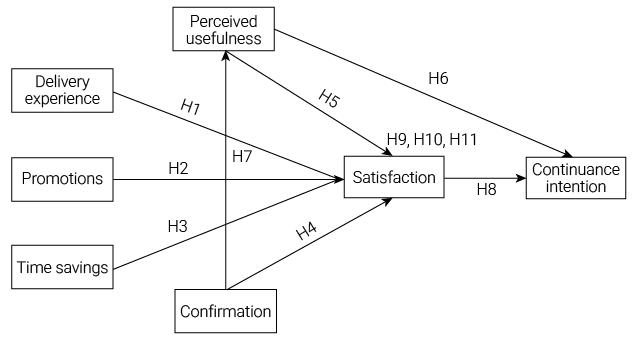
The 11 hypotheses regarding the relationships among the proposed variables are graphically presented in the study’s conceptual framework (see Figure 1).
Figure 1
Research Model
3. METHODOLOGY
3.1 Research Paradigm
This study is framed within a post-positivist epistemological stance, which assumes that social phenomena can be examined objectively, although knowledge remains provisional and subject to revision (Phillips & Burbules, 2000; Creswell, 2014). Post-positivism recognizes that reality exists independently of the researcher but can only be approximated through systematic inquiry and empirical validation.
Ontologically, the study adopts a critical realist perspective, which posits that an external reality exists but can be only partially understood through theoretical models and measurement instruments that are continually refined (Bhaskar, 1975; Guba & Lincoln, 1994). This position is appropriate for examining complex behavioral constructs—such as satisfaction and continuance intention—through structured quantitative models.
Epistemologically, the research relies on objectivity through methodological rigor by using standardized measurement instruments, minimizing researcher influence, and employing statistical procedures to enhance reliability and validity (Trochim, n.d.).
From an axiological standpoint, the study emphasizes neutrality, ethical responsibility, and transparency. Ethical considerations included informed consent, confidentiality, voluntary participation, and the use of the data exclusively for academic purposes (Resnik, 2018).
Finally, the praxeological orientation of this research reflects the intention to generate knowledge with practical relevance for the management of digital services. The findings aim to support decision-making in food delivery platforms by integrating theoretical insights with actionable recommendations (Hair et al., 2019; Sandberg & Alvesson, 2011).
3.2 Research Design
A quantitative, non-experimental, and cross-sectional design was employed to examine the causal relationships among the constructs explaining continuance intention in FDAs (Creswell, 2014; Kerlinger & Lee, 2002). All constructs were measured using Likert-scale items adapted from validated instruments, ensuring strict adherence to quantitative procedures without any qualitative categorization or coding.
Given the predictive purpose of the model and the simultaneous estimation of multiple relationships among latent variables, the data were analyzed using partial least squares structural equation modeling (PLS-SEM) with SmartPLS 4. PLS-SEM is recommended for models with reflective constructs, moderate sample sizes, and data that may not meet multivariate normality assumptions (Hair et al., 2019).
3.3 Population, Sample, and Sampling Technique
The target population consisted of adults residing in Metropolitan Lima who had used FDAs in the previous three months. A non-probability convenience sampling method was used due to accessibility constraints and the exploratory nature of the study, which aligns with common practices in digital consumer research (Etikan et al., 2016).
Following the “10-times rule” and statistical power recommendations for PLS-SEM, a minimum sample of 150 participants was required (Hair et al., 2019). A total of 174 valid responses were collected between April and May 2025, exceeding the recommended threshold and ensuring stable parameter estimation.
3.4 Instrument and Data Collection
The data collection instrument consisted of previously validated scales adapted to the context of FDAs (Fakfare, 2021; Oliver, 1999; Foroughi et al., 2024; Ng et al., 2023; Hoang & Tan, 2023). All items were measured using a five-point Likert scale (1 = strongly disagree; 5 = strongly agree), consistent with established best practices in behavioral and management research (Joshi et al., 2015).
A back-translation procedure (Beaton et al., 2000) was conducted to ensure linguistic equivalence. Three domain experts reviewed the instrument to validate clarity and conceptual consistency. A pilot test with 30 participants confirmed reliability prior to full deployment.
The survey was administered online via Google Forms and distributed through social networks and digital consumer groups. After screening for eligibility (recent FDA use), 178 responses were obtained, resulting in a 97,7 % acceptance rate. After removing incomplete or inconsistent cases, 174 responses were retained for analysis.
3.5 Data Analysis
Data were analyzed using PLS-SEM in SmartPLS 4 for the following reasons: (1) the study assessed predictive relationships between latent variables; (2) the model included multiple simultaneous structural paths; (3) the sample size was moderate (n = 174); (4) the constructs were reflective; and (5) PLS-SEM accommodated non-normal data distributions.
Both the measurement model (reliability and validity assessment) and the structural model (hypotheses testing) were evaluated following the guidelines proposed by Sarstedt et al. (2014). To assess common method bias, Harman’s single-factor test was performed, confirming that no factor accounted for more than 50 % of the total variance. Additionally, common method bias variance inflation factor (CMB-VIF) values were below 3,3 (Kock, 2015), indicating no significant bias.
3.6 Ethical Considerations
The study complied with standard ethical procedures. Participants were informed about the study’s purpose, the voluntary nature of their participation, and the confidentiality of their responses. Only individuals who provided informed consent were included. No personal identifiers were collected. Data were stored on a password-protected institutional drive accessible only to the research team. The study adhered to the ethical standards and guidelines of the University of Lima Graduate School.
4. RESULTS
The study is based on the ECM, which incorporates variables such as delivery experience, promotions, perceived usefulness, and expectation confirmation. Accordingly, PLS-SEM was used, as it is well suited to moderate sample sizes and, unlike other SEM techniques, does not require a normal distribution of the data.
Measurement Model
To assess the individual reliability of each item, factor loadings above 0,70 are commonly considered indicative of good reliability (Hair et al., 2019). As shown in Table 1, in this study all outer loadings of the latent variables exceeded the recommended threshold (ranging from 0,735 to 0,929), demonstrating satisfactory item reliability. In addition, as reported in Table 1, Cronbach’s alpha coefficients of all constructs were above the recommended value of 0,70, suggesting strong internal consistency of the employed scales (Hair et al., 2019). Likewise, the composite reliability indices, represented by rho_a and rho_c, also displayed values greater than 0,70, further supporting the consistency and reliability of the latent constructs (Hair et al., 2019). Finally, convergent validity was assessed through the average variance extracted (AVE), for which values above 0,50 are recommended (Hair et al., 2019). The results presented in Table 1 confirm that this criterion was fully satisfied, thus evidencing adequate convergent validity.
Overall, the results reported in Table 1 reveal the robustness of the measurement instrument, which is essential before evaluating the hypotheses proposed in the structural model.
In summary, the scales used in this study are reliable and valid for measuring the underlying theoretical constructs (delivery experience, promotions, time savings, perceived usefulness, expectation confirmation, satisfaction, and continuance intention), thereby allowing us to proceed with the evaluation of the structural model with confidence. Success at this stage is vital, since poor measurement would lead to biased or invalid results in the analysis of causal relationships (hypotheses).
Table 1
Results of the Reflective Measurement Model Assessment
|
Indicators |
Factor Loadings |
Cronbach’s Alpha |
Composite Reliability (rho_a) |
Composite Reliability (rho_c) |
AVE |
|
DE1: I like that the FDA allows me to order food whenever I need it. DE2: I like that the FDA makes it easy to find the delivery address on the map. DE3: I like that the FDA offers free delivery on selected orders. DE4: I like that the FDA provides information on the estimated delivery time. DE5: I like that the FDA allows real-time tracking of the delivery rider. |
0,877 0,864 0,764 0,742 0,764 |
0,872 |
0,974 |
0,901 |
0,647 |
|
PRO1: There are many promotional programs available when using the FDA. PRO2: I am very interested in promotions and offers when using the FDA. PRO3: The FDA offers me many benefits thanks to its promotions. PRO4: I like to search for promotions in different online stores when purchasing food through the FDA. |
0,762 0,735 0,884 0,748 |
0,793 |
0,824 |
0,864 |
0,616 |
|
TS1: The FDA makes it easy to compare prices across different restaurants. TS2: The FDA makes it easy to avoid traffic. TS3: The FDA makes it easy to avoid waiting times at restaurants. |
0,816 0,758 0,838 |
0,734 |
0,754 |
0,846 |
0,648 |
|
PU1: I feel that the FDA is useful for ordering and receiving food. PU2: I feel that the FDA facilitates the process of ordering and receiving food. PU3: Using the FDA enhances the experience of ordering and receiving food. PU4: Using the FDA makes the process of ordering and receiving food more efficient. |
0,818 0,850 0,879 0,865 |
0,876 |
0,883 |
0,915 |
0,728 |
|
EC1: My experience using the FDA was better than I expected. EC2: The level of service provided by the FDA exceeded my expectations. EC3: Overall, most of my expectations regarding the use of the FDA were met. |
0,923 0,905 0,866 |
0,880 |
0,881 |
0,926 |
0,807 |
|
SAT1: I am very satisfied with my overall experience using this FDA. SAT2: I believe that choosing this FDA was the right decision. SAT3: I am satisfied with the convenience provided by the FDA. SAT4: Overall, I am pleased with this FDA. |
0,920 0,882 0,901 0,884 |
0,919 |
0,920 |
0,943 |
0,805 |
|
CI1: I am likely to continue using this FDA more frequently in the future. CI2: If I have the opportunity, I will continue ordering food through this FDA. CI3: I intend to continue using this FDA to place orders. |
0,875 0,919 0,929 |
0,880 |
0,881 |
0,926 |
0,807 |
Note. DE = delivery experience, PRO = promotions; TS = time savings, PU = perceived usefulness; EC = expectation confirmation; SAT = satisfaction; CI = continuance intention; AVE = average variance extracted.
Discriminant validity was subsequently assessed using the heterotrait–monotrait (HTMT) ratio. According to Hair et al. (2019), HTMT values should be equal to or less than 0,90. As shown in Table 2, all estimated coefficients fall below this threshold, indicating that the model exhibits adequate discriminant validity. These values are essential for evaluating the quality of the measurement model, as they confirm that the latent variables used in the study are empirically distinct from one another.
The HTMT ratio aims to verify that each construct measures a truly unique concept and not simply a repetition of another construct in the proposed model (i.e., it assesses the degree of correlation between the latent variables). In this regard, the empirical results of the study indicate that the measurement model demonstrates adequate discriminant validity. For example, the HTMT value between time savings and expectation confirmation is 0,611, suggesting a clear distinction between these constructs. A key correlation is that between satisfaction and expectation confirmation, which yields an HTMT value of 0,903. Although this value is very close to the recommended threshold of 0,90, the criterion was considered met, thus confirming the distinction between these two constructs within the ECM. Similarly, perceived usefulness and continuance intention (HTMT = 0,709), as well as expectation confirmation and perceived usefulness (HTMT = 0,745), are statistically distinct. This distinction allows for the evaluation of their respective causal effects on satisfaction and continuance intention. For complete validation, discriminant validity was also assessed using the Fornell-Larcker Criterion (Fornell & Larcker, 1981) (see Table 3). The results show that the square roots of the AVE values exceed the correlations between constructs, thus fulfilling another key requirement for discriminant validity. In sum, the results presented in Table 2 confirm that the constructs driving the model (e.g., expectation confirmation and satisfaction), while related within the ECM theoretical framework, are empirically distinct. This distinction justifies their inclusion as independent variables and allow for an analysis of the complex explanatory relationships between them.
Table 2
Discriminant Validity: HTMT Values
|
TS |
EC |
CI |
DE |
PRO |
SAT |
PU |
|
|---|---|---|---|---|---|---|---|
|
TS |
|||||||
|
EC |
0,611 |
||||||
|
CI |
0,617 |
0,833 |
|||||
|
DE |
0,198 |
0,146 |
0,194 |
||||
|
PRO |
0,593 |
0,513 |
0,460 |
0,320 |
|||
|
SAT |
0,540 |
0,903 |
0,837 |
0,138 |
0,454 |
||
|
PU |
0,615 |
0,745 |
0,709 |
0,336 |
0,581 |
0,719 |
Note. DE = delivery experience, PRO = promotions; TS = time savings, PU = perceived usefulness; EC = expectation confirmation; SAT = satisfaction; CI = continuance intention.
Lastly, the Fornell–Larcker criterion was applied. In this regard, the square roots of the AVE values for each construct were calculated and compared with the correlations among the constructs. The results show that all square roots of the AVE exceed the inter-construct correlations, thus meeting the requirement for discriminant validity (Fornell & Larcker, 1981).
Table 3 provides further rigorous confirmation that the constructs (latent variables) used in the SEM analysis measure truly distinct concepts, which is a fundamental requirement for the validity of the measurement model. According to Fornell and Larcker (1981), discriminant validity is established when the square root of the AVE for each construct (displayed on the diagonal of the table) is greater than its correlations with any other construct in the model (off-diagonal values). This means that if the shared variance within a construct (i.e., the square root of its AVE) exceeds the variance it shares with other constructs (i.e., the correlations), then the construct is more similar to itself than to any other variable in the model, demonstrating its empirical uniqueness.
As shown in Table 3, expectation confirmation and satisfaction are central constructs within the ECM and, theoretically, are closely related. Their correlation is very high (0,814). However, the square root of the AVE for expectation confirmation (0,898) and satisfaction (0,897) exceeds this correlation. This finding is particularly important, as it confirms that, although cognitive judgment (expectation confirmation) and affective response (satisfaction) are strongly linked, the measurement instrument is capable to empirically distinguish between them. Similarly, continuance intention, the main dependent construct, has its strongest correlation with satisfaction (0,760). Nevertheless, the square root of the AVE for continuance intention (0,908) exceeds this value, confirming that the continuance intention is a distinct concept and not just a repetition of satisfaction.
In conclusion, Table 3 confirms that the model demonstrates strong discriminant validity. This means that both the functional factors incorporated into the model (e.g., delivery experience and promotions) and the cognitive and affective constructs derived from the ECM (expectation confirmation, perceived usefulness, satisfaction, and continuance intention) are statistically independent variables. Consequently, these constructs can be confidently included in the structural model to test the hypotheses of causal relationships. The high quality of the measurements—reflected in the high AVE values and their large square roots on the diagonal—allowed the model to satisfy this rigorous validation criterion.
Table 3
Discriminant Validity: Fornell–Larcker Criterion
|
TS |
EC |
CI |
DE |
PRO |
SAT |
PU |
|
|---|---|---|---|---|---|---|---|
|
TS |
0,805 |
||||||
|
EC |
0,507 |
0,898 |
|||||
|
CI |
0,511 |
0,739 |
0,908 |
||||
|
DE |
0,167 |
0,146 |
0,187 |
0,804 |
|||
|
PRO |
0,472 |
0,442 |
0,392 |
0,238 |
0,785 |
||
|
SAT |
0,460 |
0,814 |
0,760 |
0,138 |
0,396 |
0,897 |
|
|
PU |
0,514 |
0,661 |
0,633 |
0,297 |
0,492 |
0,647 |
0,853 |
Note. DE = delivery experience, PRO = promotions; TS = time savings, PU = perceived usefulness; EC = expectation confirmation; SAT = satisfaction; CI = continuance intention.
Structural Model
To test the proposed hypotheses, the structural model was assessed using PLS-SEM. First, collinearity among the constructs was examined using the variance inflation factor (VIF). The VIF values ranged from 1,000 to 2,132, all below the threshold of 3 suggested by Hair et al. (2019), indicating that collinearity is not a concern in this model.
Subsequently, a bootstrapping procedure with 10 000 subsamples and a 95 % confidence level was performed to estimate the standard errors and p values of the path coefficients. The results, shown in Table 4, reveal that delivery experience does not have a significant effect on satisfaction (β = –0,021, p = 0,308); therefore, H1 is not supported. Similarly, H2 and H3 are rejected, as promotions (β = –0,006, p = 0,466) and time savings (β = –0,021, p = 0,397) do not significantly influence satisfaction. Conversely, expectation confirmation exerts a strong positive effect on satisfaction (β = 0,679, p = 0,000), supporting H4.
Perceived usefulness significantly affects both satisfaction (β = 0,197, p = 0,006) and continuance intention (β = 0,243, p = 0,000), thereby supporting H5 and H6. In addition, expectation confirmation positively influences perceived usefulness (β = 0,661, p = 0,000), supporting H7. Finally, satisfaction has a strong effect on continuance intention (β = 0,602, p = 0,000), confirming H8.
Regarding the explanatory power of the model, the coefficient of determination (R²) was analyzed, considering values above 0,10 as acceptable (Hair et al., 2019). The results indicate R² values of 0,648 for satisfaction, 0,436 for perceived usefulness, and 0,612 for continuance intention, suggesting that the exogenous variables explain a substantial proportion of the variance in the endogenous constructs. Predictive relevance (Q²) was also examined. The obtained values (0,637 for satisfaction, 0,430 for perceived usefulness, and 0,529 for continuance intention) are all above the minimum threshold of 0, thereby confirming the predictive capability of the model (Hair et al., 2019).
Table 4
Path Coefficients of the Structural Model and Hypothesis Testing
|
Hypothesis |
Path |
β |
VIF |
f2 |
T-Statistic |
P-Value |
Decision |
|---|---|---|---|---|---|---|---|
|
H1 |
DE → SAT |
-0,021 |
1,120 |
0,001 |
0,501 |
0,308 |
Rejected |
|
H2 |
PRO → SAT |
-0,006 |
1,483 |
0,000 |
0,087 |
0,466 |
Rejected |
|
H3 |
TS → SAT |
-0,021 |
1,563 |
0,001 |
0,261 |
0,397 |
Rejected |
|
H4 |
EC → SAT |
0,679 |
1,944 |
0,750 |
12,043 |
0,000 |
Accepted |
|
H5 |
PU → SAT |
0,197 |
2,132 |
0,058 |
2,533 |
0,006 |
Accepted |
|
H6 |
PU → CI |
0,243 |
1,720 |
0,088 |
4,496 |
0,000 |
Accepted |
|
H7 |
EC → PU |
0,661 |
1,000 |
0,775 |
13,681 |
0,000 |
Accepted |
|
H8 |
SAT → CI |
0,602 |
1,720 |
0,543 |
10,328 |
0,000 |
Accepted |
|
Construct |
R2 |
Q2 |
|||||
|
SAT |
0,648 |
0,637 |
|||||
|
PU |
0,436 |
0,430 |
|||||
|
CI |
0,612 |
0,529 |
Note. DE = delivery experience, PRO = promotions; TS = time savings, PU = perceived usefulness; EC = expectation confirmation; SAT = satisfaction; CI = continuance intention; R² = coefficient of determination; Q² = predictive relevance.
Mediation Analysis
The mediation analysis was conducted to evaluate the indirect effects of the operational factors (i.e., promotions, time savings, and delivery experience) on continuance intention through user satisfaction. The results revealed that promotions do not exert a significant indirect effect on continuance intention through satisfaction (β = -0,003, p = 0,466). Therefore, H9 was not supported.
Similarly, the findings indicated that satisfaction does not play a significant mediating role in the relationship between time savings and continuance intention (β = -0,013, p = 0,397). Consequently, H10 was not supported.
Finally, satisfaction was not found to mediate the relationship between delivery experience and continuance intention (β = -0,013, p = 0,308). Thus, H11 was not supported.
Table 5
Mediation Analysis Results
|
Hypothesis |
Path |
β |
T-Statistic |
P-Value |
Decision |
|
H9 |
PRO → SAT → CI |
-0,003 |
0,086 |
0,466 |
Rejected |
|
H10 |
TS → SAT → CI |
-0,013 |
0,261 |
0,397 |
Rejected |
|
H11 |
DE → SAT → CI |
-0,013 |
0,502 |
0,308 |
Rejected |
Note. DE = delivery experience, PRO = promotions; TS = time savings, SAT = satisfaction; CI = continuance intention.
5. DISCUSSION
The results of this study provide relevant insights into the determinants of satisfaction and continuance intention in the use of FDAs. Contrary to the assumptions underlying H1, H2, and H3, variables such as delivery experience, promotions, and time savings did not exert a statistically significant impact on user satisfaction. Although prior research has underscored the relevance of these operational attributes, the findings reveal that their influence may be attenuated in contexts where users already possess well-formed expectations and have normalized the use of delivery apps as part of their routine consumption patterns. This suggests that, as markets evolve, operational elements increasingly function as expected standards rather than differentiating factors capable of shaping satisfaction.
Regarding hypothesis H1, while studies by Fakfare (2021) and Esper et al. (2010) highlight delivery experience as a core component of service perception, participants in this study did not assign significant weight to this factor. One possible explanation is the homogenization of operational performance across platforms, which reduces perceptual variability and limits its potential impact on satisfaction. In a similar vein, the non-significant result for H2 aligns with findings by Shefira & Mangifera (2023), who argue that promotions tend to generate short-term engagement but do not translate into enduring satisfaction due to their transactional nature. Their affective impact may diminish quickly, preventing the consolidation of long-term user–platform relationships. With respect to H3, time savings, despite being identified as a valued attribute among digital consumers (Yoon & Kim, 2007; Chiou et al., 2010), it may no longer differentiate user experiences in highly routinized environments. Efficiency, although necessary, appears insufficient to drive satisfaction unless accompanied by cognitive assessments such as perceived usefulness and expectation confirmation.
These discrepancies from traditional assumptions can be better understood by considering contextual conditions. Users in Metropolitan Lima are typically digitally fluent, frequent users of FDAs, and accustomed to relatively standardized service levels, especially after the pandemic. Such conditions may intensify reliance on cognitive pathways over affective responses, elevating the importance of perceived usefulness and expectation alignment while diminishing the influence of operational cues. Accordingly, expectation confirmation exerted a significant positive effect on satisfaction, validating H4 (Bhattacherjee, 2001; Foroughi et al., 2024). When performance aligns with expectations, users feel reassured about the platform’s reliability, reinforcing their perceived value of the service (Ng et al., 2023).
Perceived usefulness also showed a positive effect on satisfaction, confirming H5 and supporting the premise that users favor platforms that enhance efficiency and convenience (Bhattacherjee, 2001; Foroughi et al., 2024). Its significant impact on continuance intention (H6), as also noted by Ng et al. (2023), indicates that functional benefits play a decisive role in fostering sustained use, consistent with the findings of Yan et al. (2022). Additionally, the positive effect of expectation confirmation on perceived usefulness (H7) highlights how meeting initial expectations strengthens perceived value (Kurniawan et al., 2024). Satisfaction exhibited a strong positive effect on continuance intention, supporting H8 and underscoring its central role in post-adoption behavior (Bhattacherjee, 2001; Foroughi et al., 2024).
Contrary to established frameworks where satisfaction acts as an affective bridge between operational perceptions and continuance intention (Bhattacherjee, 2001; Foroughi et al., 2024), H9, H10, and H11 were not supported. The lack of mediation indicates that attributes such as promotions and time savings are processed as routine functional standards rather than emotional drivers (Parasuraman et al., 2005; Pasaribu & Aruan, 2024). Consequently, in this context, operational factors lack sufficient weight to activate satisfaction as an intermediary mechanism for user retention.
Collectively, these findings refine the ECM within emerging markets by showing that cognitive judgments (expectation confirmation, perceived usefulness) are consistently strong determinants of satisfaction and continuance intention than operational attributes. The results highlight the central role of expectation management and functional usefulness in shaping user retention within the competitive Latin American FDA landscape.
6. CONCLUSION
This study provides a comprehensive view of the factors that determine user satisfaction and continuance intention in FDAs by integrating the ECM with service-specific functional variables. The findings reveal that, contrary to expectations, traditionally relevant variables—such as delivery experience, promotions, and time savings—do not exert a statistically significant impact on user satisfaction. This suggests that while these factors may play a meaningful role during the early stages of adoption, they lose prominence once service standards become stabilized and users develop more consolidated expectations.
In contrast, expectation confirmation and perceived usefulness emerge as the key predictors of both user satisfaction and continuance intention. These results support and extend the ECM by demonstrating its applicability in digital mass-consumption environments, where cognitive assessments tend to outweigh affective reactions in shaping post-adoption behavior. The evidence also confirms that satisfaction exerts a positive and significant effect on continuance intention, highlighting the importance of delivering consistent, reliable, and value-enhancing experiences to foster consumer loyalty.
Overall, the study highlights the central role of cognitive mechanisms in the retention dynamics of food delivery platforms and underscores the need for future research to further explore contextual and moderating factors that may influence post-adoption evaluations in emerging digital ecosystems.
7. THEORETICAL IMPLICATIONS
This research offers several important theoretical contributions. Within the framework of the ECM, the findings confirm that expectation confirmation and perceived usefulness are key predictors of both user satisfaction and continuance intention in food delivery platforms. By reinforcing the centrality of these cognitive mechanisms, the study provides empirical clarity regarding how post-adoption evaluations are formed in utilitarian service contexts, showing that users tend to rely more on cognitive assessments than on affective responses when interacting with high-frequency digital platforms. In doing so, this study helps refine existing continuance models by highlighting conditions under which cognitive pathways become dominant.
The study enriches the existing literature on post-adoption behavior by incorporating service-specific functional variables into the ECM. Although these variables did not demonstrate significant effects on satisfaction, their inclusion broadens the theoretical understanding of how operational attributes behave within mature or highly competitive digital ecosystems. The results suggest that, as service standards converge across providers, traditional operational drivers may lose explanatory power, prompting the need to re-examine their role in continuance models and to explore potential moderating mechanisms.
Furthermore, this study contributes to the literature by examining FDAs within an emerging Latin American digital ecosystem, where technological adoption evolves under sociotechnical constraints that differ markedly from those in mature markets.
By demonstrating that functional attributes exert comparatively less influence than expectation confirmation and perceived usefulness, the study shows how post-adoption mechanisms in emerging economies may follow distinct behavioral patterns. This contextual perspective strengthens the theoretical rationale for extending the ECM to environments characterized by accelerated but uneven digitalization.
8. PRACTICAL IMPLICATIONS
From a practical perspective, this study provides valuable insights for delivery companies and other digital platform providers. The findings suggest that firms should prioritize strengthening user expectation confirmation by ensuring that core service elements consistently meet what is promised to users.
Additionally, perceived usefulness was shown to exert a direct impact on user loyalty, underscoring the importance of designing experiences that emphasize efficiency, convenience, and functional value. This objective can be achieved through the integration of predictive technologies, such as personalized recommendations and real-time order tracking systems.
For governments and stakeholders within the digital ecosystem, these results highlight the need to promote digital literacy and reduce the technological gap, particularly in lower-income sectors where delivery services have become essential. It is recommended that digital literacy programs incorporate modules focused on basic digital skills and user experience, thereby fostering greater inclusion and sustained use of these platforms.
9. LIMITATIONS AND FUTURE DIRECTIONS
This study provides meaningful contributions to the analysis of continuance intention in FDAs; however, several limitations should be acknowledged. First, since the research was conducted exclusively in Lima, the findings cannot be generalized to contexts with different sociocultural characteristics. Future studies could replicate this research in other regions of the country or across different Latin American markets, where variations in technological adoption, consumer expectations, and platform maturity may yield different behavioral patterns.
Second, the use of non-probabilistic sampling limits the representativeness of the results. Future research should consider employing probabilistic sampling methods to obtain more heterogeneous and generalizable samples. Moreover, given the methodological advantages of longitudinal designs, extending the temporal scope and incorporating external variables—such as economic fluctuations or technological advancements—would enrich future analyses and enable researchers to examine how continuance intention evolves over time.
From a theoretical perspective, this study focused primarily on functional variables such as time savings and delivery efficiency. Future research could explore psychological and emotional variables, including hedonic motivations, user experience, or perceived well-being, to understand whether affective processes may regain relevance in less routinized digital environments. Additionally, while satisfaction was considered as a key mediating variable between functional service perceptions and continuance intention, other potential mediators— such as user trust in the platform, perceived fairness, or customer engagement—should be examined to capture more complex dimensions of digital consumer behavior.
Finally, the study did not address potential moderating variables that may influence the strength or direction of the relationships analyzed. Future models could incorporate moderators such as prior experience with the app, frequency of use, or digital literacy, as these factors may shape how users evaluate platform performance and process expectation confirmation. Including such moderators would provide a more comprehensive understanding of the continued use of digital services and refine the predictive capacity of ECM-based models across diverse user groups.
STATEMENTS
Acknowledgments
The authors wish to express their gratitude to the academic institutions and family members who provided support and feedback during the development of this research.
Data Availability
The data supporting the findings of this study are available from the corresponding author upon reasonable request.
Use of Artificial Intelligence
For the preparation of this article, ChatGPT was used to translate certain sections of the manuscript from Spanish into English. The authors assume full responsibility for the content of the published manuscript.
Conflict of Interest
The authors declare that they have no known competing financial interest or personal relationship that could have appeared to influence the work reported in this paper.
Funding
This research received no external funding.
Author Contributions
WM: methodology, formal analysis, investigation, project administration, supervision, writing – original draft, writing – review & editing
MM: conceptualization, formal analysis, investigation, software, supervision, validation, writing – original draft, writing – review & editing
EH: data curation, formal analysis, investigation, software, writing – original draft, writing – review & editing
JN: conceptualization, formal analysis, investigation, resources, visualization, writing – original draft, writing – review & editing.
All authors have read and approved the final version of the manuscript.
Ethical Approval
Ethical approval was not required.
Originality Statement
The author confirms that this manuscript is original, has not been previously published, and is not under consideration for publication elsewhere.
REFERENCES
Al-Gahtani, S. S., & King, M. (1999). Attitudes, satisfaction, and usage: Factors contributing to each in the acceptance of information technology. Behaviour & Information Technology, 18(4), 277–297. https://doi.org/10.1080/014492999119020
Bao, Z., & Zhu, Y. (2022). Why customers have the intention to reuse food delivery apps: Evidence from China. British Food Journal, 124(1), 179–196. https://doi.org/10.1108/BFJ-03-2021-0205
Beaton, D. E., Bombardier, C., Guillemin, F., & Ferraz, M. B. (2000). Guidelines for the process of cross-cultural adaptation of self-report measures. Spine, 25(24), 3186–3191. https://doi.org/10.1097/00007632-200012150-00014
Bhaskar, R. (1975). A realist theory of science. Leeds Books.
Bhattacherjee, A. (2001). Understanding information systems continuance: An expectation-confirmation model. MIS Quarterly: Management Information Systems, 25(3), 351–370. https://doi.org/10.2307/3250921
Blattberg, R. C., & Neslin, S. A. (1990). Sales promotion: Concepts, methods, and strategies. Prentice Hall.
Chiou, W.-C., Lin, C.-C., & Perng, C. (2010). A strategic framework for website evaluation based on a review of the literature from 1995–2006. Information & Management, 47(5-6), 282-290. https://doi.org/10.1016/j.im.2010.06.002
Choi, K., Wang, Y., Sparks, B. A., & Choi, S. M. (2023). Privacy or security: Does it matter for continued use intention of travel applications? Cornell Hospitality Quarterly, 64(2), 267-282. https://doi.org/10.1177/19389655211066834
Creswell, J. W. (2014). Research design: Qualitative, quantitative, and mixed methods approaches (4th ed.). SAGE.
Davis, F. D. (1989). Perceived usefulness, perceived ease of use, and user acceptance of information technology. MIS Quarterly: Management Information Systems, 13(3), 319-340. https://doi.org/10.2307/249008
Esper, T. L., Defee, C. C., & Mentzer, J. T. (2010). A framework of supply chain orientation. The International Journal of Logistics Management, 21(2), 161-179. https://doi.org/10.1108/09574091011071906
Etikan, I., Musa, S. A., & Alkassim, R. S. (2016). Comparison of convenience sampling and purposive sampling. American Journal of Theoretical and Applied Statistics, 5(1-4). https://doi.org/10.11648/j.ajtas.20160501.11
Fakfare, P. (2021). Influence of service attributes of food delivery application on customers’ satisfaction and their behavioural responses: The IPMA approach. International Journal of Gastronomy and Food Science, 25, Article 100392. https://doi.org/10.1016/j.ijgfs.2021.100392
Fornell, C., & Larcker, D. F. (1981). Structural equation models with unobservable variables and measurement error: Algebra and statistics. JMR. Journal of Marketing Research, 18(3), 382. https://doi.org/10.2307/3150980
Foroughi, B., Yadegaridehkordi, E., Iranmanesh, M., Sukcharoen, T., Ghobakhlo, M., & Nilashi, M. (2024). Determinants of continuance intention to use food delivery apps: Findings from PLS and fsQCA. International Journal of Contemporary Hospitality Management, 36(4), 1235-1261. https://doi.org/10.1108/IJCHM-10-2022-1209
Goyal, S., Chauhan, S., Gajpal, Y., & Bhardwaj, A. K. (2023). Examining consumers’ continuance and sharing intention toward food delivery apps. Journal of Enterprise Information Management, 36(6), 1677-1707. https://doi.org/10.1108/JEIM-01-2023-0006
Grand View Research. (2025). Online food delivery market 2025-2030 [Market research report]. Grand View Research. https://www.grandviewresearch.com/industry-analysis/online-food-delivery-market-report
Guba, E. G., & Lincoln, Y. S. (1994). Competing paradigms in qualitative research. In N. K. Denzin & Y. S. Lincoln (Eds.), Handbook of qualitative research (pp. 105–117). SAGE.
Hair, J. F., Risher, J. J., Sarstedt, M., & Ringle, C. M. (2019). When to use and how to report the results of PLS-SEM. European Business Review, 31(1), 2-24. https://doi.org/10.1108/EBR-11-2018-0203
Hoang, H., & Tan, T. L. (2023). Unveiling digital transformation: Investigating technology adoption in Vietnam’s food delivery industry for enhanced customer experience. Heliyon, 9(9), Article e19719. https://doi.org/10.1016/j.heliyon.2023.e19719
Joshi, A., Kale, S., Chandel, S., & Pal, D. K. (2015). Likert scale: Explored and explained. British Journal of Applied Science & Technology, 7(4), 396–403. https://doi.org/10.9734/BJAST/2015/14975
Kerlinger, F. N., & Lee, H. B. (2002). Investigación del comportamiento: Métodos de investigación en ciencias sociales (4th ed.). McGraw-Hill.
Kock, N. (2015). Common method bias in PLS-SEM: A full collinearity assessment approach. International Journal of E-Collaboration, 11(4), 1-10. https://doi.org/10.4018/ijec.2015100101
Kurniawan, A. C., Rachmawati, N. L., Ayu, M. M., Ong, A. K. S., & Redi, A. A. N. P. (2024). Determinants of satisfaction and continuance intention towards online food delivery service users in Indonesia post the COVID-19 pandemic. Heliyon, 10(1), Article e23298. https://doi.org/10.1016/j.heliyon.2023.e23298
Lestari, E., & Riatun, R. (2024). Unveiling key factors for the continuation of E-learning adoption in blended learning environments within Indonesian higher education during the era of the ‘new normal.’ Cogent Education, 11(1), Article 2428871. https://doi.org/10.1080/2331186x.2024.2428871
Mai, X. T., Trinh, T. T., & Ryan, C. (2024). Are you hungry for play? Investigating the role of emotional attachment on continuance intention to use food delivery apps. Journal of Hospitality and Tourism Insights, 7(4), 2968–2991. https://doi.org/10.1108/JHTI-09-2023-0614
Ng, K. S. P., Zhang, J., Wong, J. W. C., & Luo, K. K. (2023). Internal factors, external factors and behavioral intention toward food delivery apps (FDAs). British Food Journal, 125(8), 2970–2987. https://doi.org/10.1108/BFJ-07-2022-0586
Nguyen, G.-D., & Dao, T.-H. T. (2024). Factors influencing continuance intention to use mobile banking: An extended expectation-confirmation model with moderating role of trust. Humanities & Social Sciences Communications, 11, Article 276. https://doi.org/10.1057/s41599-024-02778-z
Nguyen, T., Huang, E., & Nguyen, D. M. (2023). Food delivery app continuance: A dual model and segmentation approach. International Journal of Retail & Distribution Management, 51(5), 569–589. https://doi.org/10.1108/IJRDM-06-2022-0217
Nguyen-Phuoc, D. Q., Su, D. N., Tran, P. T. K., Le, D.-T. T., & Johnson, L. W. (2020). Factors influencing customer’s loyalty towards ride-hailing taxi services: A case study of Vietnam. Transportation Research Part A: Policy and Practice, 134, 96–112. https://doi.org/10.1016/j.tra.2020.02.008
Oliver, R. L. (1980). A cognitive model of the antecedents and consequences of satisfaction decisions. Journal of Marketing Research, 17(4), 460–469. https://doi.org/10.1177/002224378001700405
Oliver, R. L. (1999). Whence consumer loyalty? Journal of Marketing, 63, 33–44. https://doi.org/10.2307/1252099
Ou, X. (2025, December 17). Online food delivery in Latin America – Statistics & facts. Statista. https://www.statista.com/topics/6732/online-food-delivery-in-latin-america/
Parasuraman, A., Zeithaml, V. A., & Malhotra, A. (2005). E-S-QUAL: A multiple-item scale for assessing electronic service quality: A multiple-item scale for assessing electronic service quality. Journal of Service Research, 7(3), 213–233. https://doi.org/10.1177/1094670504271156
Pasaribu, E., & Aruan, D. T. H. (2024). Craving continuity: Unveiling the impact of integrating information system success and expectation confirmation models on sustained use of food delivery apps. Asian Journal of Engineering, Social and Health, 3(6), 1359-1376. https://doi.org/10.46799/ajesh.v3i6.342
Phillips, D. C., & Burbules, N. C. (2000). Postpositivism and educational research. Rowman & Littlefield.
Pillai, S. G., Kim, W. G., Haldorai, K., & Kim, H.-S. (2022). Online food delivery services and consumers’ purchase intention: Integration of theory of planned behavior, theory of perceived risk, and the elaboration likelihood model. International Journal of Hospitality Management, 105, Article 103275. https://doi.org/10.1016/j.ijhm.2022.103275
Resnik, D. B. (2018). The ethics of research with human subjects: Protecting people, advancing science, promoting trust. Springer.
Sandberg, J., & Alvesson, M. (2011). Ways of constructing research questions: Gap-spotting or problematization? Organization, 18(1), 23–44. https://doi.org/10.1177/1350508410372151
Sarstedt, M., Ringle, C. M., Smith, D., Reams, R., & Hair, J. F. (2014). Partial least squares structural equation modeling (PLS-SEM): A useful tool for family business researchers. Journal of Family Business Strategy, 5(1), 105–115. https://doi.org/10.1016/j.jfbs.2014.01.002
Shefira, M., & Mangifera, L. (2023). The role of customer trust in mediating service quality and perceived value of customer satisfaction with Shopeefood application users. In International Conference on Economics and Business Studies (ICOEBS-22-2) (pp. 1034-1045). Atlantis Press. https://doi.org/10.2991/978-94-6463-204-0_84
Statista Market Insights. (2025). Online food delivery – Peru. Statista. https://www.statista.com/outlook/emo/online-food-delivery/peru
Su, D. N., Nguyen-Phuoc, D. Q., Duong, T. H., Dinh, M. T. T., Luu, T. T., & Johnson, L. (2022). How does quality of mobile food delivery services influence customer loyalty? Gronroos’s service quality perspective. International Journal of Contemporary Hospitality Management, 34(11), 4178–4205. https://doi.org/10.1108/ijchm-08-2021-1039
Trochim, W. M. K. (n.d.). Research methods knowledge base. Conjointly. https://socialresearchmethods.net/kb/
Yan, Y., Zhong, S., Tian, J., & Li, T. (2022). Continuance intention of autonomous buses: An empirical analysis based on passenger experience. Transport Policy, 126, 85–95. https://doi.org/10.1016/j.tranpol.2022.07.010
Yoon, C., & Kim, S. (2007). Convenience and TAM in a ubiquitous computing environment: The case of wireless LAN. Electronic Commerce Research and Applications, 6(1), 102–112. https://doi.org/10.1016/j.elerap.2006.06.009