INDIVIDUAL AMBIDEXTERITY
AND PERFORMANCE OUTCOMES:
THE MODERATING ROLE
OF SELF-REGULATION
Article type: Original
Corresponding author:
Fernando García
[email protected]

Fernando García1 

1 Dalton State College, United States
Abstract
Objectives: This study examines the relationship between individual ambidexterity—understood as an individual’s ability to balance exploration and exploitation—and three performance outcomes: innovation performance, task performance, and personal initiative. It also explores the cognitive mechanisms of cognitive variety and cognitive interruption, and evaluates the moderating role of self-regulatory orientations. Methodology/Design: Data were collected from 297 employees and their supervisors in a U.S. manufacturing company. A multi-source survey design was used to minimize common method bias, and hypotheses were tested using hierarchical regression analyses. Results: Individual ambidexterity was positively associated with innovation performance, task performance, and personal initiative. Additionally, results show that the interaction between individual ambidexterity and assessment orientation enhances task performance, with stronger gains for employees high in assessment orientation. Originality/Value: This study extends the limited body of research on the ambidexterity–performance link at the individual level by introducing cognitive mechanisms as explanatory pathways and applying regulatory mode theory to examine moderating effects. It enhances theoretical understanding and offers novel insights into how individual differences influence multiple forms of performance. Practical Implications: Managers should promote environments that support both exploration and exploitation, recruit and train employees with ambidextrous capabilities, and align roles with employees’ regulatory orientations to maximize performance benefits. Social Implications: By showing how individuals can simultaneously meet operational demands and drive innovation, this study underscores the social value of cultivating ambidextrous skills. Such capabilities promote workforce adaptability, proactive engagement, and resilience, thereby strengthening organizational competitiveness and contributing to broader economic stability.
Keywords: individual ambidexterity, innovation performance, task performance, personal initiative
JEL Codes: J24, D23, M11, O32.
Cómo citar: García, F. (2026). Individual ambidexterity and performance outcomes: The moderating role of self-regulation.
Peruvian Journal of Management, (3), 85-112. https://doi.org/10.26439/pjm2026.n003.7990.
Historia del artículo: Received: June 11, 2025. Accepted: September 19, 2025.
Published online: April 15, 2026.
AMBIDESTREZA INDIVIDUAL Y RESULTADOS
DE DESEMPEÑO: EL PAPEL MODERADOR
DE LA AUTORREGULACIÓN
Resumen
Objetivos: este estudio examina la relación entre la ambidestreza individual (capacidad de equilibrar exploración y explotación), y tres resultados de desempeño: innovación, desempeño en tareas e iniciativa personal. Asimismo, analiza los mecanismos cognitivos de variedad e interrupción y evalúa el papel moderador de las orientaciones autorregulatorias. Metodología/diseño: se recopilaron datos de 297 empleados y supervisores en una empresa manufacturera estadounidense. Se utilizó un diseño de encuesta con múltiples fuentes para minimizar el sesgo de método común y se empleó análisis de regresión jerárquica. Resultados: la ambidestreza individual se asoció positivamente con innovación, desempeño en tareas e iniciativa personal. Además, la interacción entre la ambidestreza y la orientación de evaluación mejoró el desempeño en tareas, con mayores beneficios para los empleados con alta orientación de evaluación. Originalidad/Valor: este estudio amplía la investigación limitada sobre la relación ambidestreza–desempeño a nivel individual introduciendo mecanismos cognitivos como vías explicativas y aplica la teoría del modo regulatorio para examinar efectos moderadores. Ofrece nuevas perspectivas sobre cómo las diferencias individuales influyen en diversas formas de desempeño. Implicaciones prácticas: los gerentes deben fomentar entornos que apoyen la exploración y la explotación, reclutar y capacitar en capacidades ambidiestras y alinear los roles con las orientaciones autorregulatorias de los empleados para maximizar los beneficios. Implicaciones sociales: este estudio resalta el valor social de las habilidades ambidiestras al mostrar cómo los individuos pueden satisfacer demandas operativas e innovadoras. Estas capacidades fomentan la adaptabilidad, proactividad y la resiliencia, fortaleciendo la competitividad organizacional y contribuyendo a la estabilidad económica.
Palabras clave: ambidestreza individual, desempeño en innovación, desempeño en tareas, iniciativa personal
1. INTRODUCTION
A significant concern for managers and organizations is the continuous challenge of achieving current organizational goals while simultaneously securing the long-term success of the organization. Confronting this dilemma requires a delicate trade-off between the exploitation of current resources to achieve short-term goals and the exploration of new possibilities to maintain future success (Liang et al., 2022; March, 1991). Attaining this balance is at the core of the ambidexterity concept. Organizations engaging in exploitation while devoting enough energy to exploration are thought to be better suited for achieving expected performance and ensuring long-term survival (Levinthal & March, 1993; Peng et al., 2019). Such organizations are considered ambidextrous due to their ability to simultaneously pursue both incremental innovation (exploitation) and discontinuous innovation (exploration) (Tushman & O’Reilly, 1996). After decades of research, empirical work on ambidexterity at the organizational level has established an overall positive relationship between ambidexterity and firm performance (e.g., sales growth, performance rates, innovation, market valuation, firm survival), although some studies have found no effects or only conditional effects (O’Reilly & Tushman, 2013).
Despite this extensive body of research on ambidexterity, empirical studies examining the ambidexterity–performance link at the individual level remain limited. Individuals can and do act ambidextrously by performing both explorative and exploitative tasks, creating challenges that need to be addressed by managers. Moreover, individuals are an important source of ambidexterity, as they cumulatively influence organizational ambidexterity (Raisch et al., 2009). In today’s rapidly changing work environments—characterized by digital transformation, lean staffing, and constant innovation pressures—employees are increasingly expected to balance efficiency with adaptability. Understanding how individual ambidexterity contributes to performance has become especially relevant for organizations striving to enhance both stability and agility.
While foundational literature on ambidexterity continues to inform the field, recent empirical studies reinforce the relevance of examining ambidexterity at the individual level (March, 1991; Tushman & O’Reilly, 1996). Jasmand et al. (2012) conducted the first study analyzing the outcomes of ambidextrous behavior—customer satisfaction, sales performance, and efficiency—based on existing evidence. Zacher and Rosing (2015) found that ambidextrous behavior among employees is positively related to performance outcomes, particularly innovation within team contexts. A systematic review by Pertusa-Ortega et al. (2020) identified multiple studies linking individual ambidexterity to performance outcomes, including innovation, task performance, service, and R&D performance. Mom et al. (2018) further demonstrated that individual ambidexterity mediates the effects of HR practices on organizational outcomes. Despite this growing body of evidence, limited empirical attention has been given to the individual ambidexterity–performance link and to the ways in which self-regulatory orientations (e.g., locomotion, assessment) shape the effects of ambidexterity across multiple forms of performance (Hughes, 2018).
The purpose of this research is to address this gap by analyzing the ambidexterity–performance link at the individual level. In addition, to account for factors that may influence this relationship at both the organizational (O’Reilly & Tushman, 2013) and individual levels (Jasmand et al., 2012), this study examines the moderating effects of self-regulation. This research contributes to prior work in three key ways. First, it introduces cognitive mechanisms—specifically cognitive variety and cognitive interruption—as explanatory pathways linking ambidexterity to performance. Second, it incorporates regulatory mode theory to explain individual variation in these effects, an approach not previously applied in this context. Third, it expands the range of performance outcomes by including innovation performance, task performance, and personal initiative, thereby providing a more comprehensive understanding of the benefits of individual ambidexterity. Regulatory mode theory (Higgins et al., 2003; Kruglanski et al., 2000) is employed to examine how self-regulatory orientations influence the ambidexterity–performance link.
Specifically, this study aims to understand how individual ambidexterity contributes to key performance outcomes and under what conditions these effects are strengthened or weakened by addressing two key questions: (1) How does individual ambidexterity influence innovation performance, task performance, and personal initiative? and (2) How do self-regulatory orientations—locomotion and assessment—moderate these relationships? The next section reviews the relevant literature and presents the hypotheses. The subsequent sections describe the methodology, data analysis and results, discussion, theoretical and practical implications, limitations, directions for future research, and conclusions.
2. LITERATURE REVIEW AND HYPOTHESIS DEVELOPMENT
2.1 Theoretical Framework
This research draws upon two principal theoretical frameworks—ambidexterity theory and regulatory mode theory—to explore how individual ambidexterity influences employee performance. Although ambidexterity theory has predominantly been applied at the organizational level (March, 1991; Tushman & O’Reilly, 1996), this study extends its application to the individual level by examining how employees balance exploration and exploitation in their behavior. These dual-mode actions are anticipated to impact several facets of performance, including innovation performance, task performance, and personal initiative. Prior studies suggest that individual ambidexterity enhances job-related outcomes by encouraging flexible behavior when individuals face competing demands (Good & Michel, 2013; Jasmand et al., 2012). This perspective is particularly suitable for positions requiring high levels of proactivity, creative thinking, and the capacity to perform effectively across diverse tasks. Empirical findings further reinforce the association between ambidextrous behavior and key performance indicators such as innovation (Mom et al., 2009; Pertusa-Ortega et al., 2020; Zacher & Rosing, 2015), efficiency in task completion (Jasmand et al., 2012), and proactive work behavior (Garcia et al., 2022), all of which are central to the dependent variables addressed in this study. To clarify how ambidextrous actions lead to performance improvements, this work introduces two underlying cognitive processes—cognitive variety and cognitive interruption—that help individuals transition between explorative and exploitative tasks depending on contextual needs. These cognitive pathways offer micro-level insight into how ambidexterity is enacted in real-time, shedding light on the way individuals handle competing demands and adjust their approach to transform ambidextrous behavior into tangible performance outcomes (Eisenhardt et al., 2010).
The conceptual framework is further refined through regulatory mode theory (Higgins et al., 2003; Kalafatis et al., 2020; Kruglanski et al., 2000), which distinguishes between two self-regulatory orientations—locomotion and assessment—that influence how individuals approach and pursue their goals. These orientations are posited to moderate the impact of ambidextrous behavior on performance outcomes, depending on whether individuals are predominantly action-driven or inclined toward evaluative thinking. Regulatory mode theory is particularly relevant in this study, as it offers a compelling explanation for individual differences in workplace self-regulation, especially when initiating action (locomotion) or critically analyzing alternatives (assessment) during goal pursuit (Higgins et al., 2003; Kruglanski et al., 2000). These regulatory dispositions are especially pertinent in ambidextrous environments, where employees must consistently alternate between exploiting existing knowledge and exploring new solutions. Previous research has demonstrated that regulatory modes influence key behavioral attributes such as decision-making speed, risk tolerance, and adaptive capacity (Laureiro-Martínez et al., 2015; Pierro et al., 2006), making them highly suitable for explaining individual differences in how ambidextrous behaviors translate into outcomes like innovation performance, task performance, and personal initiative. The next section delves into existing literature and formulates hypotheses rooted in these theoretical perspectives.
2.2 Organizational Ambidexterity
Duncan (1976) was the first to introduce the concept of organizational ambidexterity, describing how firms navigate the inherent trade-offs between the competing demands of innovation and efficiency. Over time, this concept evolved into a strategic framework for ensuring long-term organizational success. In his seminal contribution, March (1991) emphasized that a firm’s ability to survive and thrive depends on effectively balancing two fundamentally different learning activities: exploration—involving search, variation, experimentation, and innovation—and exploitation—focusing on refinement, execution, and efficiency. The core of the ambidexterity paradigm lies in addressing the tension between exploiting existing capabilities that yield immediate results and exploring novel alternatives that offer future advantages. Achieving this balance is essential for sustaining adaptability and competitiveness in dynamic environments (O’Reilly & Tushman, 2013).
Organizations can achieve ambidexterity by using sequential, structural, or contextual approaches. While sequential ambidexterity requires organizations to shift organizational structures over time to accommodate exploration and exploitation demands (Duncan, 1976), structural ambidexterity requires organizations to simultaneously engage in exploration and exploitation through structurally separated units (Tushman & O’Reilly, 1996). In contrast, contextual ambidexterity requires organizations to provide a supportive environment that would allow individuals to resolve the organizational demands for exploration and exploitation (Gibson & Birkinshaw, 2004). In fact, research by Kane and Alavi (2007) and Carmeli and Halevi (2009) illustrate how organizational contexts can promote ambidextrous behavior. This shift from focusing on organizational-level mechanisms to also include individuals in shaping organizational ambidexterity highlights the important role of individual ambidexterity. Recent studies reinforce this perspective, emphasizing that individual ambidexterity significantly contributes to overall organizational performance (De Juan, 2025).
For more than two decades, ambidexterity research has mostly focused on organizational-level phenomena. Since this macro-level perspective does not analyze ambidextrous behavior, our understanding of the contribution of ambidextrous behaviors in shaping organizational ambidexterity remains incomplete. This limitation has prompted scholars to call for further research on individual ambidexterity (Good & Michel, 2013; Gupta et al., 2006; Jasmand et al., 2012; Mom et al., 2009).
2.3 Individual Ambidexterity
Recent studies affirm that ambidexterity can occur at the individual level, not just within organizational structures. One of the most influential contributions in this domain is Gibson and Birkinshaw’s (2004) contextual ambidexterity framework, which underscores how supportive organizational contexts empower individuals to exercise discretion in balancing exploration and exploitation demands. This idea is echoed in O’Reilly and Tushman’s (2004) work on ambidextrous managers, where senior leaders were shown to integrate cost-efficiency (exploitation) with innovative thinking (exploration). Similarly, Tushman et al. (2011) demonstrated that effective CEOs foster ambidextrous behavior by simultaneously enforcing discipline and promoting experimentation.
At the individual contributor level, Miron et al. (2004) found that professionals such as engineers and technicians exhibited both creativity (exploration) and attention to detail (exploitation), suggesting that individual ambidexterity is not limited to upper management. More recently, Garcia et al. (2022) defined individual ambidexterity as “the resulting behavior that combines exploration and exploitation behavior in response to organizational demands for exploration and exploitation” (p. 4), especially in contexts where individuals are afforded autonomy in regulating their behavior. For a detailed review on individual-level explorative and exploitative behavior, see Garcia et al. (2022).
Despite growing interest, this research stream remains relatively underdeveloped, as highlighted by the limited number of empirical studies (Mu et al., 2020). For instance, Mom et al. (2009) examined how contextual factors influence managerial ambidexterity; Jasmand et al. (2012) explored the antecedents and outcomes of ambidextrous behavior; and Good and Michel (2013) analyzed how individual characteristics serve as antecedents to such behavior. This scarcity of empirical evidence continues to constrain our understanding of how individual ambidexterity translates into performance outcomes. To address this gap, the present study aims to examine the performance implications of ambidextrous behavior at the individual level, an area increasingly recognized as critical for organizational adaptability.
2.4 Ambidexterity and Performance
Although studies on the ambidexterity–performance link have shown positive associations with sales growth, subjective performance ratings, and innovation, other studies have found no effects or some effects that emerge only under certain conditions (O’Reilly & Tushman, 2013). To reconcile these mixed results, Junni et al. (2013) conducted a meta-analysis and found that the positive associations were mainly moderated by contextual factors (e.g., industry type and level of analysis) and by the methodology utilized (e.g., cross-sectional vs. multimethod designs). Despite this ample research on the ambidexterity–performance link, most studies have focused on the organizational level.
The work of Jasmand et al. (2012) is, as indicated by the current stage of research, the first study to analyze the ambidexterity–performance link at the individual level. Using a sample of customer service representatives, the authors found a positive influence of ambidextrous behavior on customer satisfaction and sales performance; however, ambidextrous behavior was found to be detrimental to efficiency. Further analysis revealed that the gains in customer satisfaction and sales performance outweighed losses in efficiency, suggesting that the overall effect on performance was still positive. This study is extended in the present research by analyzing the effect of ambidextrous behavior on job performance. In addition, to consider the possibility of mixed results found in previous research, the moderating effects of self-regulation are examined.
Job performance is defined as the “aggregated value to an organization of the set of behaviors that an employee contributes both directly and indirectly to organizational goals” (Rich et al., 2010, p. 619). This behavioral perspective is consistent with the role-based, behavioral approach advanced by Welbourne et al. (1998). In this role-based approach, job performance is determined as a function of the contribution of the individual’s attributes and the influence of organizational contexts. Empirical evidence supports the notion that contextual factors—such as organizational culture, team climate, and management skills—facilitate high employee performance (Rozhkov et al., 2016). Because ambidextrous behavior reflects individual actions that combine explorative and exploitative behaviors in contexts that allow and encourage such behavior, this behavioral perspective to job performance is appropriate for examining performance outcomes resulting from choices between exploration and exploitation.
Welbourne et al.’s (1998) role-based approach suggests that employees play multiple roles beyond performing tasks that are closely related to their positions’ job descriptions. Accordingly, the career, the innovator, the team, and the organization roles were proposed as a means of overcoming the limitations of job performance systems that rely only on task performance. Because ambidextrous behavior combines exploration and exploitation, merely measuring task performance will not capture the contributions of ambidextrous employees towards other organizational goals that benefit from exploitation and exploration. Therefore, in this research, the innovator role (innovation performance) is also included to assess the extent to which ambidextrous employees behave in innovative ways within and outside their specific jobs. In addition, personal initiative is included to measure the extent to which ambidextrous employees take active, self-starting roles beyond the requirements of their job descriptions. Task performance, innovation performance, and personal initiative were chosen because they represent vital and expected outcomes of managerial practices that allow and encourage ambidextrous behavior.
This paper argues that individual ambidexterity is an important and relevant antecedent of employee performance. Although the ambidexterity–performance link has been extensively discussed at the organizational level, there are theoretical reasons to believe that such link also exists at the individual level. While organizational ambidexterity relies on sequential (Duncan, 1976), structural (Tushman & O’Reilly, 1996), or contextual (Gibson & Birkinshaw, 2004) mechanisms to achieve ambidexterity, it is posited that individuals working in contexts that allow and encourage ambidextrous behavior can achieve ambidexterity by using two cognitive mechanisms: cognitive variety and cognitive interruptions. These mechanisms have roots in cognitive psychology and have been found to positively influence job performance (Eisenhardt et al., 2010).
Cognitive variety refers to the variation in beliefs and preferences for addressing firm goals (Miller et al., 1998). This diverse set of mental templates for problem-solving provides a broader range of potential solutions, allows for multiple alternatives and combinations, and fosters greater tolerance for more diverse problem-solving strategies (Eisenhardt et al., 2010). In ambidextrous contexts, existing employees’ mental templates are expected to address common work problems through agreed-upon solutions, thereby effectively using homogeneous preferences (exploitation). Conversely, the heterogeneity of preferences provides flexibility for individually addressing work problems that may require further research and investigation (exploration). Thus, cognitive variety is expected to positively benefit job performance because it enables efficiencies in exploiting employees’ common knowledge while providing flexibility for individual exploration.
Unplanned task interruptions—particularly those that are externally driven, demand immediate attention, and fall outside an individual’s control—can significantly hinder job performance. These disruptions consume time allocated for active tasks, impose increased cognitive load, and often generate a heightened sense of time pressure (Speier et al., 1999). Empirical findings suggest that such interruptions can lead to longer task completion times, a higher incidence of errors, and overall diminished work performance (Zijlstra et al., 1999). In contrast, cognitive interruptions, or self-initiated task suspensions, may yield beneficial outcomes when strategically employed. When individuals intentionally pause their workflow to reassess ongoing efforts, these self-regulated interruptions can foster shifts in strategy or direction that enhance task performance (Eisenhardt et al., 2010). This aligns with Jett and George’s (2003) conceptualization of self-interruption as a response to a perceived gap between expected and actual task progress, triggering a shift from automatic to deliberate, mindful cognition. Such moments of reflective thinking help individuals detect inefficiencies and initiate corrective action. Discrepancies between prescribed performance paths and perceived inefficiencies—or between current approaches and envisioned improvements—often motivate these changes in direction, which in turn promote more efficient use of individual and organizational resources. Okhuysen and Eisenhardt (2002) illustrate this dynamic, showing how workers who paused to reassess time or consult with colleagues accessed better information for problem-solving, thereby avoiding unproductive paths and improving outcomes. More recent research confirms that self-directed interruptions can serve as adaptive mechanisms in complex environments, enabling knowledge workers to manage cognitive load, optimize focus, and improve output quality.
2.5 Individual Ambidexterity and Innovation Performance
Innovation performance refers to the extent to which individuals display creative and innovative behaviors within and outside their specific jobs by coming up with new ideas, working to implement new ideas, finding improved ways to do things, and creating better processes and routines (Welbourne et al., 1998). In ambidextrous contexts, supervisors are expected to support exploration of new ideas, methods, or processes to benefit performance outcomes. Supportive supervisory styles that encourage employees and provide valuable feedback were found to promote employees’ creativity and performance (Oldham & Cummings, 1996). Wang et al. (2024) also found that individual ambidexterity is positively related to employee creativity. Thus, when ambidextrous employees engage in cognitive interruptions to resolve a discrepancy, they will be more likely to engage in innovative behaviors in environments that encourage and support exploration. In addition, research on supervisor–employee relationships suggests that when employees are given greater resources, a wider decision latitude, and more freedom, they are more likely to experiment with new ideas to improve current processes, and thus more likely to display innovative behaviors (Yuan & Woodman, 2010). Moreover, research on psychological climate for innovation suggests that when individuals perceive that the working environment provides adequate support for innovation—in terms of flexibility, encouragement, and tolerance for change—they are more likely to display innovative behaviors (Scott & Bruce, 1994). Ambidextrous individuals are frequently exposed to divergent tasks requiring creativity and adaptability. This behavioral versatility, coupled with supportive contexts, enables the generation and implementation of novel ideas, which are critical for innovation performance. As individuals shift between exploitative efficiency and explorative flexibility, they develop broader problem-solving skills, an attribute of innovative capacity (Scott & Bruce, 1994; Yuan & Woodman, 2010; Zhang et al., 2022). Therefore, it is expected that ambidextrous employees who perceive adequate support and resources for exploring new ideas, improvements, or processes will be more likely to engage in innovative behaviors.
H1: Ambidexterity is positively related to innovation performance.
2.6 Individual Ambidexterity and Task Performance
Task performance refers to the extent to which individuals perform activities that will impact the quantity, quality, and accuracy of work outputs (Welbourne et al., 1998). Ambidextrous individuals are expected to switch between exploitation and exploration when completing tasks. Such transitions are expected to be triggered by a cognitive interruption, which arise due to discrepancies between prescribed outcomes and anticipated or actual inferior task outcomes. This interruption mechanism would allow individuals to explore new approaches by asking supervisors or coworkers for assistance or by providing self-generated ideas to their supervisors, thereby capitalizing on the cognitive interruption and cognitive variety mechanisms. Once a solution to the discrepancy has been found through exploration, individuals can resume working on the exploitative task. This sequencing between exploitation and exploration to improve current task outcomes by minimizing discrepancies is expected to enhance task performance. Jasmand et al. (2012) provide an example on how switching from following standard procedures in customer service (exploitation) to proactively identifying customer needs to increase sales opportunities (exploration) enabled employees to improve sales performance outcomes. Additionally, from a role-based performance perspective (Welbourne et al., 1998), ambidextrous individuals draw on both routinized and adaptive behaviors to meet short-term expectations. The ability to transition effectively between established procedures and novel methods allows for timely corrections and efficiency gains, thereby enhancing task accuracy, quantity, and quality.
H2: Ambidexterity is positively related to task performance.
2.7 Individual Ambidexterity and Personal Initiative
Personal initiative is defined as a “behavior syndrome resulting in an individual’s taking an active and self-starting approach to work and going beyond what is formally required in a given job” (Frese et al., 1996, p. 39). Examples include submitting suggestions to improve work, approaching supervisors with suggestions for improvement, searching for the causes of work problems, and changing something at work to improve it (Bono & Judge, 2003). Research on environment-driven support for initiative suggests that existing organizational conditions (e.g., perceived general climate or organizational culture) make it easier for individuals to show personal initiative (Frese & Fay, 2001). In environments that promote and encourage ambidextrous behavior, ambidextrous employees are expected to focus their efforts on required exploitative tasks while having managerial support and encouragement to explore new ways or methods to improve processes and thus improve performance outcomes. Self-generated cognitive interruptions and the availability of cognitive variety at work are expected to stimulate active and self-starting explorative roles when individuals perceive they have adequate organizational support. Personal initiative is enhanced when employees perceive discretion and support to go beyond task norms (Frese & Fay, 2001). Ambidextrous individuals, particularly those who self-interrupt and reevaluate tasks, are more likely to engage in proactive improvement behaviors that reflect initiative. Therefore, ambidextrous employees are more likely to display personal initiative.
H3: Ambidexterity is positively related to personal initiative.
2.8 The Moderating Effect of Regulatory Mode
Regulatory mode theory (Higgins et al., 2003; Kruglanski et al., 2000) describes two independent self-regulatory orientations: locomotion, the tendency to initiate and sustain movement toward goals, and assessment, the tendency to critically evaluate goals and means. These orientations are not mutually exclusive and can vary across individuals and contexts. This theory is particularly useful in ambidexterity research because ambidextrous individuals often face choices between explorative and exploitative actions, each of which can engage distinct regulatory tendencies. For example, exploration may be supported by locomotion, while exploitation may align more with assessment. By integrating regulatory mode theory, this study accounts for how individual differences in self-regulation may shape their ambidextrous behavior.
2.9 Locomotion Orientation
Locomotion orientation refers to an individual’s tendency to move away from a current state to new states and to commit psychological resources to initiating and maintaining experiential or psychological movements. Individuals with this tendency for change and for doing something different have been found to display greater commitment to prompt action, openness to change, coping with change, persistence in tasks, and activity involvement (Higgins et al., 2003; Kruglanski et al., 2000). Previous research on regulatory mode theory has shown that, given their desire to initiate and maintain movement, locomotors typically tend to disengage from a current activity to explore other activities when presented with multiple choices (Higgins et al., 2003). Situations in which individuals are given a choice are typical in ambidextrous contexts, where individuals are given the choice to balance the need for exploration and exploitation.
To a large extent, ambidextrous individuals engaged in exploitative tasks are given the option to explore new ways to improve current tasks or routines that would improve performance outcomes. When ambidextrous individuals interrupt tasks due to self-generated cognitive interruptions, potential changes in direction arise from thoughful evaluations of the efficient use of the individual’s time and organizational resources. In the absence of a locomotion orientation, the decision to switch directions at this point depends largely on the evaluation of the task itself. However, for an ambidextrous individual with a high locomotion orientation, the decision to pursue a change in direction due to cognitive interruption is also influenced by, or interacting with, the individual’s orientation toward initiating movement. Moreover, a locomotor’s desire to maintain movement is expected to interact with the individual’s decision to explore other activities by increasing the shifting between exploration and exploitation, thereby facilitating the flow of activity engagement between these two behavioral modes. In fact, research on job involvement suggests that high locomotion can enhance the flow of activities during goal pursuit by increasing both activity involvement and commitment to goal pursuit (Higgins et al., 2003). Thus, in addition to improving initiations of prompt actions, locomotion is expected to enhance the flow between exploration and exploitation.
Research on the effects of locomotion on intrinsic task motivation suggests that high (vs. low) locomotors display higher levels of intrinsic task motivation due to their propensity to remain ‘in motion’ and their preference for increased levels of experiential and psychological movement (Pierro et al., 2006). This motion-driven intrinsic task motivation is expected to further improve explorative behavior because high (vs. low) locomotors are expected to initiate and complete explorative tasks faster to maintain the desired flow of experiential movement. Moreover, according to regulatory mode theory, individuals high in locomotion tend to engage in continuous action and resist prolonged deliberation. In ambidextrous contexts, this orientation likely amplifies the behavioral momentum between exploration and exploitation, facilitating rapid idea generation and implementation. As such, innovation performance is expected to benefit most when ambidextrous behavior coexists with a high locomotion orientation. Since explorative behavior positively influences innovation (Laureiro-Martinez et al., 2015), it is expected that locomotion orientation will interact with exploration, and thus with ambidexterity, such that innovation increases at higher levels of locomotion orientation.
H1a: Locomotion moderates the relationship between ambidextrous behavior and innovation performance, such that the positive relationship is stronger at higher levels of locomotion.
Similarly, research on the effects of locomotion on extrinsic task motivation suggests that high (vs. low) locomotors display higher levels of extrinsic task motivation due to their emphasis on ‘doing’ and their tendency to invest energy and physical effort in executing work-related tasks (Pierro et al., 2006). This motion-driven extrinsic task motivation is expected to further improve exploitative behavior because high (vs. low) locomotors are likely to commit greater physical effort to work-related exploitative tasks. Since exploitation is a behavior that optimizes task performance (Aston-Jones & Cohen, 2005), locomotion orientation is expected to interact with exploitation, and thus with ambidexterity, such that an ambidextrous individual’s task performance increases at higher levels of locomotion orientation.
H2a: Locomotion moderates the relationship between ambidextrous behavior and task performance, such that the positive relationship is stronger at higher levels of locomotion.
Due to their propensity to remain ‘in motion’ and their emphasis on ‘doing’ (Pierro et al., 2006), high (vs. low) locomotors are expected to further improve their explorative and exploitative behaviors by taking a more active and self-starting role at work, driven by their preference for increased levels of experiential and psychological movement (exploration) and their tendency to invest energy and physical effort in executing work-related tasks (exploitation). Therefore, ambidextrous behavior is suspected to have a stronger relationship with personal initiative when locomotion orientation is high rather than low.
H3a: Locomotion moderates the relationship between ambidextrous behavior and personal initiative, such that the positive relationship is stronger at higher levels of locomotion.
2.10 Assessment Orientation
Assessment involves comparing current states with desired or alternate states to determine the ‘right’ course of action. Individuals with a strong assessment orientation tend to engage in accurate evaluation processes to find the best alternative, display the need to evaluate everything, compare themselves to standards, and focus on performance. In addition, given their tendency to compare alternatives to accurately decide the right course of action, high assessors prefer to wait and gather information that would help them make accurate comparisons rather than engaging in alternatives that appear reasonable (Higgins et al., 2003; Kruglanski et al., 2000).
When ambidextrous individuals use cognitive interruption to self-interrupt current tasks, such evaluation is limited to the task itself. In practice, however, ambidextrous individuals with high assessment orientations have the potential to influence such evaluation due to their tendency to make accurate comparisons between current exploitative tasks and alternate explorative tasks, thereby going beyond evaluating only based on task-related outcomes. This need to accurately assess everything may require assessors to spend more time gathering and processing additional information. Because the returns from exploration are often uncertain and may require long time horizons (March, 1991), ambidextrous individuals high in assessment orientation will tend to engage less in exploration. The uncertain nature of exploration may prevent assessors from achieving accurate assessments of explorative alternatives and fulfilling their need to accurately evaluate everything. Therefore, assessors are more likely to focus their efforts on more certain, current exploitative tasks rather than less certain explorative alternatives. As a result, ambidextrous individuals with a high assessment orientation are expected to exhibit lower levels of innovation.
H1b: Assessment moderates the relationship between ambidextrous behavior and innovation performance, such that the positive relationship is weaker at higher levels of assessment.
Similarly, when ambidextrous individuals use cognitive interruption to self-interrupt current exploitative tasks, those high in assessment are expected to focus on more certain and current exploitative tasks over explorative tasks, resulting in higher task performance. In addition, since assessors are concerned with their performance and how it is assessed by others (Higgins et al. 2003; Kruglanski et al., 2000) and tend to engage in behaviors that optimize task performance (Aston-Jones & Cohen, 2005), it is expected that, compared to explorative tasks, ambidextrous individuals with a high assessment orientation will prefer more certain, current exploitative tasks over explorative ones and will perform such tasks effectively.
H2b: Assessment moderates the relationship between ambidextrous behavior and task performance, such that the positive relationship is stronger at higher levels of assessment.
Due to their need to make accurate assessments to determine the ‘right’ choice, their focus on comparing them with standards, and their concern for their performance (Higgins et al., 2003; Kruglanski et al., 2000), high (vs. low) assessors are expected to show decreased interest in a self-starting approach that go beyond current standards. As a result, ambidextrous behavior is expected to have a weaker effect on personal initiative when assessment orientation is high.
H3b: Assessment moderates the relationship between ambidextrous behavior and personal initiative, such that the positive relationship is weaker at higher levels of assessment.
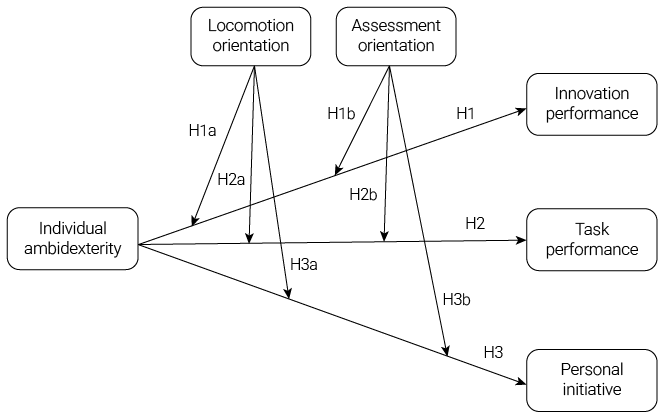
The relationships proposed in the hypotheses are summarized in a research model that integrates individual ambidexterity, performance outcomes, and the moderating role of self-regulatory orientations, which is presented in Figure 1.
Figure 1
Research Model
3. RESEARCH METHODOLOGY
3.1 Sample and Procedures
To test the hypotheses, a sample was drawn from a U.S. manufacturing company that distributes its flooring products across the North American market and employs about 800 workers. This company was selected based on the requirement to analyze a work environment that demands exploitation while encouraging exploration. It provides an ideal context for studying individual ambidexterity, as it operates under strong exploitative demands—such as quality control, efficiency, and routine production—while maintaining a well-established culture of exploration. This exploratory orientation is evidenced by multiple product innovation awards received in 2012, 2014, and 2016, prior to its acquisition by a larger, innovation-focused flooring company. In addition, the company has demonstrated a consistent responsiveness to shifting customer demands in a highly competitive industry. It is located in the Southeastern United States, in a manufacturing hub widely known as the “Carpet Capital of the World,” an area dominated by major flooring manufacturers. According to ambidexterity theory (Gibson & Birkinshaw, 2004), such dual demands at the organizational level create the conditions under which individuals are expected to self-regulate and balance exploration and exploitation behaviors. This context allows for meaningful observations of how individual ambidexterity manifests and relates to performance outcomes within a real-world, dynamic work environment. Therefore, this company provides an appropriate context in which ambidextrous behavior can be observed and the hypotheses can be tested.
To reduce common method bias, the variables were measured using different sources (Podsakoff et al., 2003). A total of 704 full-time employees were recruited and asked to complete a survey that measured assessment orientation, locomotion orientation, and control variables. Their supervisors completed a survey that measured employees’ explorative behavior, exploitative behavior, innovation performance, task performance, and personal initiative. The company’s vice president supported the study and encouraged employees to participate voluntarily; no monetary incentives were offered. The study was reviewed and approved by the Institutional Review Board (IRB) of Kennesaw State University. All participants were informed of the voluntary nature of their participation and assured of the confidentiality of their responses. Informed consent was obtained from all participants prior to data collection. Although surveys were not anonymous due to the need to match employee and supervisor responses, all personal identifiers were removed during data processing to protect participant privacy. The research followed all applicable ethical guidelines for human subjects research.
A total of 704 employee surveys and 704 supervisor surveys were distributed. Of the 365 employee surveys returned, 40 were excluded due to incomplete data, inappropriate response patterns, or missing identifiers for data pairing. Of the 554 supervisor surveys returned, data pairing produced 300 complete records. The Mahalanobis distance test (D2) was used to identify three outliers, which were subsequently removed from the dataset. The resulting sample size was 297, yielding a response rate of 42 %.
3.2 Measures and Validation
All constructs were measured using previously validated scales drawn from prior peer-reviewed studies. The survey consisted of two sections: one completed by employees and the other by their direct supervisors. When necessary, measures were adapted to the manufacturing context without altering their core meanings. All items were rated using five- to seven-point Likert scales, and Cronbach’s alpha values were calculated to assess internal consistency. Variable operationalizations and sources are detailed below.
3.2.1 Independent Variables
Individual Ambidexterity. To measure employees’ ambidextrous behavior, previous approaches (e.g., Gibson & Birkinshaw, 2004; Mom et al., 2009) were followed to calculate ambidexterity by using the combined multiplicative effects of exploration and exploitation. This approach reflects the conceptual definition of ambidexterity as the simultaneous pursuit of both dimensions, rather than their additive or independent effects. A multiplicative index better captures the idea that high ambidexterity requires high levels of both exploration and exploitation. In fact, He and Wong (2004) found that a multiplicative index, rather than their difference or sum, best reflects the interactive, synergistic nature of ambidexterity, consistent with theoretical definitions. Explorative Behavior. To measure the extent to which individuals engage in work-related activities considered explorative in nature, the seven-item scale developed by Mom et al. (2009) was used. This instrument uses a seven-point scale (1 = strongly disagree to 7 = strongly agree). Supervisors rated their subordinates using this scale. Example items include the extent to which subordinates engaged in “activities requiring quite some adaptability” and in “activities requiring [them] to learn new skills or knowledge.” (α = 0,92). Exploitative Behavior. To measure the extent to which individuals engage in work-related activities considered exploitative in nature, the seven-item scale developed by Mom et al. (2009) was used. This instrument uses a seven-point scale (1 = strongly disagree to 7 = strongly agree). Supervisors rated their subordinates using this scale. Example items include the extent to which subordinates engaged in “activities for which a lot of experience has been accumulated” and in “activities they carry out as if they were routine.” (α = 0,90).
3.2.2 Dependent Variables
The three performance outcomes were measured using Bono and Judge’s (2003) job performance items. Supervisors were asked to evaluate the performance of their subordinates using this instrument’s five-point scale (1 = needs improvement to 5 = excellent). Innovation performance contained four items. Example items include the extent to which subordinates were “coming up with new ideas” and “finding improved ways to do things” (α = 0,95). Task performance contained three items. Example items include evaluating the subordinate’s “quality of work” and “quantity of work” (α = 0,82). Personal initiative contained four items. Example items include the extent to which subordinates were “submitting suggestions to improve work” and “changing something in [their] work in order to improve it” (α = 0,93).
3.2.3 Moderating Variables
Locomotion orientation and assessment orientation were measured using Kruglanski
et al.’s (2000) twelve-item instruments for each orientation. Both used a six-point Likert scale (1 = strongly disagree to 6 = strongly agree). Locomotion orientation items include “I am a ‘go-getter’” and “When I decide to do something, I can’t wait to get started” (α = 0,85). Assessment orientation items include “I often critique work done by myself or others” and “I often feel that I am being evaluated by others” (α = 0,78).
3.2.4 Control Variables
To account for alternative explanations of variance in performance, tenure at the firm, tenure in the position, work area, gender, ethnicity, age, and conscientiousness were included as control variables. Age and experience may influence performance because, as employees get older and accumulate experience, they tend to develop more skills and knowledge (Hunter & Thatcher, 2007). To account for the effect of employees’ personality differences, conscientiousness was used as a control variable because it is the salient personality trait that consistently predicted work performance across all jobs (Barrick & Mount, 1991). Conscientiousness was measured using the four-item scale developed by Saucier (1994). This seven-point Likert scale (1 = strongly disagree to 7 = strongly agree) measures the extent to which individuals are organized, efficient, systematic, and practical (α = 0,90).
3.2.5 Validation
A confirmatory factor analysis (CFA) was conducted on the constructs included in the research model to assess model fit. Initial results suggested a less-than-modest fit (CFI = 0,83, RMSEA = 0,067). Then, to improve model fit, some scale refinements were conducted following the procedure set forth by MacKenzie et al. (2011). Of the total 49 items, eight were removed, representing less than the 20 % limit of observed variables suggested by Hair et al. (2010). The resulting improved model (CFI = 0,88, RMSEA = 0,067) offered a better model fit. Moreover, since the upper limit of the 90 % confidence interval for RMSEA (HI90 = 0,071) was below 0,10, the model can be considered an acceptable research model according to Loehlin (2004), and thus acceptable for this research.
4. DATA ANALYSIS AND RESULTS
Table 1 shows the descriptive statistics, correlations, and reliabilities for all variables. To test the proposed hypotheses, a hierarchical multiple regression analysis was employed, allowing for the stepwise entry of variables to assess both main effects and interaction effects, consistent with best practices in moderation analysis (Aiken & West, 1991). Independent variables and moderation were mean-centered prior to the analysis to reduce multicollinearity and aid interpretation of interaction terms. For each of the three independent variables (innovation performance, task performance, and personal initiative), three models were estimated: (1) a base model including control variables, (2) a main-effects model including individual ambidexterity and the two regulatory mode orientations, and (3) an interaction model adding the multiplicative interaction terms between ambidexterity and each orientation. Multicollinearity diagnostics were performed by examining variance inflation factors (VIFs), and all values fell well below the conservative threshold of 10 (Kutner et al., 2004), indicating no collinearity concerns. The significance and direction of beta coefficients were used to interpret support for the hypotheses, and simple slope analysis was conducted to prove significant interaction effects.
Table 1
Descriptive Statistics, Correlations, and Reliabilities
|
Mean |
S.D. |
1 |
2 |
3 |
4 |
5 |
6 |
7 |
8 |
9 |
10 |
11 |
12 |
13 |
14 |
15 |
||
|
1 |
Innovation Performance |
3,06 |
1,13 |
0,95 |
||||||||||||||
|
2 |
Task Performance |
3,93 |
0,80 |
0,55** |
0,82 |
|||||||||||||
|
3 |
Personal Initiative |
3,20 |
1,08 |
0,88** |
0,57** |
0,93 |
||||||||||||
|
4 |
Explorative Behavior |
3,93 |
1,54 |
0,72** |
0,37** |
0,64** |
0,92 |
|||||||||||
|
5 |
Exploitative Behavior |
5,14 |
1,17 |
0,44** |
0,45** |
0,47** |
0,44** |
0,90 |
||||||||||
|
6 |
Individual Ambidexterity |
20,97 |
10,47 |
0,72** |
0,47** |
0,67** |
0,94** |
0,67** |
-- |
|||||||||
|
7 |
Assessment Orientation |
4,05 |
1,07 |
0,16** |
-0,01 |
0,10 |
0,12* |
0,06 |
0,13* |
0,78 |
||||||||
|
8 |
Locomotion Orientation |
5,76 |
0,83 |
0,06 |
0,02 |
0,04 |
0,05 |
0,01 |
0,03 |
0,26** |
0,85 |
|||||||
|
9 |
Conscientiousness |
5,99 |
1,03 |
0,04 |
0,01 |
0,06 |
-0,02 |
-0,03 |
-0,02 |
0,19** |
0,54** |
0,90 |
||||||
|
10 |
Tenure at the Firm |
9,50 |
9,50 |
0,09 |
0,02 |
0,15* |
0,02 |
0,06 |
0,03 |
-0,07 |
-0,05 |
0,08 |
-- |
|||||
|
11 |
Tenure at the Position |
5,64 |
6,98 |
0,06 |
0,02 |
0,11 |
0,02 |
0,05 |
0,03 |
-0,14* |
-0,15** |
-0,05 |
0,70** |
-- |
||||
|
12 |
Work Area |
-- |
-- |
-0,20** |
-0,01 |
-0,25** |
-0,18** |
-0,18** |
-0,20** |
-0,05 |
-0,02 |
0,00 |
-0,11 |
-0,04 |
-- |
|||
|
13 |
Gender |
-- |
-- |
0,12** |
-0,06 |
0,05 |
0,03 |
-0,03 |
0,01 |
0,17** |
-0,08 |
0,00 |
-0,06 |
-0,18** |
0,00 |
-- |
||
|
14 |
Ethnicity |
-- |
-- |
0,28** |
0,05 |
0,28** |
0,21** |
0,14* |
0,18* |
0,13* |
-0,05 |
0,01 |
0,24** |
0,12* |
-0,24** |
0,04 |
-- |
|
|
15 |
Age |
44,61 |
12,81 |
-0,01 |
0,00 |
0,07 |
-0,02 |
0,01 |
0,00 |
-0,08 |
-0,01 |
0,07 |
0,51** |
0,46** |
-0,05 |
-0,14* |
-0,26** |
-- |
Note: N = 297; Cronbach’s alpha coefficients are shown in the diagonal; **p < 0,01 (2-tailed); * p < 0,05 (2-tailed)
Table 2 illustrates the results of the hierarchical and moderated regression analysis. The regression results reveal a significant main effect of individual ambidexterity on innovation performance (β = 0,68, p < 0,01), task performance (β = 0,49, p < 0,01), and personal initiative (β = 0,62, p < 0,01), thereby supporting Hypotheses 1, 2, and 3. However, the results do not provide support for the interactive effects of individual ambidexterity and either locomotion orientation and assessment orientation on innovation performance and personal initiative. Therefore, Hypotheses H1a, H1b, H3a, and H3b were not supported. One possible explanation for these null effects may be rooted in the contextual demands of the organization. While regulatory mode theory suggests that locomotion should enhance action-oriented behaviors and that assessment may inhibit risk-taking, it is possible that the organizational environment equally encouraged both exploration and exploitation across employees, minimizing the variance explained by individual orientations. Additionally, innovation performance and personal initiative may require additional enabling factors—such as psychological empowerment and job autonomy—which were not directly measured in this study but could moderate these relationships. The findings suggest that, while regulatory mode orientations are theoretically relevant, their influence may be conditional or secondary to broader contextual or motivational mechanisms. Although results do not support the interactive effects between individual ambidexterity and locomotion orientation on task performance (H2a), there is a significant interactive effect between individual ambidexterity and assessment orientation on task performance (β = 0,66, p < 0,05), thereby providing support for Hypothesis H2b.
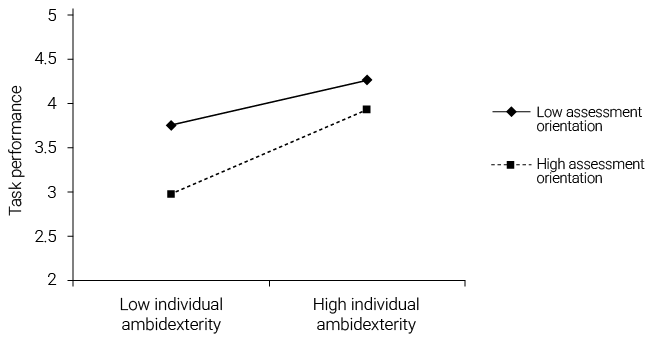
To further understand the nature of the interactive effects between individual ambidexterity and assessment orientation on task performance, the approach suggested by Aiken and West (1991) was applied. Figure 2 illustrates this interaction. As predicted, the interaction was positive, indicating that gains in task performance were greater for employees high in assessment orientation than for those low in assessment orientation as individual ambidexterity increased.
Table 2
Results of Moderated Regression Analysis for Innovation Performance, Task Performance, and Personal Initiative
|
A. Innovation Performance |
B. Task Performance |
C. Personal Initiative |
|||||||
|
Variables |
Model 1ª |
Model 2ª |
Model 3ª |
Model 1ª |
Model 2ª |
Model 3ª |
Model 1ª |
Model 2ª |
Model 3ª |
|
β (S.E.) |
β (S.E.) |
β (S.E.) |
β (S.E.) |
β (S.E.) |
β (S.E.) |
β (S.E.) |
β (S.E.) |
β (S.E.) |
|
|
Tenure at the Firm |
0,02 (0,01) |
0,04 (0,01) |
0,05 (0,01) |
0,01 (0,01) |
0,03 (0,01) |
0,04 (0,01) |
0,04 (0,01) |
0,06 (0,01) |
0,07 (0,01) |
|
Tenure at the Position |
0,09 (0,01) |
0,06 (0,01) |
0,06 (0,01) |
0,01 (0,01) |
-0,02 (0,01) |
-0,02 (0,01) |
0,08 (0,01) |
0,05 (0,01) |
0,05 (0,01) |
|
Work Area |
*-0,13 (0,18) |
-0,02 (0,13) |
-0,02 (0,13) |
0,00 (0,13) |
0,08 (0,12) |
0,07 (0,12) |
**-0,19 (0,17) |
†-0,09 (0,13) |
†-0,08 (0,13) |
|
Gender |
†0,10 (0,13) |
*0,10 (0,09) |
*0,10 (0,09) |
-0,06 (0,10) |
-0,06 (0,09) |
-0,05 (0,09) |
0,05 (0,12) |
0,05 (0,10) |
0,05 (0,10) |
|
Ethnicity |
**0,27 (0,06) |
**0,16 (0,04) |
**0,15 (0,04) |
0,05 (0,05) |
-0,01 (0,04) |
-0,02 (0,04) |
**0,22 (0,06) |
**0,13 (0,05) |
*0,12 (0,05) |
|
Age |
*-0,13 (0,01) |
*-0,10 (0,00) |
*-0,10 (0,00) |
-0,03 (0,00) |
-0,01 (0,00) |
-0,03 (0,00) |
-0,05 (0,01) |
-0,02 (0,00) |
-0,02 (0,00) |
|
Conscientiousness |
0,05 (0,06) |
0,03 (0,05) |
0,04 (0,05) |
0,02 (0,05) |
0,04 (0,05) |
0,05 (0,05) |
0,06 (0,06) |
0,06 (0,05) |
0,07 (0,05) |
|
Individual Ambidexterity |
**0,68 (0,00) |
0,38 (0,03) |
**0,49 (0,00) |
0,45 (0,03) |
**0,62 (0,00) |
0,14 (0,03) |
|||
|
Locomotion Orientation |
0,04 (0,07) |
-0,02 (0,13) |
0,00 (0,06) |
0,13 (0,12) |
0,01 (0,07) |
-0,05 (0,14) |
|||
|
Assessment Orientation |
0,02 (0,04) |
-0,01 (0,10) |
-0,06 (0,04) |
*-0,34 (0,09) |
-0,02 (0,05) |
-0,15 (0,10) |
|||
|
Individual Ambidexterity x Locomotion Orientation |
0,24 (0,01) |
-0,53 (0,01) |
0,24 (0,01) |
||||||
|
Individual Ambidexterity x Assessment Orientation |
0,09 (0,00) |
*0,66 (0,00) |
0,31 (0,000) |
||||||
|
Adjusted R² |
0,10 |
0,55 |
0,55 |
-0,02 |
0,21 |
0,22 |
0,10 |
0,47 |
0,48 |
|
ΔR² |
0,13** |
0,44** |
0,00 |
0,01 |
0,23** |
0,02* |
0,13** |
0,37** |
0,01 |
|
F for ΔR² |
5,92** |
97,13** |
0,56 |
0,28 |
28,10** |
3,32** |
5,88** |
68,15** |
1,84 |
|
F |
5,92** |
37,42** |
31,18** |
0,28 |
8,68** |
7,90** |
5,88** |
27,43** |
23,30** |
Note. ª Standardized betas (β) with standard errors (S.E.) are reported. N = 297. † p < 0,10; * p < 0,05; ** p < 0,01
Figure 2
Moderating Effects of Assessment Orientation on Individual Ambidexterity and Task Performance
5. DISCUSSION
The main purpose of this research was to examine the performance consequences of ambidextrous behavior. The findings provide empirical evidence of the positive effect of ambidextrous behavior on three performance outcomes: innovation performance, task performance, and personal initiative. As indicated by the current state of research, this is the second study to examine the ambidexterity–performance link at the individual level. The prior work of Jasmand et al. (2012), which provided empirical evidence on the positive relationship between ambidextrous behavior and sales performance, is extended here by incorporating three additional individual performance outcomes to the individual ambidexterity literature. These findings extend prior research by confirming that individual ambidexterity contributes meaningfully to multiple dimensions of performance. While previous studies—for example, Jasmand et al. (2012)—found that ambidextrous behavior among service employees enhanced customer satisfaction and sales performance, the present study expands the scope to include innovation, task performance, and personal initiative. This demonstrates that the benefits of ambidexterity cross over other performance domains. The results also support the proposition of Mom et al. (2009) that ambidextrous behavior at the managerial level can have wide-ranging benefits when reinforced by organizational contexts. Furthermore, these findings align with Good and Michel (2013), who found that ambidextrous individuals were more capable of adapting to dynamic task demands, including individual innovation (Zhang et al., 2022) and creativity (Wang, et al., 2024).
The consistent positive relationship between individual ambidexterity and all three performance outcomes supports the theoretical view that employees who can effectively alternate between explorative and exploitative behaviors generate added value for organizations (Gibson & Birkinshaw, 2004). These findings align with prior organizational ambidexterity research but extend it to the individual level by demonstrating that ambidextrous behavior contributes not only to innovation (Zhang et al., 2022) but also to day-to-day task performance and proactive engagement. This suggests that ambidextrous individuals can simultaneously meet operational demands and drive continuous improvement, a capability that is highly valued in dynamic, competitive environments.
Another contribution of this research is revealing the interaction between assessment orientation and ambidextrous behavior and their positive interaction effect on task performance. Although no support was found for the other two performance outcomes (innovation performance and personal initiative), these null results offer important theoretical insights. First, they suggest that regulatory orientations may not uniformly moderate all outcomes of ambidextrous behavior, especially in environments where innovation and initiative are already structurally encouraged. For example, even employees low in locomotion may still engage in innovation if the organization culture emphasizes experimentation. Similarly, individuals high in assessment orientation may still take initiative if there are strong incentives for proactive behavior or if expectations for initiative are embedded in role definitions. These findings point to the need for more detailed theoretical models that account for the boundary conditions under which self-regulatory modes influence performance outcomes. It is also possible that alternative moderating mechanisms—such as psychological empowerment, job autonomy, leadership style—may better explain when and how ambidexterity translates into innovation or initiative.
Overall, the results underscore the complexity of the ambidexterity–performance link and the need to consider both individual dispositions and contextual factors collectively. An intriguing outcome of this interaction is the detrimental effect of the moderator (assessment orientation) on task performance (Figure 2). Task performance drops as individuals score higher on assessment orientation, regardless of ambidexterity level. One explanation is that when employees must divert their attention to other required performance outcomes—such as innovation performance or personal initiative—those with high levels of assessment orientation will tend to be concerned about their performance and how they will be assessed by others (Higgins et al., 2003). As a result, they may perform less effectively due to limitations of time and energy demanded by distinct performance outcomes. As the interaction term shows, the detrimental effect of higher assessment orientation is greater for less ambidextrous individuals than for those who are more ambidextrous.
6. THEORETICAL IMPLICATIONS
This study contributes to advancing the theoretical understanding of individual ambidexterity by integrating recent developments from both ambidexterity theory and regulatory mode theory. Although earlier research has demonstrated that ambidextrous behavior can lead to enhanced performance (e.g., Jasmand et al., 2012), more recent literature emphasizes the need to examine the microfoundations underlying how these behaviors translate into varied performance outcomes (Pertusa-Ortega et al., 2020; Mu et al., 2020). The present finding—that individual ambidexterity is positively linked to innovation performance, task performance, and personal initiative—reinforces emerging evidence suggesting that ambidexterity promotes adaptive problem-solving and creative capacities in dynamic work environments (Wang et al., 2024; Zhang et al., 2022). These results support the argument that ambidextrous individuals contribute to both operational efficiency and innovative capability, offering organizations a means to simultaneously pursue short-term execution and long-term adaptability.
Moreover, the mixed results concerning the moderating role of regulatory mode orientations illuminate important boundary conditions in the ambidexterity–performance link. The significant interaction between assessment orientation and task performance extends prior work on individual-level self-regulation (Laureiro-Martinez et al., 2015; Wang et al., 2024), revealing that evaluative tendencies may strengthen performance in areas such as task performance, while exerting weaker—or even adverse—influences on innovation and initiative, particularly in environments that already support exploration. This suggests that future theoretical models should incorporate contextual enablers (e.g., job autonomy, innovation climate) and consider how these interact with individual self-regulatory styles to shape performance outcomes.
Overall, by synthesizing updated theoretical frameworks with empirical evidence, this study positions individual ambidexterity as a multidimensional construct, whose impact on performance is shaped not only by behavioral balance but also by underlying cognitive mechanisms and regulatory orientations. This integrative approach responds to recent calls to explore the interaction between person-level traits and organizational contexts as a way to explain performance variability in ambidextrous work settings (Mu et al., 2020; Pertusa-Ortega et al., 2020).
7. PRACTICAL IMPLICATIONS
Because employee performance is a critical driver of organizational success, the present findings offer actionable guidance for managers seeking to foster both innovation and operational efficiency. The study demonstrates that individual ambidexterity has positive effects on innovation performance, task performance, and personal initiative. First, managers should actively cultivate ambidextrous behavior by creating work environments that encourage employees to balance exploration and exploitation. This aligns with recent evidence indicating that ambidextrous individuals drive both adaptability and innovation in dynamic contexts (Wang et al., 2024; Zhang et al., 2022) and that their contributions are maximized when contextual enablers such as autonomy and innovation climate are in place (Pertusa-Ortega et al., 2020). Specific practices include embedding opportunities for employees to engage in both routine optimization and experimentation, integrating cross-functional projects, and providing feedback mechanisms that recognize both types of contributions.
Second, in recruitment and selection, organizations should assess candidates’ potential for ambidextrous behavior. This can be done through interviews focusing on behaviors or work simulations—including internships or co-ops—that assess adaptability, cognitive flexibility, and the ability to shift between divergent and convergent thinking. Training programs should also be designed to strengthen employees’ comfort with alternating between efficiency-driven and creativity-driven tasks, as prior research shows that these abilities can be enhanced through targeted skill development (Mu et al., 2020).
Third, considering the significant moderating effects of assessment orientation on task performance, employees high in assessment orientation may be effective in roles where task precision and quality are crucial. However, the results suggest that when such employees are required to simultaneously engage in multiple performance domains (e.g., innovation and initiative), their task performance may decline. Managers should consider workload design and role expectations for these employees, potentially reducing concurrent demands or providing additional resources to avoid performance trade-offs. This recommendation is consistent with recent work emphasizing that regulatory tendencies interact with role design to shape performance outcomes (Wang et al., 2024).
Finally, organizations operating in competitive, innovation-oriented industries should view ambidextrous behavior not only as a desirable trait but also as a strategic human capital capability. As highlighted by Pertusa-Ortega et al. (2020) and Mu et al. (2020), the combination of individual skills and supportive organizational contexts produces the greatest performance benefits. This means that investments in both employee capability development and organizational design are necessary to fully capture the value of ambidexterity within the workforce.
8. LIMITATIONS AND FUTURE LINES OF RESEARCH
Like all empirical work, this study is subject to several limitations that open avenues for further research. First, the use of a cross-sectional design restricts the capacity to infer causal relationships between ambidextrous behavior, self-regulatory orientations, and performance outcomes. Future research would benefit from employing longitudinal or experimental designs to capture the dynamic and temporal dimensions of these constructs more accurately. Second, data collection was conducted within a single U.S. manufacturing company. While this context was suitable for exploring individual ambidexterity, the findings may not be readily generalizable to other sectors or work environments that differ in their structural or cultural characteristics. Replication studies across diverse organizational and national contexts are therefore essential to improve external validity and determine whether the observed effects hold under different ambidexterity conditions. Notably, the mean score for ambidextrous behavior in this study was 20,97, which lies near the midpoint of the scale (range: 1 to 49), suggesting moderate expression of ambidextrous behavior. As such, future studies should explore this phenomenon in contexts exhibiting both higher and lower degrees of ambidexterity to understand its broader applicability. Third, while this study conceptually introduced cognitive mechanisms—namely, cognitive variety and self-interruption—as underlying processes, they were not empirically tested as mediators. Future research should incorporate formal mediation analyses to empirically assess how these mechanisms explain the relationship between ambidextrous behavior and performance outcomes. Fourth, findings related to the moderating role of regulatory mode orientations were mixed. Although assessment orientation was found to significantly moderate the relationship with task performance, it did not exert similar effects on innovation or initiative. Future research might examine alternative moderators, such as job autonomy, leadership support, or psychological empowerment, which could offer a more nuanced understanding of how individual traits interact with contextual factors to shape performance. Finally, given that human resource management practices—including employee empowerment, skill development, recognition, and work engagement—have been shown to enhance performance (Krishnaveni & Monica, 2018), future research should explore how these practices facilitate the emergence of ambidextrous behavior and, in turn, promote innovation, task performance, and personal initiative within organizations.
9. CONCLUSIONS
This study contributes to the growing body of research on individual ambidexterity by demonstrating its consistent positive influence on innovation, task performance, and personal initiative. By incorporating cognitive mechanisms and regulatory mode theory, it advances understanding of how individual differences and organizational contexts jointly shape performance outcomes. The findings underscore that while ambidextrous behavior is broadly beneficial, its impact can vary depending on self-regulatory orientations, with assessment orientation strengthening its effect on task performance. Overall, the results highlight the strategic importance of cultivating ambidextrous capabilities at the individual level, offering both theoretical insights and practical guidance for organizations aiming to balance efficiency with innovation.
STATEMENTS
Data Availability
The data that support the findings of this study are available from the author upon
request.
Use of Artificial Intelligence
No AI tools were used in the preparation of this manuscript.
Conflict of Interest
The author declares no conflict of interest.
Funding
This research did not receive any specific grant from funding agencies in the public, commercial, or not-for-profit sectors.
Author Contributions (CRediT)
FG: conceptualization, methodology, formal analysis, writing, original draft, review & editing.
Ethical Approval
Not applicable.
Declaration of Originality
The author declares that this manuscript is original, has not been previously published, and is not under consideration for publication elsewhere.
REFERENCES
Aiken, L. S., & West, S. G. (1991). Multiple regression: Testing and interpreting interactions. Sage. https://books.google.com.pe/books?id=LcWLUyXcmnkC
Aston-Jones, G., & Cohen, J. D. (2005). An integrative theory of locus coeruleus-norepinephrine function: Adaptive gain and optimal performance. Annual Review of Neuroscience, 28, 403-450. https://doi.org/10.1146/annurev.neuro.28.061604.135709
Barrick, M. R., & Mount, M. K. (1991). The Big Five personality dimensions and job performance: A meta-analysis. Personnel Psychology, 44(1), 1-26. https://doi.org/10.1111/j.1744-6570.1991.tb00688.x
Bono, J. E., & Judge, T. A. (2003). Self-concordance at work: Toward understanding the motivational effects of transformational leaders. Academy of Management Journal, 46(5), 554-571. https://www.jstor.org/stable/30040649
Carmeli, A., & Halevi, M. Y. (2009). How top management team behavioral integration and behavioral complexity enable organizational ambidexterity: The moderating role of contextual ambidexterity. The Leadership Quarterly, 20(2), 207-218. https://doi.org/10.1016/j.leaqua.2009.01.011
De Juan, L. L. (2025). Individual ambidexterity and organizational performance among employees. Journal of Interdisciplinary Perspectives, 3(2), 369-381. https://www.jippublication.com/index.php/jip/article/view/713
Duncan, R. B. (1976). The ambidextrous organization: Designing dual structures for innovation. In R. H. Kilman, L. R. Pondy & D. P. Slevin (Eds.), The management of organization design: Strategies and implementation (pp. 167-189). Elsevier Science.
Eisenhardt, K. M., Furr, N. R., & Bingham, C. B. (2010). CROSSROADS—Microfoundations of performance: Balancing efficiency and flexibility in dynamic environments. Organization Science, 21(6), 1125-1279. https://doi.org/10.1287/orsc.1100.0564
Frese, M., & Fay, D. (2001). Personal initiative: An active performance concept for work in the 21st century. Research in Organizational Behavior, 23, 133-187. https://doi.org/10.1016/S0191-3085(01)23005-6
Frese, M., Kring, W., Soose, A., & Zempel, J. (1996). Personal initiative at work: Differences between East and West Germany. The Academy of Management Journal, 39(1), 37-63. https://www.jstor.org/stable/256630
Garcia, F., Guidice, R. M., & Mero, N. P. (2022). The interactive effect of person and situation on explorative and exploitative behavior. Journal of Management & Organization, 28(6), 1235-12-55. https://doi.org/10.1017/jmo.2019.50
Gibson, C. B., & Birkinshaw, J. (2004). The antecedents, consequences, and mediating role of organizational ambidexterity. The Academy of Management Journal, 47(2), 209-226.
Good, D., & Michel, E. (2013). Individual ambidexterity: Exploring and exploiting in dynamic contexts. The Journal of Psychology, 147(5), 435-453. https://doi.org/10.1080/00223980.
2012.710663
Gupta, A. K., Smith, K. G., & Shalley, C. E. (2006). The interplay between exploration and exploitation. Academy of Management Journal, 49(4), 693-706. https://doi.org/10.5465/amj.2006.22083026
Hair Jr., J. F., Black, W. C., Babin, B. J., & Anderson, R. E. (2010). Mutivariate data analysis (7th ed.). Pearson Prentice Hall.
He, Z.-L., & Wong, P.-K. (2004). Exploration vs. exploitation: An empirical test of the ambidexterity hypothesis. Organization Science, 15(4), 375-497. https://doi.org/10.1287/orsc.1040.0078
Higgins, E. T., Kruglanski, A. W., & Pierro, A. (2003). Regulatory mode: Locomotion and assessment as distinct orientations. In M. P. Zanna (Ed.), Advances in experimental social psychology (Vol. 35, pp. 293-344). Elsevier Academic Press. https://doi.org/10.1016/S0065-2601(03)01005-0
Hughes, M. (2018). Organisational ambidexterity and firm performance: Burning research questions for marketing scholars. Journal of Marketing Management, 34(1-2), 178-229. https://doi.org/10.1080/0267257X.2018.1441175
Hunter, L. W., & Thatcher, S. M. B. (2007). Feeling the heat: Effects of stress, commitment, and job experience on job performance. Academy of Management Journal, 50(4), 953-968. https://doi.org/10.5465/amj.2007.26279227
Jasmand, C., Blazevic, V., & De Ruyter, K. (2012). Generating sales while providing service: A study of customer service representatives’ ambidextrous behavior. Journal of Marketing, 76(1), 20-37. https://doi.org/10.1509/jm.10.0448
Jett, Q. R., & George, J. M. (2003). Work interrupted: A closer look at the role of interruptions in organizational life. The Academy of Management Review, 28(3), 494-507. https://doi.org/10.5465/amr.2003.10196791
Junni, P., Sarala, R., Taras, V., & Tarba, S. (2013). Organizational ambidexterity and performance: A meta-analysis. Academy of Management Perspectives, 27(4), 299-312. https://doi.org/10.5465/amp.2012.0015
Kalafatis, S. P., Blankson, C., Boatswain, M. L., & Tsogas, M. H. (2020). Preference for action: Regulatory mode in B2B positioning decision-making. Journal of Business & Industrial Marketing, 35(12), 2111-2125. https://doi.org/10.1108/jbim-04-2019-0145
Kane, G. C., & Alavi, M. (2007). Information technology and organizational learning: An investigation of exploration and exploitation processes. Organization Science, 18(5), 796-812. https://doi.org/10.1287/orsc.1070.0286
Krishnaveni, R., & Monica, R. (2018). Factors influencing employee performance: The role of human resource management practices and work engagement. International Journal of Business Performance Management, 19(4), 450-475. https://doi.org/10.1504/IJBPM.2018.095093
Kruglanski, A. W., Thompson, E. P., Higgins, E. T., Atash, M. N., Pierro, A., Shah, J. Y., & Spiegel, S. (2000). To “do the right thing” or to “just do it”: Locomotion and assessment as distinct self-regulatory imperatives. Journal of Personality and Social Psychology, 79(5), 793-815. https://doi.org/10.1037/0022-3514.79.5.793
Kutner, M., Nachtsheim, C., & Neter, J. (2004). Applied linear regression models (4th ed.). McGraw-Hill. https://www.amazon.com/Applied-Linear-Regression-Models-Student/dp/0073014664
Laureiro-Martinez, D., Brusoni, S., Canessa, N., & Zollo, M. (2015). Understanding the exploration–exploitation dilemma: An fMRI study of attention control and decision-making performance. Strategic Management Journal, 36(3), 319-338. https://doi.org/10.1002/smj.2221
Levinthal, D. A., & March, J. G. (1993). The myopia of learning. Strategic Management Journal, 14, 95-112. http://www.jstor.org/stable/2486499
Liang, H., Wang, N., & Xue, Y. (2022). Juggling information technology (IT) exploration and exploitation: A proportional balance view of IT ambidexterity. Information Systems Research, 33(4), 1386-1402. https://doi.org/10.1287/isre.2022.1105
Loehlin, J. C. (2004). Latent variable models: An introduction to factor, path, and structural equation analysis (4th ed.). Psychology Press. https://doi.org/10.4324/9781410609823
MacKenzie, S. B., Podsakoff, P. M., & Podsakoff, N. P. (2011). Construct measurement and validation procedures in MIS and behavioral research: Integrating new and existing techniques. MIS Quarterly, 35(2), 293-334. https://doi.org/10.2307/23044045
March, J. G. (1991). Exploration and exploitation in organizational learning. Organization Science, 2(1), 71-87. https://doi.org/10.1287/orsc.2.1.71
Miller, C. C., Burke, L. M., & Glick, W. H. (1998). Cognitive diversity among upper‐echelon executives: Implications for strategic decision processes. Strategic Management Journal, 19(1), 39-58. https://www.jstor.org/stable/3094179
Miron, E., Erez, M., & Naveh, E. (2004). Do personal characteristics and cultural values that promote innovation, quality, and efficiency compete or complement each other? Journal of organizational behavior, 25(2), 175-199. https://doi.org/10.1002/job.237
Mom, T. J. M., Van den Bosch, F. A. J., & Volberda, H. W. (2009). Understanding variation in managers’ ambidexterity: Investigating direct and interaction effects of formal structural and personal coordination mechanisms. Organization Science, 20(4), 812-828. https://doi.org/10.1287/orsc.1090.0427
Mom, T. J. M., Chang, Y.-Y., Cholakova, M., & Jansen, J. J. P. (2018). A multilevel integrated framework of firm HR practices, individual ambidexterity, and organizational ambidexterity. Journal Of Management, 45(7), 3009-3034. https://doi.org/10.1177/0149206318776775
Mu, T., Van Riel, A., & Schouteten, R. (2020). Individual ambidexterity in SMEs: Towards a typology aligning the concept, antecedents and outcomes. Journal of Small Business Management, 60(2), 347-378. https://doi.org/10.1080/00472778.2019.1709642
Okhuysen, G. A., & Eisenhardt, K. M. (2002). Integrating knowledge in groups: How formal interventions enable flexibility. Organization Science, 13(4), 370-386. https://doi.org/10.1287/orsc.13.4.370.2947
Oldham, G. R., & Cummings, A. (1996). Employee creativity: Personal and contextual factors at work. The Academy of Management Journal, 39(3), 607-634. https://doi.org/10.5465/256657
O’Reilly, C. A., III, & Tushman, M. L. (2004). The ambidextrous organization. Harvard Business Review, 82(4), 74-81. https://hbr.org/2004/04/the-ambidextrous-organization
O’Reilly, C. A., III, & Tushman, M. L. (2013). Organizational ambidexterity: Past, present, and future. Academy of Management Perspectives, 27(4), 324-338. https://doi.org/10.5465/amp.2013.0025
Peng, M. Y.-P., Lin, K.-H., Peng, D. L., & Chen, P. (2019). Linking organizational ambidexterity and performance: The drivers of sustainability in high-tech firms. Sustainability, 11(14), Article 3931. https://doi.org/10.3390/SU11143931
Pertusa-Ortega, E. M., Molina-Azorín, J. F., Tarí, J. J., Pereira-Moliner, J., & López-Gamero, M. D. (2020). The microfoundations of organizational ambidexterity: A systematic review of individual ambidexterity through a multilevel framework. BRQ. Business Research Quarterly, 24(4), 355-371. https://doi.org/10.1177/2340944420929711
Pierro, A., Kruglanski, A. W., & Higgins, E. T. (2006). Regulatory mode and the joys of doing: Effects of ‘locomotion’ and ‘assessment’ on intrinsic and extrinsic task‐motivation. European Journal of Personality, 20(5), 355-375. https://doi.org/10.1002/per.600
Podsakoff, P. M., MacKenzie, S. B., Lee, J.-Y., & Podsakoff, N. P. (2003). Common method biases in behavioral research: A critical review of the literature and recommended remedies. Journal of Applied Psychology, 88(5), 879-903. https://doi.org/10.1037/0021-9010.88.5.879
Raisch, S., Birkinshaw, J., Probst, G., & Tushman, M. L. (2009). Organizational ambidexterity: Balancing exploitation and exploration for sustained performance. Organization science, 20(4), 685-695. https://doi.org/10.1287/orsc.1090.0428
Rich, B. L., LePine, J. A., & Crawford, E. R. (2010). Job engagement: Antecedents and effects on job performance. Academy of Management Journal, 53(3), 617-635. https://doi.org/10.5465/AMJ.2010.51468988
Rozhkov, M., Cheung, B. C. F., & Tsui, E. (2016). Workplace context and its effect on individual competencies and performance in work teams. International Journal of Business Performance Management, 18(1), 49-81. https://doi.org/10.1504/IJBPM.2017.080842
Saucier, G. (1994). Mini-Markers: A brief version of Goldberg’s unipolar Big-Five markers. Journal of Personality Assessment, 63(3), 506-516. https://doi.org/10.1207/s15327752jpa6303_8
Scott, S. G., & Bruce, R. A. (1994). Determinants of innovative behavior: A path model of individual innovation in the workplace. Academy of Management Journal, 37(3), 580-607. https://doi.org/10.2307/256701
Speier, C., Valacich, J. S., & Vessey, I. (1999). The influence of task interruption on individual decision making: An information overload perspective. Decision Sciences, 30(2), 337-360 https://doi.org/10.1111/j.1540-5915.1999.tb01613.x
Tushman, M. L., & O’Reilly, C. A. (1996). Ambidextrous organizations: Managing evolutionary and revolutionary change. California Management Review, 38(4), 8-29. https://doi.org/10.2307/41165852
Tushman, M. L., Smith, W. K., & Binns, A. (2011). The ambidextrous CEO. Harvard Business Review, 89(6), 74-80. http://www.iot.ntnu.no/innovation/norsi-pims-courses/tushman/Tushman,%20Smith%20&%20Binns%20(2011).pdf
Wang, J., Kim, T.-Y., Bateman, T. S., Jiang, Y., & Tang, G. (2024). A paradox theory lens on proactivity, individual ambidexterity, and creativity: An empirical look. Journal of Organizational Behavior, 45(6), 896-911. https://doi.org/10.1002/job.2786
Welbourne, T. M., Johnson, D. E., & Erez, A. (1998). The role-based performance scale: Validity analysis of a theory-based measure. The Academy of Management Journal, 41(5), 540-555. https://doi.org/10.2307/256941
Yuan, F., & Woodman, R. W. (2010). Innovative behavior in the workplace: The role of performance and image outcome expectations. Academy of Management Journal, 53(2), 323-342. https://doi.org/10.5465/amj.2010.49388995
Zacher, H., & Rosing, K. (2015). Ambidextrous leadership and team innovation. Leadership & Organization Development Journal, 36(1), 54-68. https://doi.org/10.1108/lodj-11-2012-0141
Zhang, M. J., Zhang, Y., & Law, K. S. (2022). Paradoxical leadership and innovation in work teams: The multilevel mediating role of ambidexterity and leader vision as a boundary condition. Academy of Management Journal, 65(5), 1652-1679. https://doi.org/10.5465/amj.2017.1265
Zijlstra, F. R. H., Roe, R. A., Leonora, A. B., & Krediet, I. (1999). Temporal factors in mental work: Effects of interrupted activities. Journal of Occupational and Organizational Psychology, 72(2), 163-185. https://doi.org/10.1348/096317999166581