THE IMPACT OF ARTIFICIAL INTELLIGENCE
IN SUPPLY CHAIN RISK MANAGEMENT:
A TARGETED LITERATURE REVIEW
Alfredo Armijos de la Cruz
https://orcid.org/0000-0003-4442-2697
Universidad Politécnica de Valencia – UPV, Valencia, España
Victor Hugo González Jaramillo
https://orcid.org/0000-0002-2443-5397
Escuela Superior Politécnica del Litoral - ESPOL, Guayaquil, Ecuador
Received: 20 April, 2026 / Accepted: 30 April, 2026
https://doi.org/10.26439/ddee2026.n008.8777
This is an open access article, published under the terms of the Creative Commons Attribution 4.0 International (CC BY 4.0) license.
ABSTRACT. Global supply chains have become increasingly complex and volatile, intensifying the need for robust risk management strategies that leverage emerging Industry 5.0 technologies. Artificial intelligence (AI) has emerged as a transformative tool in mitigating risks by enhancing predictive analytics, improving decision-making, and strengthening organizational resilience within supply networks. This study conducts a targeted literature review based on the Preferred Reporting Items for Systematic Reviews and Meta-Analyses (PRISMA) guidelines to assess the impact of AI on supply chain risk management (SCRM). The review synthesizes key findings from recent research, categorizing AI applications into supply network management knowledge areas. The results indicate that AI-driven technologies, including machine learning, natural language processing, and predictive analytics, significantly enhance risk visibility, improve forecasting accuracy, and reduce disruption response times. Nevertheless, challenges such as data quality, ethical considerations, algorithmic transparency, and implementation costs remain critical barriers to adoption. The study concludes by offering recommendations for future research and outlining practical implications for organizations seeking to integrate AI into their SCRM strategies.
KEYWORDS: artificial intelligence / supply chain risk management / machine learning / predictive analytics
JEL codes: C88, M11, D81
EL IMPACTO DE LA INTELIGENCIA ARTIFICIAL EN LA GESTIÓN DE RIESGOS DE LA CADENA DE SUMINISTRO: UNA REVISIÓN FOCALIZADA DE LA LITERATURA
RESUMEN. La creciente complejidad y volatilidad de las cadenas de suministro globales ha intensificado la necesidad de estrategias sólidas de gestión de riesgos apoyadas en tecnologías emergentes de la Industria 5.0. En este contexto, la inteligencia artificial (IA) se ha consolidado como una herramienta capaz de fortalecer la capacidad predictiva, optimizar la toma de decisiones y mejorar la resiliencia organizacional en las redes de suministro. El presente estudio desarrolla una revisión rápida de literatura basada en las directrices PRISMA con el objetivo de analizar el impacto de la IA en la gestión de riesgos de la cadena de suministro (SCRM). La revisión sintetiza hallazgos recientes sobre aplicaciones de aprendizaje automático, procesamiento de lenguaje natural y analítica predictiva en procesos de identificación, evaluación y mitigación de riesgos. Los resultados muestran que las tecnologías basadas en IA contribuyen significativamente a mejorar la visibilidad de riesgos, aumentar la precisión de los pronósticos y reducir los tiempos de respuesta frente a disrupciones. No obstante, persisten desafíos relacionados con la calidad de los datos, la transparencia algorítmica, las consideraciones éticas y los costos de implementación. Finalmente, el estudio plantea implicancias prácticas para las organizaciones y propone líneas de investigación futura orientadas a fortalecer la integración de la IA en las estrategias de gestión de riesgos de las cadenas de suministro.
PALABRAS CLAVE: inteligencia artificial / gestión de riesgos de la cadena de suministro / aprendizaje automático / analítica predictiva
1. INTRODUCTION AND OBJECTIVES
The integration of artificial intelligence (AI) into supply chain risk management (SCRM) has gained significant attention due to increasing global disruptions, such as the COVID-19 pandemic. While AI offers promising solutions for enhancing supply chain resilience and efficiency, a clear gap remains in the literature regarding its strategic alignment with organizational goals and practical implementation across different industries (Dey et al., 2024; Wong et al., 2024). Previous research has examined the role of AI) in mitigating risks. However, there remains a need for a comprehensive synthesis that evaluates its effectiveness across diverse supply chain contexts and identifies the barriers to its adoption. This study addresses these gaps by conducting a targeted literature review to assess how AI enhances risk management strategies and to identify the challenges that remain unaddressed.
Existing studies, such as Mukherjee et al. (2023), highlight the link between AI implementation and firm performance, emphasizing the role of AI-driven resilience. However, there is limited discussion of how variations across industries, firm sizes, and supply chain structures influence AI adoption and risk mitigation strategies. Similarly, while research by Golan et al. (2020) and Modgil et al. (2022) demonstrates the impact of AI on decision-making and information sharing, there is a lack of comparative analyses assessing the effectiveness of various AI-driven risk management techniques. Moreover, ethical challenges, data privacy concerns, and potential biases in AI algorithms remain underexplored, as noted by Baryannis et al. (2019) and Belhadi et al. (2024).
1.1 Research Questions and Objectives
This study aims to address the following research questions:
- How does AI contribute to supply chain risk identification, assessment, and mitigation?
- What are the primary benefits and challenges of AI adoption in SCRM across different industries?
- What are the key barriers (e.g., ethical, financial, technological) to AI implementation in SCRM, and how could they be addressed?
- Based on the research questions outlined above, this study aims to:
- Examine the current applications of AI in SCRM, focusing on predictive analytics, machine learning, and real-time risk assessment.
- Identify the key benefits and challenges of integrating AI into SCRM, with particular emphasis on resilience, cost efficiency, and decision-making.
- Highlight existing research gaps and propose directions for future research, with particular emphasis on ethical considerations, implementation barriers, and strategic alignment.
2. METHODOLOGY
This study employed the Preferred Reporting Items for Systematic Reviews and Meta-Analyses (PRISMA) framework to ensure a structured and transparent selection of relevant literature (Moher et al., 2015). The PRISMA approach was chosen for its rigorous and replicable process for literature selection (Figure 1). It enhances the reliability of targeted reviews by minimizing bias and improving the quality of included studies (Ganann et al., 2010; Haby et al., 2016; Kelly et al., 2016). This approach ensures that the study selection process based on a targeted literature review (Polisena et al., 2015; Smela et al., 2023) aligns with best practices in evidence synthesis, particularly in multidisciplinary fields such as AI in SCRM.
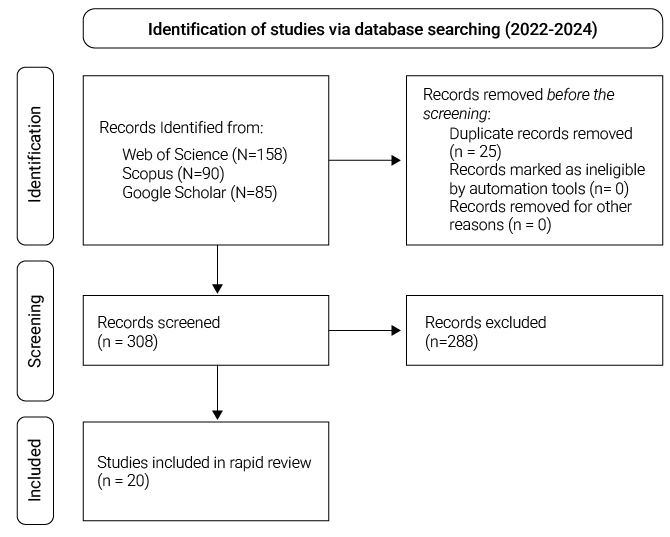
A total of 333 records were initially identified from three major academic databases: Web of Science (n = 158), Scopus (n = 90), and Google Scholar (n = 85) (Figure 1). These databases were selected based on their comprehensive indexing of peer-reviewed journal articles, conference proceedings, and industry-relevant studies related to AI and supply chain management. The search was conducted using combinations of the following keywords:
- “Artificial Intelligence” AND “Supply Chain Risk Management”
- “Machine Learning” AND “Supply Chain Disruptions”
- “Predictive Analytics” AND “Supply Chain Resilience”
To ensure transparency, explicit inclusion and exclusion criteria were established as follows:
- Inclusion criteria: Studies published between 2022 and 2024, peer-reviewed journal articles, and conference proceedings explicitly addressing applications of AI in SCRM.
- Exclusion criteria: Articles not focused on risk management, studies lacking methodological rigor, and non-English language publications.
After removing 25 duplicate records, 308 articles advanced to the screening phase, during which titles and abstracts were reviewed against the predefined criteria. Following this rigorous process, 288 articles were excluded due to irrelevance or insufficient methodological quality. Ultimately, 20 studies were included in the review. Although the final sample size is relatively small, it is justified by the specificity and recency of applications of
Figure 1
PRISMA Flow Diagram of Article Selection
AI in SCRM. Expanding the dataset would likely have introduced less relevant or redundant studies, potentially diluting the study’s focus. Future research could broaden the scope by considering a wider timeframe or additional databases to further validate the evolving role of AI in SCRM.
The PRISMA flow diagram in Figure 1 visually illustrates the study selection process, outlining the systematic approach undertaken to ensure the inclusion of high-quality and pertinent studies. This methodology enhances the credibility of the findings by adhering to a structured selection process.
3. RESULTS
Finally, Table 1 summarizes the findings according to authors, benefits, and challenges. The review illustrates how AI enhances supply chain agility, enables predictive risk assessment, automates logistics and inventory processes, and facilitates adaptive risk management strategies.
Table 1
Benefits and Challenges from the Reviewed Articles
|
Authors |
Key benefits |
Challenges |
|
Allahham et al. (2024) |
Improves risk alert systems, enhances data-driven decision-making, supports supply chain security. |
Concerns over AI apprehensions and the need for robust IT infrastructure. |
|
Bidin et al. (2024) |
Provides real-time risk assessment, strengthens resilience, enhances decision-making. |
Scalability issues, integration with legacy systems. |
|
Edhrabooh & Al-Alawi (2024) |
Optimizes demand forecasting, enhances inventory management, improves logistics efficiency. |
Requires high-quality data, difficulty in model interpretation. |
|
Ejjami & Boussalham (2024) |
Enhances operational efficiency, automates predictive maintenance, reduces downtime. |
Algorithmic transparency issues, potential biases in AI models. |
|
Ismaeil & Lalla (2024) |
Improves demand forecasting, reduces operational costs, enhances customer service. |
Data security concerns, legal and regulatory challenges. |
|
Jahin et al. (2024) |
Facilitates proactive risk management, improves supply chain agility, enables real-time insights. |
Data inconsistencies, difficulty in standardization. |
|
Liu et al. (2024) |
Boosts supplier collaboration, enhances adaptive capabilities, improves resilience. |
High investment costs need continuous monitoring. |
|
Narayanan et al. (2024) |
Enhances predictive accuracy, improves real-time monitoring, optimizes risk assessment. |
Challenges in data governance, high implementation costs. |
|
Nezianya et al. (2024) |
Improves fraud detection, enhances demand forecasting, enables real-time risk alerts. |
Ethical concerns, data privacy challenges. |
|
Nnaji et al. (2024) |
Optimizes financial risk assessment, enhances supply chain financing, and improves liquidity management. |
Regulatory and compliance hurdles, risk of automation biases. |
|
Rane et al. (2024) |
Improves sustainability practices, enhances risk mitigation strategies, optimizes logistics. |
High initial costs, ongoing maintenance requirements. |
|
Rauf et al. (2024) |
Improves detection of counterfeit goods, enhances risk monitoring, ensures compliance. |
Scalability issues, integration with regulatory frameworks. |
|
Riad et al. (2024) |
Improves risk prediction, enhances supplier collaboration, enables real-time monitoring. |
High implementation cost, data privacy concerns. |
|
Thenmozhi & Krisknakumari (2024) |
Automates logistics processes, optimizes route planning, and enhances inventory management. |
Integration issues with traditional systems. |
|
Vandana et al. (2024) |
Automates warehouse management, improves predictive maintenance and optimizes supplier relationships. |
High dependency on robust IT infrastructure. |
|
Yassin (2023) |
Strengthens decision-making, improves risk prediction, supports proactive risk mitigation. |
Dependence on high-quality data, complexity in AI implementation. |
|
Zhang (2024) |
Enhances efficiency and resilience, reduces costs, prevents disruptions. |
Technical expertise required, complexity in implementation. |
4. DISCUSSION AND CONCLUSIONS
4.1 How AI is Transforming SCRM
Based on the results of this rapid literature review, the role of AI in SCRM has evolved significantly, with a strong focus on enhancing resilience, visibility, and predictive capabilities. Integrating AI-driven tools, including machine learning (ML), predictive analytics, and real-time data monitoring, has fundamentally transformed how organizations identify, assess, and mitigate risks within their supply chains, as discussed below.
AI-Driven Risk Identification and Prediction
One of the primary advantages of AI in SCRM is its ability to proactively identify and predict risks. Traditional risk management techniques rely on historical data and static models, which lack flexibility to respond to real-time disruptions. Through predictive analytics, AI enables organizations to process vast amounts of structured and unstructured data from multiple sources, such as supplier performance records, market trends, geopolitical events, and weather patterns (Narayanan et al., 2024). For instance, AI can:
- Detect potential supplier failures by analyzing historical performance and relevant economic indicators.
- Predict the likelihood of natural disasters affecting logistics routes and use real-time tracking data to anticipate potential transportation delays.
Enhancing Supply Chain Visibility
AI-powered tools provide real-time supply chain visibility, through technologies such as Internet of Things (IoT) and blockchain. Companies leverage AI-driven monitoring systems to track inventory levels, logistics movements, and warehouse conditions, thereby enabling more responsive and efficient supply chain operations (Thenmozhi & Krisknakumari, 2024). Key benefits could include:
- Real-time monitoring: AI-integrated IoT devices allow firms to track shipments and storage conditions, thereby reducing the risk of damage or theft.
- Blockchain technology: When combined with AI, blockchain ensures transparency and traceability of goods, thereby reducing risks and supporting regulatory compliance.
Improving Decision-Making with AI-Enabled Scenario Planning
Based on the research by Riad et al. (2024), AI-driven simulations and scenario planning enable organizations to prepare for potential disruptions. By modeling various risk scenarios, companies can assess the impact of supplier failures, transportation disruptions, and sudden demand fluctuations. For instance:
- Manufacturers can simulate the effects of a critical supplier shutdown and adjust their procurement strategies accordingly.
- Retailers can model the impact of a pandemic on consumer demand and adapt their inventory management strategies.
- Logistics providers can use AI to optimize alternative routes in case of natural disasters or geopolitical tensions.
Strengthening Resilience Through Adaptive AI Capabilities
Adaptive AI capabilities can enhance supply chain resilience by enabling dynamic adjustments in response to unexpected events (Liu et al., 2024). Organizations that integrate AI-driven adaptive systems can rapidly shift production, reallocate resources, and adjust sourcing strategies.
4.2 Challenges and Considerations of Using AI in SCRM
While AI offers a number of benefits for SCRM, organizations must also consider several challenges to ensure successful adoption:
- Data quality and availability: AI models require high-quality, real-time data to function effectively. Issues such as inconsistent supplier data or fragmented systems can hinder AI-driven insights. (Nezianya et al., 2024).
- Interpretability of AI decisions: According to Ismaeil & Lalla (2024), AI algorithms—particularly deep learning models—often function as “black boxes,” making it difficult for supply chain managers to understand their recommendations.
- High implementation costs: Small and medium-sized enterprises (SMEs) may face challenges related to AI infrastructure, training, and integration costs (Jahin et al., 2024; Vandana et al., 2024).
4.3 Conclusion and Future Research Directions
AI offers significant potential to transform SCRM by providing tools for risk prediction, real-time monitoring, and enhanced supply chain resilience. However, the successful implementation of AI requires careful consideration of several challenges and limitations, including data quality, model interpretability, costs and resource allocation, ethical concerns, and integration with existing systems. The existing literature highlights the benefits of AI in SCRM; nevertheless, prior research indicates that AI implementation remains an emerging field, with many areas requiring further investigation, as outlined below:
- Development of Explainable AI (XAI) Models: Developing transparent and interpretable AI models is essential for supply chain managers. Such models can enhance trust and facilitate the adoption of AI across all supply chain echelons, including risk management (Sodiya et al., 2024).
- Scalable Solutions for SMEs: There is a need to develop AI solutions that are affordable and easy to implement for small and medium-sized enterprises (SMEs). These solutions may include open-source tools, cloud-based platforms, and consulting services tailored to the needs of SMEs (Wong et al., 2024).
- Case Studies and Empirical Validation: More case studies and empirical evidence of AI implementation in different sectors and contexts are needed to identify best practices and assess the real impact of these technologies, primarily focused on the effect on supply chain risk management in other geographical regions (Allahham et al., 2024).
In conclusion, the integration of AI into supply chain risk management offers transformative opportunities to enhance resilience, efficiency, and sustainability. However, organizations must navigate existing uncertainties, implementation challenges, and contextual variations to fully harness the potential of AI. This rapid literature review reveals substantial evidence supporting the benefits of AI while also highlighting critical gaps that future research must address to ensure its effective application in real-world contexts.
REFERENCES
Allahham, M., Sharabati, A. A. A., Al-Sager, M., Sabra, S., Awartani, L., & Khraim, A. S. L. (2024). Supply chain risks in the age of big data and artificial intelligence: The role of risk alert tools and managerial apprehensions. Uncertain Supply Chain Management, 12(1), 399-406. https://doi.org/10.5267/j.uscm.2023.9.012
Baryannis, G., Validi, S., Dani, S., & Antoniou, G. (2019). Supply chain risk management and artificial intelligence: State of the art and future research directions. International Journal of Production Research, 57(7), 2179-2202. https://doi.org/10.1080/00207543.2018.1530476
Belhadi, A., Mani, V., Kamble, S. S., Khan, S. A. R., & Verma, S. (2024). Artificial intelligence-driven innovation for enhancing supply chain resilience and performance under the effect of supply chain dynamism: An empirical investigation. Annals of Operations Research, 333(2), 627-652. https://doi.org/10.1007/s10479-021-03956-x
Bidin, M. F., Espinosa-Jaramillo, M. T., Castillo Martínez, D. C., Nik Hashim, N. A. A., Chauhan, S., & Karmode, S. (2024). Adaptive supply chain risk management using AI: Mitigating disruptions and enhancing resilience in the post-pandemic era. Tuijin Jishu/Journal of Propulsion Technology, 45(2). https://doi.org/10.52783/tjjpt.v45.i02.6294
Dey, P. K., Chowdhury, S., Abadie, A., Vann Yaroson, E., & Sarkar, S. (2024). Artificial intelligence-driven supply chain resilience in Vietnamese manufacturing small- and medium-sized enterprises. International Journal of Production Research, 62(15), 5417-5456. https://doi.org/10.1080/00207543.2023.2179859
Edhrabooh, K. M., & Al-Alawi, A. I. (2024). AI and ML applications in supply chain management field: A systematic literature review. In Proceedings of the 2024 ASU International Conference in Emerging Technologies for Sustainability and Intelligent Systems (ICETSIS) (pp. 202-206). IEEE. https://doi.org/10.1109/ICETSIS61505.2024.10459449
Ejjami, R., & Boussalham, K. (2024). Resilient supply chains in Industry 5.0: Leveraging AI for predictive maintenance and risk mitigation. International Journal for Multidisciplinary Research, 6(4). https://doi.org/10.36948/ijfmr.2024.v06i04.25116
Ganann, R., Ciliska, D., & Thomas, H. (2010). Expediting systematic reviews: Methods and implications of rapid reviews. Implementation Science, 5, Article 56. https://doi.org/10.1186/1748-5908-5-56
Ganesh, A. D., & Kalpana, P. (2022). Future of artificial intelligence and its influence on supply chain risk management – A systematic review. Computers & Industrial Engineering, 169, Article 108206. https://doi.org/10.1016/j.cie.2022.108206
Golan, M. S., Jernegan, L. H., & Linkov, I. (2020). Trends and applications of resilience analytics in supply chain modeling: systematic literature review in the context of the COVID-19 pandemic. Environment Systems and Decisions, 40(2), 222-243. https://doi.org/10.1007/s10669-020-09777-w
Haby, M. M., Chapman, E., Clark, R., Barreto, J., Reveiz, L., & Lavis, J. N. (2016). Designing a rapid response program to support evidence-informed decision-making in the Americas region: Using the best available evidence and case studies. Implementation Science, 11(1), Article 117. https://doi.org/10.1186/s13012-016-0472-9
Ismaeil, M. K. A., & Lalla, A. F. (2024). The role and impact of artificial intelligence on supply chain management: Efficiency, challenges, and strategic implementation. Journal of Ecohumanism, 3(4), 89-106. https://doi.org/10.62754/joe.v3i4.3461
Jackson, I., Ivanov, D., Dolgui, A., & Namdar, J. (2024). Generative artificial intelligence in supply chain and operations management: A capability-based framework for analysis and implementation. International Journal of Production Research, 62(17), 6120-6145. https://doi.org/10.1080/00207543.2024.2309309
Jahin, M. A., Naife, S. A., Saha, A. K., & Mridha, M. F. (2024). AI in supply chain risk assessment: A systematic literature review and bibliometric analysis (v. 4). arXiv. https://doi.org/10.48550/arXiv.2401.10895
Kelly, S. E., Moher, D., & Clifford, T. J. (2016). Quality of conduct and reporting in rapid reviews: An exploration of compliance with PRISMA and AMSTAR guidelines. Systematic Reviews, 5(1), Article 79. https://doi.org/10.1186/s13643-016-0258-9
Liu, Z., Costa, C., & Wu, Y. (2024). Leveraging data-driven insights to enhance supplier performance and supply chain resilience. World Journal of Innovation and Modern Technology, 7(5), 125-131. https://doi.org/10.53469/wjimt.2024.07(05).15
Modgil, S., Gupta, S., Stekelorum, R., & Laguir, I. (2022). AI technologies and their impact on supply chain resilience during COVID-19. International Journal of Physical Distribution & Logistics Management, 52(2), 130-149. https://doi.org/10.1108/IJPDLM-12-2020-0434
Moher, D., Shamseer, L., Clarke, M., Ghersi, D., Liberati, A., Petticrew, M., Shekelle, P., Stewart, L. A., & PRISMA-P Group. (2015). Preferred reporting items for systematic review and meta-analysis protocols (PRISMA-P) 2015 statement. Systematic Reviews, 4(1), Article 1. https://doi.org/10.1186/2046-4053-4-1
Mukherjee, S., Baral, M. M., Nagariya, R., Chittipaka, V., & Pal, S. K. (2023). Artificial intelligence-based supply chain resilience for improving firm performance in emerging markets. Journal of Global Operations and Strategic Sourcing, 17(3), 516-540. https://doi.org/10.1108/JGOSS-06-2022-0049
Narayanan, N. S. P., Ghapar, F., Chew, L. L., Kaliani Sundram, V. P., M. Naidu, B., Zulfakar, M. H., & Daud, A. (2024). Artificial intelligence-powered risk assessment in supply chain safety. Information Management and Business Review, 16(3S(I)a), 107-114. https://doi.org/10.22610/imbr.v16i3S(I)a.4124
Nayal, K., Raut, R., Priyadarshinee, P., Narkhede, B. E., Kazancoglu, Y., & Narwane, V. (2022). Exploring the role of artificial intelligence in managing agricultural supply chain risk to counter the impacts of the COVID-19 pandemic. The International Journal of Logistics Management, 33(3), 744-772. https://doi.org/10.1108/IJLM-12-2020-0493
Nezianya, M. C., Adebayo, A. O., & Ezeliora, P. (2024). A critical review of machine learning applications in supply chain risk management. World Journal of Advanced Research and Reviews, 23(3), 1554-1567. https://doi.org/10.30574/wjarr.2024.23.3.2760
Nnaji, U. O., Benjamin, L. B., Eyo-Udo, N. L., & Etukudoh, E. A. (2024). Advanced risk management models for supply chain finance. World Journal of Advanced Research and Reviews, 22(2), 612-618. https://doi.org/10.30574/wjarr.2024.22.2.1444
Polisena, J., Garritty, C., Umscheid, C. A., Kamel, C., Samra, K., Smith, J., & Vosilla, A. (2015). Rapid Review Summit: An overview and initiation of a research agenda. Systematic Reviews, 4, Article 137. https://doi.org/10.1186/s13643-015-0111-6
Rane, N. L., Desai, P., Rane, J., & Paramesha, M. (2024). Artificial intelligence, machine learning, and deep learning for sustainable and resilient supply chain and logistics management. In D. Patil, N. L. Rane, P. Desai, & J. Rane (Eds.), Trustworthy artificial intelligence in industry and society (pp. 156-184). Deep Science Publishing. https://doi.org/10.70593/978-81-981367-4-9_5
Rauf, M. A., Jim, M. M. I., Rahman, M. M., & Tariquzzaman, M. (2024). AI-powered predictive analytics for intellectual property risk management in supply chain operations: A big data approach. International Journal of Science and Engineering, 1(4), 32-46. https://doi.org/10.62304/ijse.v1i04.184
Riad, M., Naimi, M., & Okar, C. (2024). Enhancing supply chain resilience through artificial intelligence: Developing a comprehensive conceptual framework for AI implementation and supply chain optimization. Logistics, 8(4), Article 111. https://doi.org/10.3390/logistics8040111
Smela, B., Toumi, M., Świerk, K., Francois, C., Biernikiewicz, M., Clay, E., & Boyer, L. (2023). Rapid literature review: Definition and methodology. Journal of Market Access & Health Policy, 11(1), Article 2241234. https://doi.org/10.1080/20016689.2023.2241234
Sodiya, E. O., Jacks, B. S., Ugwuanyi, E. D., Adeyinka, M. A., Umoga, U. J., Daraojimba, A. I., & Lottu, O. A. (2024). Reviewing the role of AI and machine learning in supply chain analytics. GSC Advanced Research and Reviews, 18(2), 312-320. https://doi.org/10.30574/gscarr.2024.18.2.0069
Thenmozhi, V., & Krisknakumari, S. (2024). Artificial intelligence in enhancing operational efficiency in logistics and SCM. International Journal of Scientific Research in Science and Technology, 11(5), 316-323. https://doi.org/10.32628/ijsrst24115107
Vandana, M., Naveena, M., Ellaturu, N., Kumari, T. L., Bambuwala, S., & Rajalakshmi, M. (2024). Ai-driven solutions for supply chain management. Journal of Informatics Education and Research, 4(2), 861-868. https://doi.org/10.52783/jier.v4i2.849
Wong, L.-W., Tan, G. W.-H., Ooi, K.-B., Lin, B., & Dwivedi, Y. K. (2024). Artificial intelligence-driven risk management for enhancing supply chain agility: A deep-learning-based dual-stage PLS-SEM-ANN analysis. International Journal of Production Research, 62(15), 5535-5555. https://doi.org/10.1080/00207543.2022.2063089
Yassin, M. (2023). Artificial intelligence and machine learning uses in supply chain risk management. PsyArXiv. https://doi.org/10.31234/osf.io/ke7jr
Zhang, D. (2024). AI integration in supply chain and operations management: Enhancing efficiency and resilience. Applied and Computational Engineering, 90(1), 8-13. https://doi.org/10.54254/2755-2721/90/2024melb0060