Effects of Mediated and Non-Mediated
Environments on Interactions Among
University Students: A Systematic Review
Anaclara Fosco Schmoele
https://orcid.org/0009-0002-3807-6062
María Agustina Tuzinkievicz Kóbila
https://orcid.org/0000-0002-7443-9003
Nadia Soledad Peralta
https://orcid.org/0000-0001-9950-6949
Mariano Castellaro
https://orcid.org/0000-0001-5470-9662
IRICE, CONICET-UNR (National Council for Scientific and Technical Research);
National University of Rosario (UNR), Rosario, Argentina
Correo electrónico: [email protected]
Recibido : 27 de julio de 2025 / Aceptado: 16 de diciembre de 2025
doi: https://doi.org/10.26439/persona2025.n2.8061
ABSTRACT. As technology-mediated environments become increasingly prevalent in educational settings, understanding their impact on student interactions during learning processes is vital. Despite the growing integration of technology in education, there remains a significant gap regarding systematic reviews comparing various educational environments. Our research focused on conducting a systematic review of the effects of different settings on university students’ interactions. A comprehensive analysis of quasi-experimental and experimental studies was carried out to understand how mediated and non-mediated environments influence student learning interactions, with particular emphasis on academic and non-academic tasks. Following a meticulous selection process, we identified 16 pertinent articles. The findings revealed significant differences in interaction dynamics based on the type of environment utilized and demonstrated that, while the nature of the tasks did not significantly modify interaction patterns, the choice of environment played a crucial role in shaping these dynamics. In conclusion, this study underscores the necessity of carefully considering the unique advantages and challenges presented by both mediated and non-mediated environments in educational curriculum design. Integrating these insights into curriculum development may enable educators to more effectively tailor educational experiences that enhance student interaction and foster deeper learning. This approach is critical for maximizing the potential benefits of educational technologies and creating more engaging and effective learning environments.
Keywords: Systematic review / interaction environments / mediation /
socio-cognitive interactions / university students
El impacto de los entornos mediados
y no mediados en las interacciones entre estudiantes
universitarios: una revisión sistemática
RESUMEN. A medida que los entornos mediados por tecnología se vuelven cada vez más prevalentes en los ámbitos educativos, comprender su impacto en las interacciones de los estudiantes durante los procesos de aprendizaje es vital. A pesar de la creciente integración de la tecnología en la educación, existe un importante vacío respecto a las revisiones sistemáticas que comparan diversos entornos educativos. Nuestra investigación se centró en realizar una revisión sistemática de los efectos de diferentes entornos en las interacciones de los estudiantes universitarios. Este estudio involucró un análisis exhaustivo de estudios cuasiexperimentales y experimentales para entender cómo los entornos mediados y no mediados influyen en las interacciones de aprendizaje de los estudiantes, con especial énfasis en tareas académicas y no académicas. A través de un meticuloso proceso de selección, identificamos 16 artículos. Los hallazgos indicaron diferencias significativas en la dinámica de las interacciones basadas en el entorno utilizado y demostraron que, aunque la naturaleza de las tareas no alteraba significativamente los patrones de interacción, la elección del entorno jugaba un papel crucial en la configuración de estas dinámicas. Este estudio subraya la necesidad de considerar cuidadosamente las ventajas y desafíos en los entornos mediados y no mediados en el diseño de los currículos educativos. Al integrar estas percepciones en el desarrollo curricular, los educadores pueden adaptar más efectivamente las experiencias educativas para mejorar la interacción de los estudiantes y fomentar un aprendizaje más profundo. Este enfoque es crítico para maximizar los beneficios potenciales de las tecnologías educativas y crear entornos de aprendizaje más atractivos y efectivos.
Palabras clave: revisión sistemática, entornos de interacción, mediación,
interacciones socio-cognitivas, estudiantes universitarios.
INTRODUCTION
Understanding Interactions from a Socio-Constructivist Perspective
The study of interactions among students from a socio-constructivist perspective is based on the postulates of Jean Piaget and Lev Vygotsky, both of whom emphasized the subject’s active role in constructing knowledge. Vygotsky also highlighted social bonds as fundamental and essential support for cognitive development, suggesting that developmental changes necessarily occur within contexts of interaction among individuals (Castellaro & Peralta, 2020).
Socio-cognitive interactions refer to intersubjective processes that occur in tasks involving knowledge construction and cognitive changes among participants (Peralta et al., 2023). These interactions allude to a form of social exchange in task-oriented contexts, usually related to knowledge learning or problem-solving (Leguizamón et al., 2020). These exchanges give rise to a space of shared meaning, or intersubjectivity, aimed at achieving a common understanding of the situation among participants. In this sense, intersubjectivity is both the process and product of the joint construction of a shared field of meaning among two or more individuals engaged in a common activity (Castellaro & Peralta, 2020).
Moreover, contemporary Vygotskian theories emphasize the importance of scaffolding processes within peer relationships. In peer interactions, individuals are regarded as approximately equal in terms of status and competence, which allows them to express their opinions more freely than adults and to negotiate without feeling obliged to accept their peers’ proposals. This dynamic not only enables the creation of genuine solutions but also opens the door to innovative solutions, thereby showcasing the potential of this concept (Verba, 1994).
From this perspective, social-cognitive interactions play a prominent role in knowledge construction processes. University academic environments, as privileged settings, are crucial for the in-depth study and analysis of collaborative knowledge construction processes. As Castellaro and Peralta (2020) emphasize, the academic environment is not just a social setting but a context of utmost relevance for our research.
Mediated Environments as a Tool for Learning
Traditional classrooms have increasingly incorporated technological tools to enhance learning and adapt to the current demands of society (Cedeño Cedeño et al., 2023). These tools include online course platforms, chat applications, videoconferencing systems, and blogs. Technological resources have proven to be a tool that improves collaboration and creativity among students (Jara Conohuillca, 2021). Furthermore, these technologies can enable new forms of peer assessment, as well as individual and group reflection on the learning experience (Shu & Gu, 2018).
Interaction environments can be classified as mediated and non-mediated. Mediated environments refer to interactions that use various technological resources, such as chat applications, discussion forums, and shared online documents. These environments could be either synchronous or asynchronous. The former occurs in real time, as in chat-based interactions, whereas the latter takes place with a time delay, such as via email (Vendityaningtyas & Styati, 2018). Conversely, non-mediated environments—including face-to-face interactions—refer to environments where technology does not intervene.
The introduction of novel interaction environments calls for a comprehensive evaluation to assess their influence on student interactions within educational frameworks. The diversity of these environments underscores the need for a thorough understanding of their effects on interactions. Delving into this matter provides valuable insights into the intricate interplay between the learning environment and student interactions.
Research Background
Several studies (Alzahrani & Alhalafawy, 2022; Cedeño Cedeño et al., 2023; González Aldana et al., 2017; Khaldi et al., 2023; Cabrera Larreategui et al., 2021; Lundin et al., 2018; Manzano-León et al., 2021; Pellas & Mystakidis, 2020; González Pérez & Sosa Díaz, 2021; Prieto Andreu, 2020; Subhash & Cudney, 2018; Vlachopoulos & Makri, 2017; Zabala-Vargas et al., 2020) have analyzed the effects of different technological tools on interactions within academic contexts, thereby providing a relevant background for the present review.
Among these contributions, several studies have mainly focused on blended learning environments (González Aldana et al., 2017; Cabrera Larreategui et al., 2021; Lundin et al., 2018; González Pérez & Sosa Díaz, 2021). This educational modality proposes the integration of face-to-face and online classes. In the study by González Aldana et al. (2017), most of the analyzed articles involved samples of university students. The authors examined studies that implemented blended learning through various platforms, including online course platforms that allow the creation of chat rooms with audio and video capabilities.
The results underlined that this arrangement improves communication among students. In other words, the blended learning modality favors the shift from traditional lectures—where the teacher is the primary transmitter of knowledge—to more interactive approaches centered on student interactions. This dynamic approach fosters active student participation through online activities such as group discussions within online learning platforms and collaborative projects using online document tools.
Furthermore, this modality has been shown to benefit students’ academic performance. The use of various virtual resources, including videos, online discussions, and social networks, may motivate students to engage in learning activities. The motivational experience likely plays a pivotal role in fostering better retention and understanding of the subject matter covered during the learning process. Moreover, positive student responses underscore the benefits of flexibility and adaptability, which resulted from the opportunity to engage at their individual pace.
Cedeño Cedeño et al. (2023) reviewed 18 studies on the impact of online search engines and chat functions on students’ academic performance. They found that these tools can enhance learning, improve comprehension and retention, and foster student participation. Additionally, students with lower levels of academic competence may benefit from online tutoring and access to resources such as digital libraries, guides, and manuals. However, negative outcomes may occur without proper teacher training and appropriate curricular adjustments.
Other background studies have focused on gamification in academic contexts (Alzahrani & Alhalafawy, 2022; Khaldi et al., 2023; Manzano-León et al., 2021; Pellas & Mystakidis, 2020; Prieto Andreu, 2020; Subhash & Cudney, 2018; Vlachopoulos & Makri, 2017; Zabala-Vargas et al., 2020). According to Prieto Andreu (2020), gamification in education refers to incorporating game elements and mechanics into learning environments with the aim of engaging students in academic content and improving motivation and classroom participation.
Most gamification techniques are implemented through online course platforms, which allow students to access activities, monitor their progress, and receive immediate feedback. The logic embedded in games provides students with visual access to point systems, badges, leaderboards, and challenges that track their progress in real time (Khaldi et al., 2023).
In the study carried out by Alzahrani and Alhalafawy (2022), the authors conducted a literature review on the use of gamification in distance education during the COVID-19 pandemic. The technologies employed mainly online course platforms, applications for creating quiz-based assessments in the form of questions on academic topics, and instant messaging tools. The results revealed that gamification benefits distance education, especially by increasing learning motivation and improving academic performance. However, the authors underlined that this modality also presents particular challenges, such as the limited internet access, difficulties in handling platforms, and the emergence of negative feelings, including anxiety and nervousness.
Overall, most systematic reviews on blended learning and gamification have focused on motivation and individual participation, while the influence of mediation on interaction processes remains largely unexplored. In this context, the present study offers new insights into how different learning environments shape students’ social interactions.
OBJECTIVES
This paper presents a systematic review of experimental and quasi-experimental studies that compare interactions among university students across mediated and non-mediated environments while they engage in different types of tasks. The objective of this review is to examine how these environments influence student interactions.
Thus, the specific objectives of the study are as follows:
1. To recognize the mediated and non-mediated interaction environments examined in the reviewed studies.
2. To distinguish the types of tasks students perform in these studies, differentiating between academic or non-academic tasks.
3. To identify the aspects of student interactions that constitute the focus of such analyses.
4. To analyze how different aspects of socio-cognitive interactions vary as a function of the interaction medium and the type of task performed.
METHODS
We conducted a systematic review of articles published in indexed journals using the Google Scholar search engine and the electronic library of the Ministry of Science and Technology of Argentina (https://biblioteca.mincyt.gob.ar/). This electronic library functions as a meta-search engine, offering access to different academic databases, including ScienceDirect, EBSCOhost, Scopus, Wiley Online Library, among others.
Our goal was to identify and analyze articles that provide insights into student interactions in face-to-face and online chat settings. The search process was carried out in two stages. In the first stage, searches were conducted in Spanish using keywords such as “interacción entre estudiantes Y cara a cara VS chat” and “interacción socio-cognitiva Y estudiantes Y cara a cara O chat.” However, these initial searches did not yield relevant results, as the articles suggested by the databases did not contain information sufficiently relevant to the research objective. In this stage, the exclusion criterion was that the Spanish-language studies mostly employed qualitative research designs.
In the second stage, we expanded the search using English-language terms to increase both the scope and precision of the results. We used the following keywords: “student interaction AND face-to-face OR chat,” “student interaction AND face-to-face OR computer-mediated,” “student interaction AND online-text chat face-to-face oral discussion,” “social interaction AND students AND modality,” and “collaborative dialogue task AND students AND modality.”
We meticulously defined a set of inclusion criteria to ensure the selection of high-quality studies. We focused on experimental or quasi-experimental scientific papers, a criterion that was verified by examining each study’s methodology section. Furthermore, we centered on articles published from 2018 onward. We made this choice because of the rapid expansion of virtual learning environments in recent years, and platforms like Zoom, Google Meet, and Microsoft Teams are widely used in educational contexts. This trend was further boosted by the COVID-19 pandemic, which contributed to the consolidation of virtual learning communities in this field (García Díaz et al., 2021; Gutiérrez Mendoza & Rodríguez Rodríguez, 2023). This period highlights an important shift in virtual learning, marked by significant technological advances and new educational practices. Likewise, we included only studies written in English or Spanish, involving university students as participants, and comparing various aspects of their interactions in different interaction environments. These criteria were rigorously applied using filtering tools available in the selected databases.
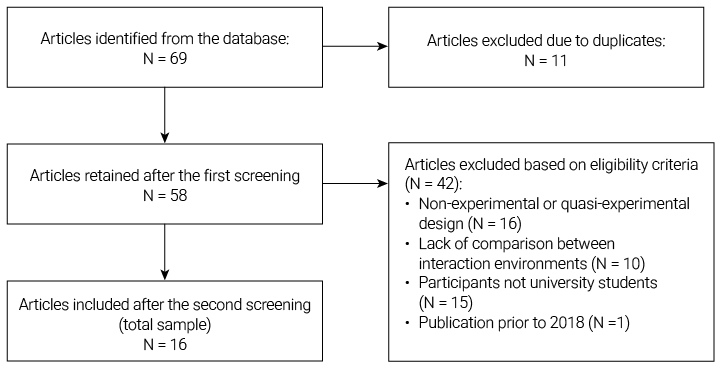
The initial search yielded a total of 69 articles. After removing 11 duplicate papers, 58 articles remained for screening based on the inclusion criteria. Most papers were excluded for one of the following reasons: non-experimental or non-quasi-experimental design (n = 16), inclusion of non-university participants (n = 15), no cross-environment comparisons (n = 10), or publication prior to 2018 (n = 1). After applying all inclusion criteria, the final sample consisted of 16 articles, all published in English. Figure 1 illustrates the flow diagram of the article selection process.
Figure 1
Summary of the Identification, Screening, and Inclusion Process
Although the review was limited to publication in English and Spanish—which may introduce language bias—this choice ensured access to the most relevant research. To reduce potential bias, two reviewers independently screened and extracted the data, resolving any discrepancies through discussion until consensus was reached.
Data Analysis
We conducted an exhaustive reading of the final corpus of articles to construct the results. First, we identified the interaction environments examined in the studies and classified them as mediated and non-mediated. This classification was based on the theoretical framework proposed by Herring (1996), who coined the concept of computer-mediated communication and defined it as communication between humans through computers. Consequently, we classified face-to-face environments as non-mediated. Mediated environments were further categorized into chat, video calls, chat with chatbots, asynchronous and synchronous forums, online collaborative documents, and virtual reality.
Next, we classified the assignments according to whether students performed academic or non-academic tasks. Academic tasks were defined as activities whose content focused on a specific field of study and were oriented toward facilitating learning (Peralta et al., 2023), whereas non-academic tasks were intended for students to interact and get to know each other (e.g., ice-breaker activities).
Subsequently, we identified several aspects of the interactions addressed in the reviewed studies. Each article was assigned to a category according to the most prevalent aspect analyzed: psychosocial, communicative, or linguistic. Psychosocial aspects were related to emotional and social components involved in getting to know and relating to peers, as well as feelings derived from learning, such as motivation and perceived flexibility. Communicative aspects played a pivotal role in understanding the qualities and characteristics of verbal interaction among students. These aspects encompassed the number of exchanges, as well as the quality, depth, and frequency of contributions. Lastly, linguistic aspects delved into the linguistic properties of the exchanges, such as fluency, pronunciation, accentuation, and vocabulary.
RESULTS
Table 1 presents the general characteristics of the studies identified, including the interaction environments compared, the aspect of interaction analyzed, and the type of task used.
Table 1
General Characteristics of the Reviewed Articles
|
Author |
Sample |
Interaction Environment |
Interaction Aspect |
Type of Task |
|---|---|---|---|---|
|
Ajabshir (2019) |
N = 106; Iran |
NM–M (synchronous forum, asynchronous communication) |
Linguistic |
Discussion about school life |
|
Baccon et al. (2019) |
N = 146 women; mean age = 19 y/o; Australia |
NM–M (chat, virtual reality) |
Psychosocial |
NA Casual |
|
Drouin et al. (2022) |
N = 417 (297 |
NM–M (chat, chatbot) |
Psychosocial |
NA Casual |
|
Kessler et al. (2020) |
N = 10 (6 women and 4 men); mean age = 20 y/o; USA |
NM–M (chat) |
Communicative |
Group essay writing |
|
Liao (2018) |
N = 6; mean age = 21,5 y/o; USA |
NM–M (chat) |
Communicative |
Group essay writing |
|
Lin (2019) |
N = 99 (77 women and 22 men) |
NM–M |
Psychosocial |
Role-playing |
|
Namaziandost et al. (2022) |
N = 81; Iran |
M (written chat)–M (voice chat) |
Linguistic |
Problem-solving |
|
Zeinali Nejad et al. (2021) |
N = 45; Iran |
NM–M (synchronous forum, asynchronous communication) |
Linguistic |
Consensus task |
|
Pham (2022) |
N = 26 (6 men and 20 women); |
NM–M (collaborative online document) |
Communicative |
Collaborative writing |
|
Roos et al. (2020) |
N = 108; Netherlands |
NM–M (chat, video chat) |
Communicative |
NA Discussion about politics |
|
Shu & Gu (2018) |
N = 51; China |
NM–M (online forum) |
Communicative |
Discussion about technology |
|
Tang (2019) |
N = 30; USA |
NM–M (online forum) |
Linguistic |
Decision-making |
|
Thi Thai et al. (2019) |
N = 106; mean age =20,48 y/o; Vietnam |
NM–M (online forum) |
Psychosocial |
Discussion about physiology |
|
Vendityaningtya & Styati (2018) |
N = 52; Indonesia |
NM–M (online forum) |
Linguistic |
Writing and discussion |
|
Weiser et al. (2018) |
N = 66; Israel |
NM–M (video call) |
Communicative |
Discussion |
|
Yen et al. (2018) |
N = 85; USA |
NM–M (online forum) |
Psychosocial |
Discussion |
Note. NM = non-mediated; M = mediated; NA = non-academic tasks; A = academic tasks.
Mediated and Non-Mediated Interaction Environments
Regarding the first objective—to recognize the mediated and non-mediated interaction environments examined in the reviewed studies—we found that most articles (81,25 %) compared two interaction environments. Most of these studies compared chat-based media with face-to-face media (Ajabshir, 2019; Kessler et al., 2020; Liao, 2018; Lin, 2019; Zeinali Nejad et al., 2021; Pham, 2022; Shu & Gu, 2018; Tang, 2019; Thi Thai et al., 2019; Vendityaningtyas & Styati, 2018; Yen et al., 2018). Other studies compared face-to-face interaction with video calls (Weiser et al., 2018) and synchronous voice chat with asynchronous voice chat (Namaziandost et al., 2022). In contrast, a smaller proportion of the studies (18,75 %) compared three environments: face-to-face interaction, chat, and video calls (Roos et al., 2020); face-to-face interaction, virtual reality, and chat (Baccon et al., 2019); and face-to-face interaction, chat, and chat with a chatbot (Drouin et al., 2022).
Types of Tasks Performed by Students
Concerning the objective of distinguishing between the types of tasks employed in the reviewed studies—based on whether they were academic or non-academic—a clear majority (81,25 %) of the tasks identified were academic (Ajabshir, 2019; Kessler et al., 2020; Liao, 2018; Lin, 2019; Namaziandost et al., 2022; Zeinali Nejad et al., 2021; Pham, 2022; Shu & Gu, 2018; Tang, 2019; Thi Thai et al., 2019; Vendityaningtyas & Styati, 2018; Yen et al., 2018; Weiser et al., 2018). All of these tasks were designed to be conducive to active student participation and classroom learning. Across all the abovementioned studies, the tasks mainly consisted of group-based oral and written discussions centered on particular topics. For example, Ajabshir (2019) used role-specific hypothetical situation discussions. Lin (2019) and Yen et al. (2018) focused their tasks on discussions about academic questions. Zeinali Nejad et al. (2021) engaged students in tasks involving finding differences in images, reaching an agreement, and conversing about personal topics. Tang (2019) focused on making travel plans, while Namaziandost et al. (2022) addressed topics of personal interest. Thi Thai et al. (2019) discussed issues related to human and animal physiology, whereas Shu and Gu (2018) examined the advantages and disadvantages of new media. Kessler et al. (2020), Liao (2018), and Vendityaningtyas and Styati (2018) included conversations on various topics, followed by individual writing on the content discussed. Finally, Pham (2022) involved students in writing and revising drafts in English, first face-to-face and then online, or vice versa.
In contrast, a smaller proportion of studies (18,75 %) employed non-academic tasks, such as engaging in informal conversations with interaction partners. This category includes the studies conducted by Baccon et al. (2019), Drouin et al. (2022), and Roos et al. (2020). In both Baccon et al. (2019) and Drouin et al. (2022), the task consisted of a 20-minute conversation addressing personal questions. In the study by Roos et al. (2020), participants engaged in a discussion task focused on controversial political statements.
Aspects of Student Interactions Addressed in the Analyses
Regarding the objective of identifying the aspects of student interactions analyzed in the reviewed studies, it is essential to begin with a clarification. Although the aspects discussed below are closely related and have been examined across multiple studies, we identified specific elements that received greater attention in order to facilitate comparative analysis and the formulation of meaningful conclusions. When an article addressed several aspects, it was classified according to the aspect explored in the greatest depth. However, in the following section, the same article may be referenced for its results in more than one of the aspects mentioned.
In this context, the analysis revealed that the set of scientific articles examined in this systematic review focused on interactions from three perspectives: communicative (37,50 %), psychosocial (31,25 %), and linguistic (31,25 %).
Concerning communicative aspects, the studies by Liao (2018) and Kessler et al. (2020) focused on the analysis of quantitative and qualitative characteristics of peer discussions. Quantitatively, they measured the length of the conversations—which is the number of characters uttered per session—and the number of turns of speech per conversation. A turn was defined as each time the word passed from one participant to another. Qualitatively, they analyzed the lexical complexity of the conversations, indicating the variety and depth of the words used, as well as the complexity of the lexical and syntactic structures employed.
Likewise, Pham (2022) evaluated the suggestions and comments students provided on their peers’ work. Shu and Gu (2018) analyzed the depth of student engagement and understanding of course topics, along with students’ willingness to comment on their peers’ work, and to consider the comments received to update their work. Weiser et al. (2018) focused on the frequency of students’ engagement during interactions with their teachers and peers. Finally, Roos et al. (2020) studied social regulation, understood as the process by which individuals express consensus and dissent in their opinions, while attempting to maintain positive interpersonal relationships.
In studies assessing psychosocial aspects, Baccon et al. (2019) examined self-disclosure, conceptualized as the expression of personal aspects to a peer, including sharing life anecdotes, giving opinions on daily life issues, and revealing emotions. Similarly, Drouin et al. (2022) analyzed feelings of solidarity and sympathy emerging during tasks aimed at getting to know a stranger through casual conversation. Along this line, Lin (2019) and Yen et al. (2018) analyzed student satisfaction and motivation within academic contexts. Finally, Thi Thai et al. (2019) and Yen et al. (2018) examined perceived flexibility. According to Thi Thai et al. (2019), this concept refers to students’ ability to decide when, where, and what to study.
As for linguistic aspects, we found a large portion of the reviewed literature focused on second language learning (Ajabshir, 2019; Namaziandost et al., 2022; Zeinali Nejad et al., 2021; Tang, 2019; Vendityaningtyas & Styati, 2018). Ajabshir (2019) focused on acquiring a second language, requesting speech acts and using lexical items. Request speech acts are verbal utterances through which speakers ask for favors, request information, or seek assistance. Namaziandost et al. (2022) analyzed vocabulary, pronunciation, and fluency as components of oral proficiency in second language learning. Similarly, Zeinali Nejad et al. (2021) focused on English pronunciation, analyzing word stress and pronunciation accuracy among language learners. Tang (2019) analyzed the oral production of Chinese modal verbs. Modal verbs, such as can, will, and should, are used to express the speaker’s attitude, ability, possibility, obligation, permission, or probability toward the action of the main verb in a sentence. Finally, Vendityaningtyas and Styati (2018) examined discussion and writing activities. From the discussions, they analyzed students’ comments and suggestions regarding how to start writing tasks, while in the writings, they evaluated grammar, punctuation, and vocabulary use.
Variation of Socio-Cognitive Interaction Aspects by Medium and Type of Task
Finally, regarding the last objective—to analyze how the different aspects of socio-cognitive interactions vary as a function of the interaction medium and the type of task performed—the presentation of the results is first organized by the interaction aspects examined: (a) psychosocial, (b) communicative, and (c) linguistic. Subsequently, these aspects are analyzed in relation to the type of task: (i) Non-academic or (ii) academic. Within each category, distinctions are made based on the interaction medium, i.e., mediated or non-mediated.
a. Psychosocial Aspects
(i) Non-Academic Tasks
Among studies that analyzed non-mediated interactions in non-academic tasks, several emphasize that the presence of nonverbal and contextual cues seems to have an impact on psychosocial aspects of interaction, such as peer liking. In addition, this component seems to be related to a greater capacity for self-revelation.
In the study by Baccon et al. (2019), within non-mediated interactions, students expressed more personal opinions and disclosed more emotions to their peers compared to those who interacted via chat. The authors suggest that, as an environment with higher availability of communicative cues, the face-to-face setting may have fostered greater trust and friendliness among peers, generating an environment conducive to self-disclosure.
These findings are consistent with those reported by Drouin et al. (2022). Their study showed that, in face-to-face environments, peers were rated as more likable. In addition, this environment seems to have been conducive to conversations about personal issues than the other environments examined.
As mentioned above, several studies have highlighted the effect of the absence of nonverbal and contextual cues on the psychosocial aspects of interaction in mediated environments. The survey conducted by Baccon et al. (2019) found that chats—a medium characterized by the almost complete absence of such cues—were associated with the least objective and perceived self-revelations recorded. This pattern was observed not only in the amount of personal information shared during conversations (referred to by the researchers as “objective self-disclosure”) but also in people’s perception of how much they had shared (“perceived self-disclosure”). After the conversations, students also reported feeling that they had shared less personal information than in other settings. In addition, participants reported liking their partner less than those who interacted with the chatbot.
However, some features of specific mediated environments could benefit emotional and relational aspects of interactions. Baccon et al. (2019) showed that virtual reality environments yielded higher self-disclosure scores than chat-based interactions. The authors believe that adding communicative cues in virtual reality environments may create more favorable conditions for generating intimacy among students.
In line with this, Drouin et al. (2022) found that during chatbot interactions, participants felt less concerned about introducing themselves and could disclose personal issues more efficiently. This medium provides a judgment-free space that is not always present in human communication. Participants reported feeling less anxious and less worried about potential negative opinions from their interaction partners.
(ii) Academic Tasks
Regarding the study of psychosocial aspects in non-mediated academic task contexts, Thi Thai et al. (2019) and Yen et al. (2018) found that participants experienced less flexibility in this modality than in mediated settings. They felt they had fewer choices in deciding when and where to study.
However, when examining course satisfaction, Lin (2019) found that students who did not have to deal with internet access problems to synchronize their messages needed less time to complete assignments, usually in a single session.
The study by Thi Thai et al. (2019) further indicated that participants experienced greater perceived flexibility in mediated environments, as they considered that these settings offered more opportunities to define when and where to study. Nevertheless, no significant differences were found across environments concerning variables such as motivation to learn and feelings of self-efficacy.
In relation to academic satisfaction, research such as that conducted by Lin (2019) identified that students who engaged in discussions via chat reported problems in coordinating and synchronizing comments in real time. When faced with delayed responses or even lack of responses, students experienced greater uncertainty, which in turn led to more delays in completing the task.
b. Communicative Aspects
(i) Non-Academic Tasks
Regarding communicative aspects in non-mediated, non-academic task contexts, the study by Roos et al. (2020) highlighted greater fluency in the conversations. According to the authors, the presence of nonverbal cues seems to have played a role, as participants expressed a greater number of “small stimuli” of encouragement or understanding—such as “hmm” or “yes”—while their interaction partners were speaking. This behavior contributed to making the conversation more dynamic and responsive and may help characterize the linguistic factor of this type of interaction.
In mediated, non-academic task contexts, the article by Roos et al. (2020) points out that participants in this type of interaction felt a reduced social connection, i.e., less emotional bonding. They also perceived lower levels of solidarity and understanding. The study suggests that the absence of nonverbal cues has led to more straightforward expressions of disagreement. As a result, chat-based conversations were less ambiguous, as statements were more direct. This pattern could be attributed to participants’ adaptability and their efforts to compensate for the lack of nonverbal and contextual cues.
(ii) Academic Tasks
In academic task contexts, studies have shown that the temporality of the face-to-face interaction seems to cause a greater volume of discourse, reflected in the length of the discussions (Kessler et al., 2020, Liao, 2018, Vendityaningtyas & Styati, 2018). Likewise, faster response times in this medium enabled participants to negotiate ideas more effectively and ask for more clarifications on their peers’ statements (Pham, 2022). This immediacy also favored integrating peers’ responses into one’s own response, thereby enriching subsequent written work.
Moreover, the feedback time inherent in non-mediated interactions appears to generate greater depth in discussions, as observed by Shu and Gu (2018). In this context, students achieved greater understanding of course topics and demonstrated a greater willingness to comment on their peers’ work and to consider the feedback received when updating their own work. In addition, student dialogues tended to be more open and likely to stimulate deeper and more reflective thinking.
In contrast, mediated environments in academic task contexts seem to have impacted the length of synchronous conversations via chat (Kessler et al., 2020; Liao, 2018; Vendityaningtyas & Styati, 2018). These studies reported that participants spoke less and contributed less to the dialogue. However, these findings differ from those of Pham (2022), who examined asynchronous peer feedback using an online document platform. In that study, participants commented more on their peers’ writing, as they perceived that the more leisurely feedback facilitated the development of more informed critiques and allowed additional time for reading and proofreading. In addition, participants mentioned that working within an online document enabled them to look up additional information in parallel, such as dictionaries. They also reported feeling less inhibited when criticizing their peers’ writing, as they were less concerned about their peers’ reactions.
Despite the lower frequency of verbal interventions by participants in this modality (Liao, 2018; Lin, 2019; Kessler et al., 2020; Vendityaningtyas & Styati, 2018), interactions were characterized by a homogeneous interaction pattern. Shu and Gu (2018) observed a similar trend, noting that in online lessons of a blended-learning course, participation in online forums was mainly balanced, with all students able to interact actively and equally. This balance means that no student dominated the conversation, and the initiative to ask questions or make comments came predominantly from the students themselves.
Similar results were reported by Namaziandost et al. (2022), who found that chat-based interactions were characterized by an equitable contribution pattern, allowing all group students to participate. Similarly, Liao (2018) observed that students with a lower language proficiency could participate equally in discussions, as the medium allowed them to express themselves at their own pace. In contrast to these findings, Weiser et al. (2018) revealed that interaction medium had no significant impact on learner participation.
c. Linguistic Aspects
(ii) Academic Tasks
Regarding linguistic aspects of interaction, this type of slower feedback proved beneficial in studies on second language learning by providing learners with more time to review and improve their performance. Zeinali Nejad et al. (2021) found that mediated groups outperformed non-mediated groups. Specifically, synchronous voice chat groups achieved higher scores, suggesting that this modality supported pronunciation development, as producing and receiving audio-based feedback allowed students to focus on their errors and try to improve them in subsequent responses.
Also, the increased intervals in conversation gave students more time to review their pronunciation and perfect their performance. In addition, this more direct handoff may have enhanced information processing and retention through visual access to saved peer comments in chat. Being able to type at one’s own pace may facilitate more effectively information processing, and the limited content produced in chat may also support easier retrieval of information.
Finally, this response time inherent to mediated interactions also appears to have affected conversational fluency, as reported by Vendityaningtyas and Styati (2018). In their study, mediated groups exhibited lower performance in writing tasks, with participants indicating that communication problems—such as occasional slow internet access—negatively affected conversational fluency. Accordingly, linguistic aspects were examined only in academic tasks, since linguistic aspects were not addressed in non-academic activities in the reviewed studies.
DISCUSSION
The present study proposed a systematic review of experimental and quasi-experimental studies—published as journal articles—that examined the influence of different environments on interactions among university students. The final corpus comprised 16 experimental or quasi-experimental articles comparing interactions in mediated and non-mediated environments across academic and non-academic tasks.
Regarding the first specific objective, which aimed to recognize the interaction environments examined in the reviewed articles, face-to-face and chat were the most frequently used. Other environments, such as voice chat, video conferencing, virtual reality, and chat with chatbots, were also included. Concerning the second specific objective, which addressed the distinction between the types of tasks (academic or non-academic), we found a predominance of academic tasks. This result is understandable given that the population under study consisted of university students. With respect to the third specific objective, most of the reviewed articles analyzed the communicative, psychosocial, and linguistic aspects. However, these aspects were often treated as interrelated, with many studies accounting for the complexity of the phenomenon by simultaneously analyzing interactions based on several factors.
Regarding the fourth specific objective, the findings highlight that socio-cognitive interactions among university students vary according to the environment in which they occur. First, we recognized the effect of the absence or presence of nonverbal cues. Their presence in non-mediated environments seems to benefit the psychosocial aspects of interactions, as it has been associated with higher levels of intimacy toward interaction partners.
This, in turn, has been linked to greater self-disclosure (Baccon et al., 2019), sympathy (Drouin et al., 2022), and understanding (Roos et al., 2020). However, we identified that students felt less comfortable in these environments when they had to criticize or emphasize disliked peer comments (Drouin et al., 2022; Roos et al., 2020). In other words, non-mediated settings present a contradiction: while they tend to foster interpersonal closeness, they do not necessarily promote comfort in expressing disagreement. This difficulty has been identified in the literature and warrants attention to ensure that socio-cognitive interactions maintain their knowledge-building potential (Castellaro & Peralta, 2020).
Likewise, we observed that mediated environments incorporating more nonverbal and contextual cues, such as virtual reality, would favor certain psychosocial aspects of interactions. In the study by Baccon et al. (2019), higher levels of self-disclosure were reported in virtual reality compared to chat-based settings. This finding may be explained by how participants interacted in this environment: participants had headphones that allowed them to emulate their head and neck movements and speak in their own voices. This greater degree of control of the device may have generated a closer emulation of non-mediated environments. In addition, since it was a new experience for the participants, it generated excitement and increased motivation to perform the task.
Differences between mediated and non-mediated environments were also observed in the feedback during the communicative exchanges. On the one hand, non-mediated interactions were characterized by faster response times, which may have led to more fluid and dynamic communication. This conversational fluency may favor collaborative learning by allowing faster integration of ideas and greater depth in discussions (Lin, 2019; Shu & Gu, 2018; Pham, 2022; Vendityaningtyas & Styati, 2018). Moreover, this characteristic may have promoted longer and more in-depth group discussions (Kessler et al., 2020; Liao, 2018).
On the other hand, in mediated environments, dialogues were also oriented toward collaboration among participants and the negotiation of meaning, rather than relying exclusively on the teacher (Liao, 2018; Namaziandost et al., 2022; Shu & Gu, 2018). However, communication in these environments tends to be slower and less synchronized than in non-mediated environments. This can lead to greater uncertainty and a lack of interest in learners (Lin, 2019), as well as longer delays (Vendityaningtyas & Styati, 2018).
Additionally, slower feedback may have influenced the length and level of participation in group discussions (Kessler et al., 2020; Liao, 2018), where fewer verbal contributions were observed. Nevertheless, these feedback characteristics may have positively impacted learning (Ajabshir, 2019; Liao, 2018; Namaziandost et al., 2022; Zeinali Nejad et al., 2021). Having more time to review and refine comments, as well as seeing written comments from peers, seems to have positively influenced new language learning.
From a socio-constructivist perspective, feedback is a central mediational tool within the learner’s zone of proximal development, enabling learners to progress from independent to collaborative performance (Vygotsky, 1978). Immediate, dialogic feedback in non-mediated environments may more effectively support co-regulation and the co-construction of knowledge, while delayed or less synchronized feedback in mediated settings may make this process more effortful (Lin, 2019; Vendityaningtyas & Styati, 2018).
Regarding task type, it can be concluded that the use of academic and non-academic tasks is associated with the choice of different aspects of interactions as objects of analysis. Consequently, no definitive conclusions could be drawn regarding how the aspects of interactions vary according to the type of task. The variations observed across the different aspects studied are probably due to the environments in which the interactions occurred.
Overall, both mediated and non-mediated environments offer unique advantages and disadvantages for student interactions. Mediated environments can be beneficial for students who experience greater difficulty in academic performance, as noted in several studies (Cedeño Cedeño et al., 2023; Namaziandost et al., 2022). Likewise, these environments appear to be advantageous for students who face challenges in socialization, as several articles identify that they are freer from personal judgment (Baccon et al., 2019; Drouin et al., 2022). Such environments could be strategically implemented in introductory or ice-breaking activities at the beginning of a course, capitalizing on their potential to create a more open and judgment-free atmosphere. However, a potential disadvantage is delayed feedback, which may generate more uncertainty in student communication (Lin, 2019).
Non-mediated environments offer advantages that are largely associated with conversational fluency. Because students can respond more quickly, they report feeling more comfortable communicating their ideas, which may suggest that such environments facilitate collaboration among students (Vendityaningtyas & Styati, 2018). These settings may be particularly suitable for tasks that require in-depth discussion and spontaneous idea exchange, such as brainstorming sessions, debates, and collaborative decision-making activities. However, they may be less conducive for introverted or less proficient students, as conversations in these environments tend to be less democratic (Liao, 2018; Namaziandost et al., 2022; Shu & Gu, 2018).
In conclusion, the findings of this study not only contribute to the existing literature on the influence of interaction environments among university students but may also be useful for education stakeholders involved in the design and implementation of instructional strategies.
LIMITATIONS
The replicability of this review is limited, as Google Scholar and the MINCyT Electronic Library periodically update their indexing and search settings, which may lead to variations in future results. Additionally, only two databases were searched, which may have limited the scope of the literature reviewed. The review also focused exclusively on studies examining interactions among university students, which may have overlooked interactions in different academic strata that we have yet to explore. Had the search included participants from different age groups or academic settings, new aspects of interaction would have been discovered. These limitations offer opportunities for future research to complement the present findings and to contribute to a better understanding of contemporary social interactions.
REFERENCES
Ajabshir, Z. F. (2019). The effect of synchronous and asynchronous computer-mediated communication (CMC) on EFL learners’ pragmatic competence. Computers in Human Behavior, 92, 169-177. https://doi.org/10.1016/j.chb.2018.11.015
Alzahrani, F. K. J., & Alhalafawy, W. S. (2022). Benefits and challenges of using gamification across distance learning platforms at higher education: A systematic review of research studies published during the COVID-19 pandemic. Journal of Positive School Psychology, 6(10), 1948-1977. https://www.journalppw.com/index.php/jpsp/article/view/13543
Baccon, L. A., Chiarovano, E., & MacDougall, H. G. (2019). Virtual reality for teletherapy: Avatars may combine the benefits of face-to-face communication with the anonymity of online text-based communication. Cyberpsychology, Behavior, and Social Networking, 22(2), 158-165. https://doi.org/10.1089/cyber.2018.0247
Cabrera Larreategui, S. Y., Rojas Yalta, E. M., Montenegro Torres, D., & López Regalado, O. (2021). El aula invertida en el aprendizaje de los estudiantes: Revisión sistemática. Revista Electrónica de Tecnología Educativa, 77, 152-168. https://doi.org/10.21556/edutec.2021.77.1967
Castellaro, M., & Peralta, N. S. (2020). Pensar el conocimiento escolar desde el socioconstructivismo: Interacción, construcción y contexto. Perfiles Educativos, 42(168), 140-156. https://doi.org/10.22201/iisue.24486167e.2020.168.59439
Cedeño Cedeño, R. J., Vásquez Castro, P. C., & Maldonado Palacios, I. A, (2023). Impacto de las tecnologías de la información y la comunicación (TIC) en el rendimiento académico: Una revisión sistemática de la literatura. Ciencia Latina Revista Multidisciplinar, 7(4), 10297-10316. https://doi.org/10.37811/cl_rcm.v7i4.7732
Drouin, M., Sprecher, S., Nicola, R., & Perkins, T. (2022). Is chatting with a sophisticated chatbot as good as chatting online or FTF with a stranger? Computers in Human Behavior, 128 Article 107100. https://doi.org/10.1016/j.chb.2021.107100
García Díaz, E., Padial Suárez, J. J., & Berrocal de Luna, E. (2021). Evaluación de las plataformas digitales más utilizadas durante la actual pandemia (Covid-19). Reidocrea, 10(30), 21-35. https://doi.org/10.30827/Digibug.70942
González Aldana, M. A., Perdomo Osorio, K. V., & Pascuas Rengifo, Y. (2017). Aplicación de las TIC en modelos educativos blended learning: Una revisión sistemática de literatura. Sophia, 13(1), 144-154. https://doi.org/10.18634/sophiaj.13v.1i.364
González Pérez, A., & Sosa Díaz, M. J. (2021). Aspectos pedagógicos, tecnológicos y de interacción social del aprendizaje móvil: Revisión sistemática de la literatura. Educatio Siglo XXI, 39(1), 257-280. https://doi.org/10.6018/educatio.469271
Gutiérrez Mendoza, U. P., & Rodríguez Rodríguez, G. E. (2023). Impacto de los entornos virtuales en el proceso educativo pre y post pandemia. Revista de Climatología, 23, 2455-2464. https://doi.org/10.59427/rcli/2023/v23cs.2455-2464
Herring, S. C. (1996). Introduction. In S. C. Herring (Ed.), Computer-Mediated Communication: Linguistic, social, and cross-cultural perspectives (pp. 1-12). Benjamins.
Jara Conohuillca, R. J. (2021). Pedagogical strategies with technology in the teaching of university academic writing: A systematic review. Revista Digital de Investigación en Docencia Universitaria, 15(1), Article e1209. https://doi.org/10.19083/10.19083/ridu.2021.1209
Kessler, M., Polio, C., Xu, C., & Hao, X. (2020). The effects of oral discussion and text chat on L2 Chinese writing. Foreign Language Annals, 53(4), 666-685. https://doi.org/10.1111/flan.12491
Khaldi, A., Bouzidi, R., & Nader, F. (2023). Gamification of e-learning in higher education: A systematic literature review. Smart Learning Environments, 10, Article 10. https://doi.org/10.1186/s40561-023-00227-z
Leguizamón, R., Rondini, M., Castellaro, M., & Peralta, N. S. (2020). Clasificación y descripción de sistemas categoriales sobre interacción sociocognitiva entre pares. Propósitos y Representaciones 8(2), Article e556. http://dx.doi.org/10.20511/pyr2020.v8n2.556
Liao, J. (2018). The impact of face-to-face oral discussion and online text-chat on L2 Chinese writing. Journal of Second Language Writing, 41, 27-40. https://doi.org/10.1016/j.jslw.2018.06.005
Lin, G.-Y. (2019). Scripts and mastery goal orientation in face-to-face versus computer-mediated collaborative learning: Influence on performance, affective and motivational outcomes, and social ability. Computers & Education, 143, Article 103691. https://doi.org/10.1016/j.compedu.2019.103691
Lundin, M., Bergviken Rensfeldt, A., Hillman, T., Lantz-Andersson, A., & Peterson, L. (2018). Higher education dominance and siloed knowledge: A systematic review of flipped classroom research. International Journal of Educational Technology in Higher Education, 15, Article 20. https://doi.org/10.1186/s41239-018-0101-6
Manzano-León, A., Camacho-Lazarraga, P., Guerrero, M. A., Guerrero-Puerta, L., Aguilar-Parra, J. M., Trigueros, R., & Alias, A. (2021). Between level up and game over: A systematic literature review of gamification in education. Sustainability, 13(4), Article 2247. https://doi.org/10.3390/su13042247
Namaziandost, E., Razmi, M. H., Hernández, R. M., Ocaña-Fernández, Y., & Khabir, M. (2022). Synchronous CMC text chat versus synchronous CMC voice chat: Impacts on EFL learners’ oral proficiency and anxiety. Journal of Research on Technology in Education, 54(4), 599-616. https://doi.org/10.1080/15391523.2021.1906362
Pellas, N., & Mystakidis, S. (2020). A systematic review of research about game-based learning in virtual worlds. Journal of Universal Computer Science, 26(8), 1017-1042. https://doi.org/10.3897/jucs.2020.054
Peralta, N. S., Castellaro, M., Tuzinkievicz, M. A., & Curcio, J. M. (2023). Argumentación en jóvenes universitarios: Revisión de investigaciones realizadas desde el socioconstructivismo. Revista Latinoamericana de Ciencias Sociales, Niñez y Juventud, 21(2), 1-23. https://doi.org/10.11600/rlcsnj.21.2.5783
Pham, H. T. P. (2022). Computer-mediated and face-to-face peer feedback: Student feedback and revision in EFL writing. Computer Assisted Language Learning, 35(9), 2112-2147. https://doi.org/10.1080/09588221.2020.1868530
Prieto Andreu, J. M. (2020). Una revisión sistemática sobre gamificación, motivación y aprendizaje en universitarios. Teoría de la Educación, 32(1), 73-99. https://doi.org/10.14201/teri.20625
Roos, C. A., Postmes, T., & Koudenburg, N. (2020). The microdynamics of social regulation: Comparing the navigation of disagreements in text-based online and face-to-face discussions. Group Processes & Intergroup Relations, 23(6), 902-917. https://doi.org/10.1177/1368430220935989
Shu, H., & Gu, X. (2018). Determining the differences between online and face-to-face student–group interactions in a blended learning course. The Internet and Higher Education, 39, 13-21. https://doi.org/10.1016/j.iheduc.2018.05.003
Subhash, S., & Cudney, E. A. (2018). Gamified learning in higher education: A systematic review of the literature. Computers in Human Behavior, 87, 192-206. https://doi.org/10.1016/j.chb.2018.05.028
Tang, X. (2019). The effects of task modality on L2 Chinese learners’ pragmatic development: Computer-mediated written chat vs. face-to-face oral chat. System, 80. 48-59. https://doi.org/10.1016/j.system.2018.10.011
Thi Thai, N. T., De Wever, B., & Valcke, M. (2019). Face-to-face, blended, flipped, or online learning environment? Impact on learning performance and student cognitions. Journal of Computer Assisted Learning, 36(3), 397-411. https://doi.org/10.1111/jcal.12423
Vendityaningtyas, V., & Styati, E. W. (2018). Effect of computer-mediated communication and face-to-face communication on the students’ writing. Lingua Cultura, 12(3), 233-239. https://doi.org/10.21512/lc.v12i3.4235
Verba, M. (1994). The beginnings of collaboration in peer interaction. Human Development, 37(3), 125-139. https://doi.org/10.1159/000278249
Vlachopoulos, D., & Makri, A. (2017). The effect of games and simulations on higher education: A systematic literature review. International Journal of Educational Technology in Higher Education, 14, Article 22. https://doi.org/10.1186/s41239-017-0062-1
Vygotsky, L. S. (1978). Mind in society: The development of higher psychological processes. Harvard University Press.
Weiser, O., Blau, I., & Eshet-Alkalai, Y. (2018). How do medium naturalness, teaching-learning interactions and students’ personality traits affect participation in synchronous E-learning? The Internet and Higher Education, 37, 40-51. https://doi.org/10.1016/j.iheduc.2018.01.001
Yen, S. C., Lo, Y., Lee, A., & Enriquez, J. (2018). Learning online, offline, and in-between: Comparing student academic outcomes and course satisfaction in face-to-face, online, and blended teaching modalities. Education and Information Technologies, 23, 2141–2153. https://doi.org/10.1007/s10639-018-9707-5
Zabala-Vargas, S. A., Ardila-Segovia, D. A., García-Mora, L. H., & Benito-Crosetti, B. L. (2020). Aprendizaje Basado en Juegos (GBL) aplicado a la enseñanza de la matemática en educación superior. Una revisión sistemática de la literatura. Formación Universitaria, 13(1), 13-26. http://doi.org/10.4067/S0718-50062020000100013
Zeinali Nejad, M., Golshan, M., & Naeimi, A. (2021). The effect of synchronous and asynchronous computer-mediated communication (CMC) on learners’ pronunciation achievement. Cogent Psychology, 8(1), Article 1872908. https://doi.org/10.1080/23311908.2021.1872908