From International Recognition to Local
Ownership: The Meaning of the UNESCO
Creative City Label and Its Implications
for Public Space in João Pessoa
Del reconocimiento internacional a la apropiación local:
el significado de la designación de João Pessoa como Ciudad
Creativa de la UNESCO y sus implicaciones para el espacio público
KELLY da Silva Santos
Universidade Federal de Paraíba, Brazil
https://orcid.org/0009-0003-3513-464X
Eliane Superti
Universidade Federal de Paraíba, Brazil
https://orcid.org/0000-0003-2620-1401
Received: December 30th, 2026
Approved: August 10th, 2026
doi: https://doi.org/10.26439/limaq2026.n018.8515
In the emerging knowledge economy, creativity has become a core element of urban planning, diffusing from cities in the Global North to those in the Global South. This article analyzes the meanings associated with the UNESCO Creative City designation awarded to João Pessoa, Brazil. By employing a qualitative approach that combines documentary analysis with semi-structured interviews with managers, the study investigates how this global label is appropriated and reinterpreted at the local level, as well as its implications for urban public space. The findings indicate that, while the designation carries strong symbolic value and generates tangible practical effects, its translation into urban public space remains fragmented. The territorialization of the label and its social appropriation are limited and conditional on local administrative priorities and institutional capacity. This article contributes to the creative city debate by underscoring the heterogeneity of creative city implementations and by advancing understanding of the UNESCO Creative Cities Network in the context of the Global South.
Brazil, creative cities, global south, João Pessoa, urban creativity, UCCN
En la emergente economía del conocimiento, la creatividad se ha convertido en un componente central de la planificación urbana y se ha difundido desde las ciudades del Norte Global hacia las del Sur Global. Este artículo analiza los significados asociados a la designación de João Pessoa, Brasil, como Ciudad Creativa de la Unesco. Mediante un enfoque cualitativo que combina análisis documental y entrevistas semiestructuradas con gestores, se examina cómo esta etiqueta global es apropiada y reinterpretada localmente, así como sus implicancias para el espacio público urbano. Los resultados muestran que, aunque la designación posee un importante valor simbólico y genera efectos prácticos concretos, su expresión en el espacio público sigue siendo fragmentaria. La territorialización de la etiqueta y su apropiación social son limitadas y dependen de las prioridades administrativas locales y de la capacidad institucional. El artículo contribuye al debate sobre las ciudades creativas al destacar la heterogeneidad de sus implementaciones y ampliar la comprensión de la Red de Ciudades Creativas de la Unesco en el contexto del Sur Global.
Brasil, ciudades creativas, sur global, João Pessoa, creatividad urbana, UCCN
This is an open access article, published under the terms of the Creative Commons Attribution 4.0 International (CC BY 4.0) license.
Introduction
In recent decades, culture and creativity have assumed a central role in urban development and revitalization strategies. They play a crucial part in the creative city strategies that first emerged in core Anglo-Saxon nations and quickly gained traction, establishing themselves as standard references for urban planning worldwide.
Despite criticisms regarding its essence, the speed of its dissemination, and its socio-spatial impacts (Catungal et al., 2009; Jakob, 2010; Peck, 2005; Scott, 2006; Whiting et al., 2022), this agenda has been embraced by various governments. Many operate under the belief that these strategies can serve as urban economic resources (Grodach, 2017) and provide a competitive advantage (Florida, 2002) in a context of global competition for investment, labor, and tourism. Furthermore, the transformation of urban areas into centers of economic and social innovation enhances economic visibility while enriching the local cultural fabric (Liu, 2024; Ratiu, 2013).
A pivotal milestone in the international diffusion of this agenda was the establishment of the Creative Cities Network (UCCN) by UNESCO in 2004. By 2025, the Network included 408 cities from over 100 countries, categorized into eight fields: Architecture1, Crafts and Folk Art, Design, Film, Gastronomy, Literature, Media Arts, and Music.
Brazil is one of the most represented countries in the Network. João Pessoa—the case study for this research—is located in the Northeast of Brazil, a region characterized by socio-economic inequality and a lower HDI than the South or Southeast. Despite the region’s vast cultural heritage and the Global South’s concentration in the Crafts and Folk Art category, João Pessoa is the only city in Brazil recognized in this field, and has been fostering both national and international intercity cooperation.
This article addresses the following research question: What symbolic and practical meanings do the managers involved in the designation process assign to the Creative City label, and how do their perceptions contribute to an understanding of the potential implications of this global brand for urban public space?
Rather than merely discussing the designation’s nature—a recurring theme in existing literature (Gathen et al., 2021; Guimarães et al., 2020; Rinaldi et al., 2025; Rosi, 2014)—this study aims to understand the construction of creative cities in the Global South. By analyzing the case of João Pessoa through the perspectives of local managers involved in the process, we explore the territorialization of the policy and its urban repercussions. Furthermore, by examining how the Creative City concept is appropriated and reinterpreted by local administration, this article aims to assist policymakers and actors in the creative sector in better understanding its implications, limitations, and potential.
This qualitative research employs data triangulation, which combines semi-structured interviews with documentary analysis. Beyond this introduction and the conclusion, the article consists of four sections: an overview of creative cities; the methodology; the case study and its urban implications; and a discussion of the results, with an emphasis on the meanings attributed to the designation.
Creative Cities as a Contemporary Urban Strategy
From a creativity perspective, the city is viewed as a dynamic, holistic space—an environment where creative aptitude thrives, stimulates the economy, and expands the repertoire of solutions for urban challenges (Kong, 2014; Landry, 2008). A creative city, therefore, fosters a “culture of creativity” among its citizens, influencing how they participate and engage in urban life (Landry, 2011; Yencken, 1988). As Pratt (2010, p. 14) describes: “Today the notion of a creative city stands as much for a political and social mantra as an urban, social or economic policy, or even an aspiration.”
A growing number of cities of varying sizes have adopted this urban strategy, but what actually defines a creative city? As an “umbrella concept,” it encompasses multifaceted and occasionally contradictory visions, where different approaches emphasize specific dimensions: attracting a creative class through urban amenities; fostering environments that stimulate creative agents; strengthening creative industries and economy; and valorizing art and cultural infrastructure (Baycan et al., 2016; Florida, 2002; Grodach, 2017; Hartley, 2005; Landry, 2011; Reis, 2011; Yencken, 1988).
Despite this polysemy, the creative city proposal represents a concrete urban paradigm shift. The traditional industrial and functional city model, which centers on productivity and efficiency, is abandoned in favor of a vision where culture, creativity, and collaboration serve as the structural elements of urban development (Landry, 2008, 2011).
The agenda is rooted in urban and cultural policies of the Global North, emerging in response to socioeconomic transformations caused by the crisis of Fordism, neoliberal expansion, globalization, and advances in information and communication technologies. Its origins can be traced to two main Anglo-Saxon trajectories. First, those of the United Kingdom and Australia in the 1990s, which established culture as an economic asset through the creative industries (Department for Culture, Media and Sport, 2001; Ward, 1995); and second, in the United States, through Richard Florida’s (2002) theory, which prioritized attracting the creative class by offering desirable urban amenities. The success of these initiatives institutionalized creativity within urban planning, fostering a creative urban milieu as a development strategy (Mohammad, 2017) and consolidating what is known as the “creative turn” in urban policy (Pratt, 2009).
The rapid diffusion of this strategy has drawn significant criticism, particularly regarding its proximity with urban entrepreneurship and neoliberal governance agendas (Bóren & Young, 2012; Peck, 2005). Critics have highlighted its tendency toward conceptual simplification, characterizing it as a “normative policy script” that often overlooks local contexts (Jakob, 2010; Kong, 2014). They argue that this approach may obscure or exacerbate inequalities, including cultural homogenization, commodification of culture, precarious creative labor, and gentrification (Evans, 2003; Luckman et al., 2009; Peck, 2005, 2020; Whiting et al., 2022). Furthermore, questions have been raised about its conceptual viability, as creativity is inherently unpredictable and cannot be guaranteed or planned solely through favorable conditions or the concentration of creative individuals (Kong, 2014; Scott, 2006).
Despite trenchant critiques, some scholars argue against discarding the concept entirely (Da Silva & Muzzio, 2023; Luckman et al., 2009; Whiting et al., 2022). Local actors interpret and appropriate the creative city framework through distinct motivations and cultural contexts, leading to outcomes varying across cases. This article adopts this perspective, conceiving creative cities as a circulating agenda shaped by processes of diffusion, translation, and local reinterpretation.
The expansion of this agenda has taken on characteristics of a “syndrome,” as described by Scott (2006). According to Peck (2020), the “creative cities syndrome” reflects a process of discursive and political contagion that has driven its rapid diffusion as a fast policy. This movement is sustained by a transnational epistemic community2—comprising politicians, academics,3 consultants, cultural managers, and international organizations— whose influence across social and cultural spheres has circulated and legitimized the idea. This situation reflects the consolidation of a politico-discursive rationality that underpins a new international urban agenda (Couto, 2023), granting creative cities a “license to travel.”
Central to this dissemination is the role of UNESCO and other UN agencies, which have promoted the creative economy as a “viable development option” since the early 2000s (Vlassis & De Beukelaer, 2019). Luerdi (2023) highlights UNESCO’s entrepreneurial role in establishing the UCCN as a platform that influences participants while upholding a commitment to sustainable urban development and international cooperation. This involvement prompts an investigation into the UCCN’s role in diffusing and legitimizing creative cities.
The UNESCO Creative Cities Network (UCCN)
According to the UCCN, creative cities recognize creativity as a driver of sustainable development, integrate creativity and cultural industries into urban planning, and seek international cooperation (UNESCO, n.d., 2004, 2007, 2024b). Consequently, UNESCO has shaped and institutionalized the concept by aligning it with its agenda to promote culture-led development — a framework that increasingly emphasizes sustainable development over time.
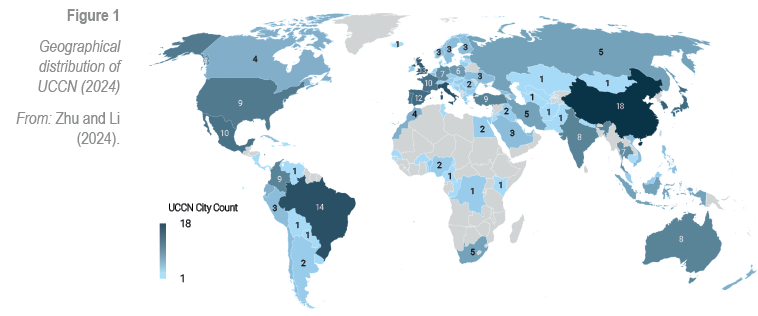
UNESCO4 defines the UCCN as an “expanding international network of cities with growing potential to innovate in culture-led urban development.” This expansion has been remarkable, increasing from nine cities in nine countries in 2006 to 350 cities in over 100 countries by 2024, as illustrated in Figure 1.
Perceptions regarding this accelerated growth remain ambiguous. O’Connor et al. (2020) argue that ratifying the 2005 UNESCO Convention or joining the UCCN functions as an admission into a “new global club of moderns,” creating pressure for policymakers to adopt the label to avoid appearing obsolete (Peck, 2005). Guimarães et al. (2020) report that both long-standing and new members harbor concerns about this rapid expansion, noting divergent expectations within the Network.
Recently, geographical balance and integration of the Global South have moved to the forefront of discussions within the Network.5 The high number of Brazilian and Chinese cities (Figure 1) reflects the geopolitical realignment in the diffusion of the UCCN toward the Global South, as discussed by Zhu and Li (2024)6.
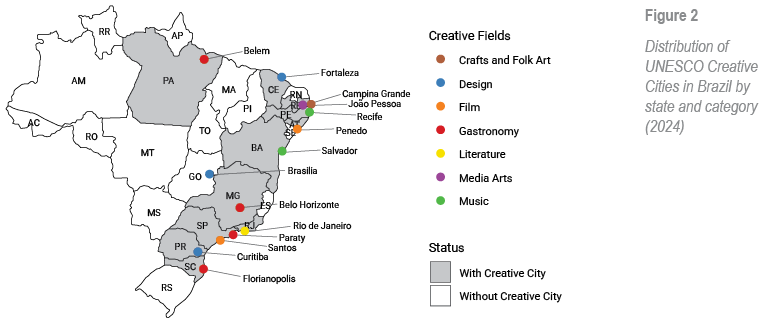
Brazilian cities began joining the Network in 2014, with Curitiba (PR) in Design and Florianópolis (SC) in Gastronomy as the initial designees. By 2024, the country boasted 14 cities (see Figure 2). The Brazilian Network of Creative Cities (RBCC) was established via Ordinance No. 55/2022 by the Ministry of Tourism (2022), which demonstrates a formal recognition of creative city strategies as guidelines for municipal policies aimed at fostering the creative economy and promoting sustainable urban and tourism development.
Global South Cities in the UCCN
Academic production regarding creative cities in the Global South remains limited, as the literature focuses primarily on experiences from the Global North. There is also a research gap concerning creative cities in Latin America and the field of Crafts and Folk Art field. This void contrasts with the recent reorientation and expansion of the UCCN toward the Global South, which hosts a high concentration of cities in the categories of Crafts and Folk Art, Music, and Gastronomy. Approximately 65% of cities recognized in the Crafts and Folk Art category are located in the Global South. Similarly, in South America, traditional categories dominate: Gastronomy (18%), Music (18%), and Crafts and Folk Art (15%).7.
Guimarães et al. (2020) argue that the concentration of Global South cities in the Crafts and Folk Art category stems from their deep historical roots and presence across diverse cultural contexts. This contrasts with categories that require technical infrastructure, technology, and funding—factors that limit Global South participation due to structural capacity gaps. As a result, traditional categories demonstrate higher levels of participation from the Global South.
Although UCCN affiliation is framed as a universal creativity-based development model, its implementation faces increasing local contestation. This contestation arises from the friction between ideal models and empirical reality, along with distinct historical trajectories, cultural-political conditions, and context-specific resources and actors (Gueniffey & Sakamura, 2025; Mbaye & Pratt, 2020; Peck & Theodore, 2015; Rinaldi et al., 2025; Skoglund & Laven, 2019).
Thus, the recognition of João Pessoa aligns with broader integration patterns of the Global South within the UCCN. Rather than being passively reproduced, this case illustrates how cities actively territorialize the Creative City label in Global South realities. As Duxbury et al. (2012) argue, various creative city models should be explored beyond the overly instrumental logics typically accompanying them.
Methodology
In this study, we conducted semi-structured interviews8 with four key managers associated with public administration and the Brazilian Micro and Small Business Support Service (Sebrae-PB), identified as M1, M2, M3, and M4. A purposive sampling approach guided our selection, based on prior mapping of institutional actors with direct involvement and specialized knowledge of the application and implementation processes. This selection was further validated during the interviews, as participants consistently identified this specific group as the primary source of institutional, technical, and decision-making information.
Data triangulation was performed through documentary research, which included analyzing the preliminary application document9 submitted to the UCCN, monitoring reports (Parts I and II), and reviewing the 2017 UCCN application guidelines (UNESCO, 2017, 2021, 2024a). These sources were supplemented by a non-systematic literature review, which, given the multidisciplinary nature of the topic, facilitated a critical synthesis and a theoretical-empirical dialogue. We conducted a content analysis of documents and interviews, following Bardin’s (2015) three-stage framework. The third column of Table 1 outlines the procedures conducted in each stage.
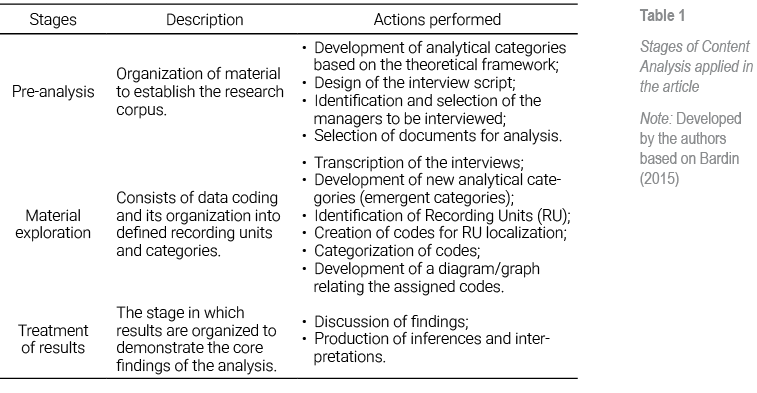
The documentary content analysis was guided by the official UCCN application criteria (UNESCO, 2017) to understand João Pessoa’s acceptance into the network. The analysis of the interviews employed a dual approach: a deductive strategy to identify perceptions already established in the literature, and an inductive lens to capture context-specific nuances. Prominent themes were coded and categorized into two dimensions—practical and symbolic—using ATLAS.ti software. The following discussion presents the results obtained.
Case study: João Pessoa as a Creative City of Crafts
and Folk Art
As the capital of the State of Paraíba, João Pessoa serves as the state’s economic hub, particularly within the creative sector (Casa Firjan, 2025). Its designation as a Creative City occurred in 2017, eight years after the municipal administration received the initial proposal from Sebrae-PB and the state government. This trajectory suggests that the candidacy emerged from a prolonged process of political articulation. The continuity of the visual identity (Figure 3), designed in 2009 by Fábio Morais, preserves the legacy of this process.
The candidacy category selection strategy was primarily driven by a symbolic dimension. This dimension reflects the need to valorize and reinforce the creative potential of local craftsmanship. It also aimed to legitimize existing initiatives, such as the Paraíba Crafts Fair, Museum, and Market. Thus, this choice can be seen as a part of a strategy for building cultural identity, one that did not privilege any specific craft typology but instead established the city as the principal gateway for Paraiban artisanal production.
This strategy is further reflected in the Sereais da Penha Association’s endorsement of the candidacy10. Given the longstanding organizational challenges within Paraíba’s artisanal sector (Santos et al., 2025), the collective not only lent social legitimacy by representing the creative sector but also demonstrated tangible outcomes from municipal craft valorization policies. In 2025, the association further consolidated its status as a local cultural reference by gaining recognition as an Intangible Cultural Heritage of the city (Prefeitura Municipal de João Pessoa, 2025).
Among the initiatives associated with the Creative City designation, the institutionalization of the creative economy within the municipal governance structure stands out. In 2021, the Creative Economy Coordination was established under the Secretariat for Economic Development and Labor (SEDEST)11, reinforcing the municipality’s efforts to provide greater institutional stability for this agenda. Three flagship projects were developed to strengthen the artisanal productive chain: the Innovation and Design Laboratory for Competitive Crafts (Labin), established in 2018 as the program’s management hub, which encompasses training activities, fairs, and seminars (Figure 4); the Barn Creative Space, dedicated to commercialization and exhibition of crafts (Figure 5); and the proposed Social Factory, focused on artisanal production, which — despite having being planned eight years prior — has yet to be implemented, revealing persistent gaps between policy design and execution. In parallel, SEDEST’s “I Can” initiative extends support to the creative economy beyond crafts by providing microcredit to various creative sectors (UNESCO, 2021, 2024a).
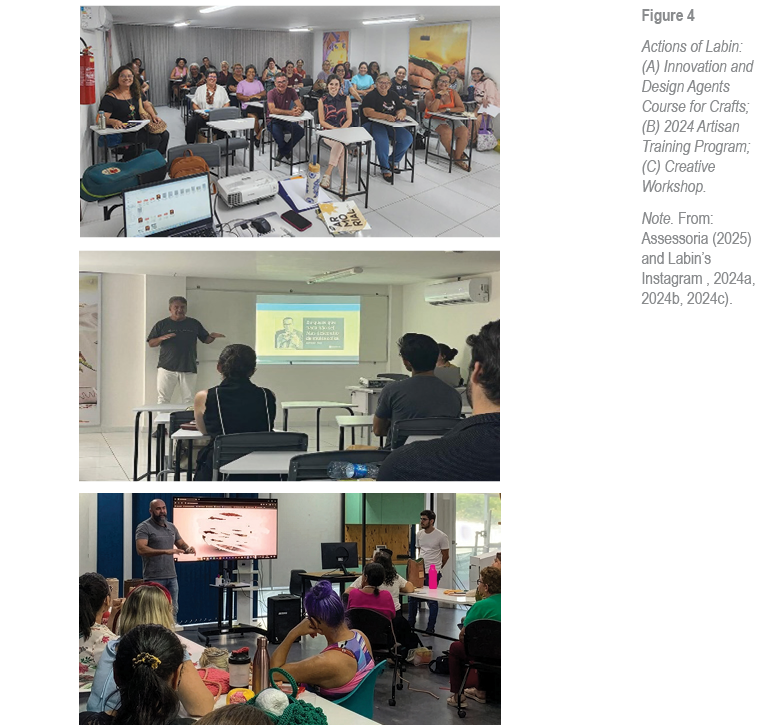
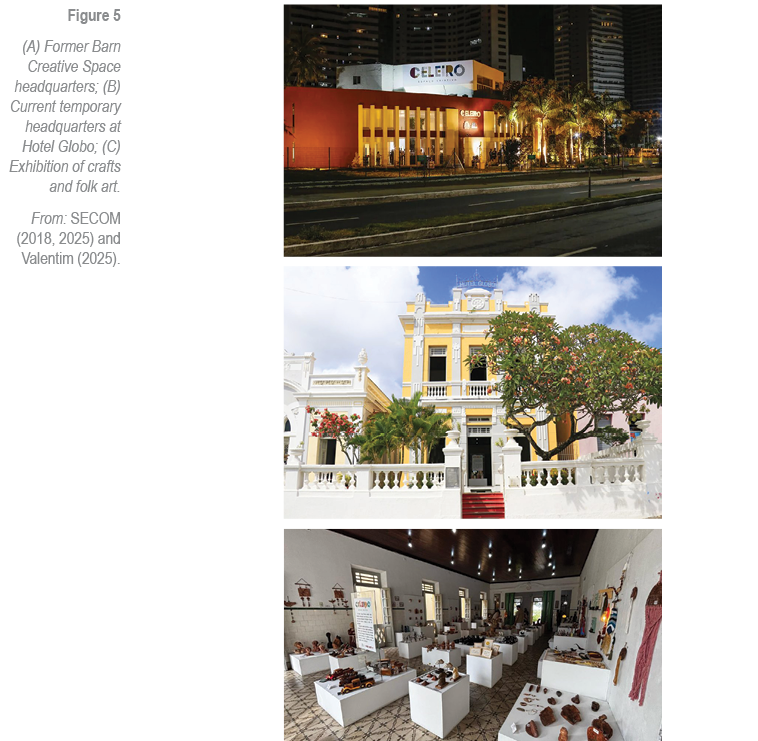
Beyond fostering the local economy, these initiatives sought to anchor crafts in urban space as part of local identity while simultaneously integrating them into a broader project of historic center revitalization. Labin’s headquarters, for instance, occupies a restored historic building in the city’s historic center, while the proposed creative district12 signals the mobilization of the creative economy as a strategy for urban regeneration. As Gadelha (2025) notes, despite its potential, the proposed creative district may pose gentrification risks commonly associated with similar initiatives.
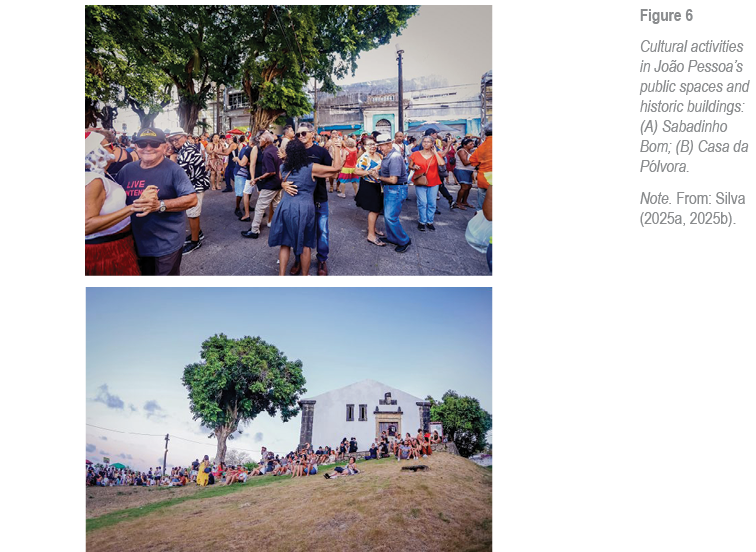
The revitalization of João Pessoa’s historic center reflects an attempt to reconcile objectives related to heritage preservation, the recognition of local identity, and the development of a creative ecosystem. The initiatives of the permanent cultural program illustrated in Figure 6 demonstrate efforts to encourage the circulation of people through public spaces and, consequently, foster their engagement with the city. Such cultural uses of public spaces create conditions for citizens not only to occupy urban space but also to actively produce it by articulating its physical, social, and symbolic dimensions, in line with Lefebvre’s (2008, 2009) conception of the right to the city.
Costa and Nascimento (2024) argue that the relationship between city and creativity oscillates between a logic of rupture — associated with a market-oriented approach to the production of urban space — and a logic of promise — grounded in the potential exercise of the right to the city. In João Pessoa, these dimensions overlap. While creativity is mobilized as an instrument of economic development, initiatives also seek to foster a “culture of creativity” (Landry, 2011; Pratt, 2010; Yencken, 1988).
In summary, the study identifies three main implications for urban public space in João Pessoa: the activation and reconfiguration of spatial uses through the mobilization of cultural and creative resources as mechanisms for urban revitalization; efforts to construct a local cultural identity; and constraints affecting the continuity of these processes, including the partial implementation of governance mechanisms and planned projects. Consistent with Tay (2005), the creative city concept serves both as a model for urban renewal and as a framework for understanding the socioeconomic and cultural transformations of cities. It further emphasizes how urban spaces can be reimagined, revitalized, and reoriented within an increasingly competitive global context.
Results
The Figure 7 synthesizes the research findings and illustrates the two dimensions that guide the managers’ perceptions of the label.
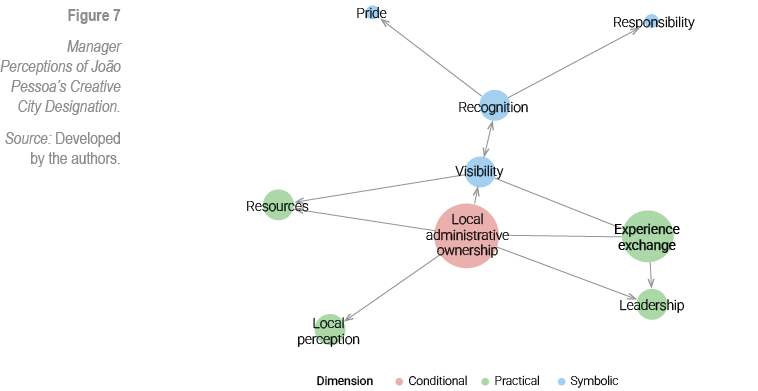
The symbolic dimension—encompassing recognition, visibility, responsibility, and pride—relates to identity and institutional reputation, highlighting challenges related to territorialization and local ownership. The practical dimension—including resources, perception, experience exchange, and leadership—concerns policy implementation and its urban materialization. Crucially, local administrative ownership acts as a conditional variable that permeates both dimensions.
Symbolic Dimension
The city’s participation in the Network is primarily understood as an instrument for enhancing visibility, recognition, and the legitimation of existing initiatives. Although the UCCN does not provide direct funding, the symbolic recognition associated with the designation enhances the city’s credibility among potential partners by serving as a “showcase” (M2). M3’s observation that “UNESCO is a major symbol” underscores the significance of this recognition, which strengthens the city’s reputation, creates opportunities for cooperation and resource mobilization, and generates expectations regarding the city’s performance.
In this context, linking the city’s image to an internationally recognized brand influences how the city constructs and projects its identity, creating opportunities for city branding However, the literature warns that an overly promotional approach can reduce the designation to an “empty label,” undermining the Network’s core goals of cooperation and development (Chan et al., 2019; Gathen et al., 2021; Pearson & Pearson, 2017; Rinaldi et al., 2025; Rosi, 2014). The case of João Pessoa reveals a mismatch between its potential and its effective use of this symbolic resource.
Although a recurrent association exists between the Crafts and Folk Art segment and tourism (Arcos-Pumarola et al., 2023; Gonçalves & Costa, 2022; UNESCO, 2024b), this connection has struggled to materialize as a structured tourism promotion strategy. One interviewee referenced tourism policies, and M2’s emphasized the need to “further promote [the designation] to reach the end-citizen and the tourists [...] there is a lack of this identity appeal” suggesting that the designation’s potential for identity building remains underutilized. This finding is significant because one of the original expectations of the candidacy was that aggregating symbolic value to the city’s cultural and environmental heritage would reinforce its vocation for high-quality tourism. Unlike other cities that, to varying degrees, construct their image around the title, the designation has not established itself as an identity or branding element for the population of João Pessoa. The managers themselves acknowledge that the feelings of pride and responsibility they share do not resonate with broader society.
Despite the existence of initiatives that materialize the designation, as discussed in the previous section, the outcomes of efforts to construct an urban identity associated with the title remain largely confined to institutional and intra-network spheres. M3 stated: “If you go out on the street and ask a hundred people passing by [about the label], I am certain that all hundred will say they didn’t know about it.” This points to a disconnect between the actions associated with the designation and the local population’s symbolic appropriation of it.
The communication and awareness-raising strategies outlined in the candidacy were characterized by short-term and ad hoc approaches. Compounding this issue, the lack of a visual landmark hinders public recognition of the city’s participation in the Network, as noted by the interviewees. Since the designation remains imperceptible in the urban landscape, the transformations associated with the program are often perceived in isolation, which limits their connection to a broader Creative City project. Furthermore, the city has not yet launched a website for the João Pessoa Creative City program, despite the proposal made (UNESCO, 2021). This absence, which has also been observed in other Brazilian cities, indicates a gap in consolidating the creative city label, thereby limiting social engagement (Correa, 2018).
Some of these challenges stem from challenges in both urban governance and institutional coordination. According to interviews and documents, Sebrae-PB’s role as the primary driver of political articulation and municipal awareness-raising during the candidacy process, combined with the difficulties of embedding the program’s actions as a cross-cutting urban development policy, reveals that the municipal administration has a limited degree of ownership. M2’s perception that “management itself is often unaware of the designation’s existence,” illustrates this institutional fragility.
The non-establishment of the Permanent Management Group, as foreseen in the candidacy, has deepened this fragility, according to interviewees. Its absence has contributed to the erosion of institutional memory, slowed implementation in the face of political and administrative turnover, and reduced the city’s capacity to advocate for resources in internal budget disputes. This, in turn, constrains the territorialization and expansion of initiatives related to the designations within urban space.
However, these challenges are not unique to João Pessoa. Interviewees indicated that other Brazilian Creative Cities face similar difficulties. At the international level, M3 noted that such difficulties persist, particularly among cities in the Crafts and Folk Art field, which often encounter greater resource limitations than cities in other creative fields.
Challenges related to symbolic appropriation, territorialization, and the partial implementation of administrative mechanisms are evident in various member cities, particularly in lower-income areas (UNESCO, 2024b). The majority of these cities are located in the Global South, where structural constraints exacerbate existing obstacles. The unique characteristics of the creative sector add to this complexity. M4 observes that, while the designation arises from the quality of local craftsmanship, residents often do not recognize or value it. This observation aligns with the findings of Santos et al. (2025), who identify the devaluation of local crafts as a core challenge faced by Paraiban artisans, hindering the development of a sense of belonging and collective identity.
Practical Dimension
Regarding the practical implications of UCCN membership, all interviewees identified the Network’s primary value as its function as a laboratory of ideas that enables exchanges with other member cities — a core benefit widely recognized throughout the Network (UNESCO, 2024b). M4 articulates this dimension, noting that “the greatest gain [from Network participation] is precisely this opportunity to learn about and share innovative, successful projects from around the world that can be applied to our own city.”
Internally, Network membership also fosters cooperation among local actors and strengthens internal coordination, as documented in the literature (Guimarães et al., 2020; Rinaldi et al., 2025; Tran, 2025). In João Pessoa, despite the challenges involved, interviewees noted that securing the label fostered closer collaboration among the municipal government, Sebrae-PB, academia, the state government, and the creative sector. This collaboration strengthened initiatives capable of influencing the city’s physical, social, economic, and identity dimensions, infusing the designation with “a very important meaning, not only symbolically, but from a public management perspective” (M1).
Another tension identified in the literature concerns the repositioning of cultural and creative actors as entrepreneurs (Stevenson, 2020), a dynamic also reflected in the interviews. Given the instabilities surrounding artisanal production, particularly in peripheral urban contexts (Albuquerque dos Anjos et al., 2021; Marquesan & Figueiredo, 2014), a dilemma emerges between maintaining an artisanal identity and adopting an entrepreneurial rationality. This is often encouraged by public managers but is permeated by conflicts and resistance among artisans (Sá et al., 2025). This tension is evident, for instance, in design intervention initiatives within the creative process. According to M2, although such initiatives proved productive and were carried out with sensitivity to local specificities, the interviewee also recognized the dilemmas associated with transforming crafts into a primary source of livelihood. M2 emphasized that this requires a gradual process: “the foundation must be very solid” and “steps cannot be skipped,” particularly because artisanal production operates at a rhythm fundamentally distinct from industrial logic.
Interviewees perceive the Creative City designation as an inducer of gradual change, with its potential remaining contingent on local ownership. M3’s observation that the designation adds value but does not, in itself, determine investment in the creative economy reveals a layered relationship between symbolic recognition and its translation into concrete action. Aligned with Skoglund and Laven (2019), deeper connections with the local level are necessary for the tangible effects of UCCN membership to materialize. Interviewees emphasized that, although the city has progressed within its existing capacities, it operates below its full potential. Therefore, obtaining the designation does not entail its automatic embeddedness. Although initiatives that manifest in urban space have been identified, their effects remain contingent upon the capacity for coordination among local actors, the continuity of actions, and the social appropriation of these transformations.
Paradox: The Tension Between External Recognition and Incipient Local Perception
The practical perception of the designation elucidates the role that João Pessoa plays in leading articulation efforts, fostering cultural exchange, and assisting other cities with their applications. According to M3, cooperation among Brazilian creative cities stems directly from João Pessoa. During its candidacy, the city proposed the Planning Secretaries Forum to unite Brazilian creative cities. Later renamed Ecriativa, this initiative expanded to include various municipal departments (Culture, Tourism, Development), ultimately driving the formation of the RBCC. On an international level, the city orchestrated the Ibero-American Council for Crafts and Folk Art (IberoArte) to strengthen cooperation among Latin American cities. Although previously latent, the consolidation of IberoArte occurred only under the leadership of João Pessoa (M2; M3).
Thus, a paradox is observed: while the city achieves significant external recognition, the local appropriation of the title remains incipient. As Dos Santos (2020) note, knowledge of the designation tends to be concentrated among actors already engaged in the creative sector, while the diffusion of this knowledge to broader society remains a major challenge. Understanding these weaknesses in territorialization provides the necessary foundation for interpreting the mismatches in how managers perceive and utilize the title.
Conclusion
Creative city strategies shape how urban spaces are designed, governed, and experienced. Following Pratt’s (2011) understanding of the creative city as socially, culturally, and economically situated, João Pessoa serves as a lens through which to examine how UNESCO’s Creative City designation is appropriated, operationalized, reinterpreted, adapted, and, at times, fragmented as different actors, political disputes, and interests emerge. In this regard, the study advances the understanding that the adoption of the creative city discourse varies across cities and may shift within a single locality over time.
While the literature often emphasizes the instrumentalization of creative cities as a place-marketing strategy, João Pessoa reveals an indirect branding effect that is primarily confined to institutional and intra-network spheres. Emphasizing branding as the primary rationale for adopting the creative city discourse tends to obscure the social, political, and territorial formations in which that discourse is embedded. In the case examined, the designation acquires meanings that, from the perspective of the interviewed managers, transcend its promotional function. It has also been utilized as a mechanism for cooperation, mobilizing resources, and strengthening of internal coordination. In this context, culture and creativity are pursued not only as resources for economic opportunities but also as instruments for recognizing local urban identity. These elements are capable of influencing how the city produces, uses, and assigns meaning to its spaces, although the outcomes of this process remain contested.
Although several initiatives have materialized the designation in spatial, social, and economic terms, a disconnect remains between these actions and their recognition by the broader population as part of a Creative City project. Interviewees attribute this gap to the limits of local appropriation, which emerged as a conditioning factor in the territorialization of the policy within public spaces. The specificities of the creative sector should also be considered. Nevertheless, even if the symbolic dimension of this commitment has not been fully realized, the initiatives implemented represent tangible, albeit imperfect, achievements.
These findings indicate that international recognition operates neither as a starting point nor as an endpoint, but rather as a form of mediation. In other words, the designation functions as a political instrument with its potential contingent upon political and institutional commitment at the local level. Rather than viewing the local context as an obstacle, the friction between global and local scales should be understood as productive — opening space for repoliticization, reflection, innovation, and contestation (De Beukelaer, 2021). As Pratt (2011) proposes, the designation should be seen less as an award and more as a learning process capable of stimulating new ways of thinking about and implementing creativity-oriented policies while considering the specificities of each context.
For future research, it would be important to examine the extent to which the designation has been effectively incorporated into João Pessoa’s urban planning agenda, especially considering the proposed creative district. Since the designation has not yet been communicated to the broader population, understanding how a shared urban identity is constructed — or eroded — also warrants further inquiry. Finally, the main limitation of this study was the inability to access the official application document,13 which highlighted a broader challenge in preserving institutional memory. This restricted access to endorsement letters and limited the understanding of civil society’s participation in the proposal’s development. Moreover, the analysis presented here was limited to the perspectives of managers associated with the municipal administration and Sebrae-PB; future research should incorporate the views of creative actors and civil society to address this gap.
References
Alves, P. M. B. (2018). Strategies for sustainable development of the UNESCO creative cities: Conclusions from the XI UCCN Annual Meeting (2017). In F. García & M. G. Y. M. Redmon (Eds.), VI Creative Cities International Conference Proceedings (pp. 61–75). Scientific Association Icono14. http://hdl.handle.net/10400.14/30808
Assessoria. (2025). [Photograph]. Prefeitura de João Pessoa. https://www.joaopessoa.pb.gov.br/noticias/prefeitura-apresenta-projetos-finais-do-curso-dos-agentes-de-inovacao-e-design-para-o-artesanato/
Albuquerque dos Anjos, R., Marcel de Arruda Torres, P., & Barros da Mota Silveira, N. (2021). Artesanato paraibano: um estudo sobre identidade e território em associações de artesãs da Paraíba. DAT Journal, 6(1), 198–212. https://doi.org/10.29147/dat.v6i1.335
Arcos-Pumarola, J., Georgescu Paquin, A., & Hernández Sitges z, M. (2023). The use of intangible heritage and creative industries as a tourism asset in the UNESCO Creative Cities Network. Heliyon, 9, 1–11. Article e13106. https://doi.org/10.1016/j.heliyon.2023.e13106
Bardin, L. (2015). Análise de conteúdo. Edições 70.
Barroso, E. (2017, November 2). João Pessoa Cidade Criativa da UNESCO no artesanato e na arte popular. Eduardo Barroso – Blog. https://eduardobarroso.blogspot.com/2017/11/joao-pessoa-cidade-criativa-da-unesco.html
Baycan, T., Fusco Girard, L., & Nijkamp, P. (2016) Creative and sustainable cities: A new perspective. In L. Fusco Girard, T. Baycan & P. Nijkamp (Eds.). Creative and sustainable cities: A new perspective (2nd ed., pp. 1-12). Routledge.
Borén, T., & Young, C. (2013). Getting creative with the ‘creative city’? Towards new perspectives on creativity in urban policy. International Journal of Urban and Regional Research, 37(5), 1799–1815. https://doi.org/10.1111/j.1468-2427.2012.01132.x
Casa Firjan. (2025, June 18). Mapeamento da indústria criativa 2025. https://casafirjan.
com.br/mapeamento-da-industria-criativa/mapeamento-da-industria-
criativa-2025
Catungal, J. P., Leslie, D., & Hii, Y. (2009). Geographies of displacement in the creative city: The case of Liberty Village, Toronto. Urban Studies, 46(5-6), 1095–1114. https://doi.org/10.1177/0042098009103856
Chan, A., Alexandri, M. B., & Tresna, P. W. (2019). Place brand experience of Bandung City as UNESCO’s Creative City Network in city economy development. Review of Integrative Business and Economics Research, 8(Suppl. 4), 225–238. https://buscompress.com/uploads/3/4/9/8/34980536/riber_8-s4_16_h18-142_225-238.pdf
Correa, C. (2018). Presença online das cidades criativas brasileiras: análise dos websites oficiais. Diálogo com a Economia Criativa, 3(9), 63–75. https://doi.org/10.22398/2525-2828.3963-75
Costa, A. V. F., & Nascimento, J. C. do. (2024). Cidade criativa à brasileira: potencial para o desenvolvimento sustentável. Diálogo com a Economia Criativa, 9(27), 70–86. https://doi.org/10.22398/2525-2828.092770-86
Couto, B. G. do. (2023). Cidades criativas e a agenda internacional das políticas turístico-culturais de renovação urbana. Cadernos Metrópole, 25(57), 397–418. https://doi.org/10.1590/2236-9996.2023-5702
Da Silva, A. P., & Muzzio, H. (2023). Uma cidade criativa para potencializar o desenvolvimento local sustentável. Revista Eletrônica de Administração, 29(1). https://doi.org/10.1590/1413-2311.378.122393
De Beukelaer, C. (2021). Friction in the creative city. Open Cultural Studies, 5(1), 40–53. https://doi.org/10.1515/culture-2021-0001
Department for Culture, Media and Sport. (2001). Creative industries: Mapping document 2001. https://www.gov.uk/government/publications/creative-industries-mapping-documents-2001
Dos Santos, N. de A. e S. F. (2021). Crossroads between city diplomacy and city branding towards the future: Case study on the film cities at UNESCO Creative Cities Network. Place Branding and Public Diplomacy, 17, 105–125. https://doi.org/10.1057/s41254-020-00174-3
Duxbury, N., Fortuna, C., Bandeirinha, J. A., & Peixoto, P. (2012). Em torno da cidade criativa. Revista Crítica de Ciências Sociais, 99, 5–8. https://doi.org/10.4000/rccs.5089
Evans, G. (2003). Hard-branding the cultural city – from Prado to Prada. International Journal of Urban and Regional Research, 27, 417–440. https://doi.org/10.1111/1468-2427.00455
Florida, R. (2002). The rise of the creative class: And how it’s transforming work, leisure, community and everyday life. Basic Books.
Gadelha, R. W. S. (2025). O distrito criativo na regeneração do Centro Histórico de João Pessoa: Estudo de casos, análise de potencialidades e limitações [Master’s thesis, Federal University of Pernambuco]. Attena. Repositório Digital da UFPE. https://repositorio.ufpe.br/handle/123456789/68530
Gathen, C., Skoglund, W., & Laven, D. (2021). The UNESCO creative cities network: A case study of city branding. In C. Bevilacqua, F. Calabrò & L. Della Spina (Eds.), New metropolitan perspectives: NMP 2020, Smart Innovation Systems and Technologies, 178 (pp. 727–737). Springer. http
Gibson, C., & Klocker, N. (2004). Academic publishing as “creative” industry, and recent discourses of “creative economies”: Some critical reflections. Area, 36(4), 423–434. http://www.jstor.org/stable/20004416
Gonçalves, F. J. B., & Costa, C. M. M. (2022). Barcelos, UNESCO creative city: A perspective paper of the craftspeople. Journal on Tourism & Sustainability, 6(1), 6-14. https://doi.org/10.5281/zenodo.7504126
Grodach, C. (2017). Urban cultural policy and creative city making. Cities, 68, 82–91. https://doi.org/10.1016/j.cities.2017.05.015
Gueniffey, B., & Sakamura, K. (2025). Operationalization of the creative city concept in Japan: A comparative review with a special focus on Kanazawa and environmental sustainability. Sustainability, 17(13), Article 6127. https://doi.org/10.3390/su17136127
Guimarães, A. D., Ribeiro, S. B., & Machado, A. F. (2020). Repercussion of the label in a comparative analysis of indicators: The case of two UNESCO Creative Cities. Creative Industries Journal, 14(2), 152–168.https://doi.org/10.1080/17510694.2020.1796461
Hartley, J. (2005). Creative industries. In J. Hartley (Ed.), Creative industries (pp. 1–40). Blackwell Publishing.
Jakob, D. (2010). Constructing the creative neighborhood: Hopes and limitations of creative city policies in Berlin. City, Culture and Society, 1(4), 193–198. https://doi.org/10.1016/j.ccs.2011.01.005
Kong, L. (2014). From cultural industries to creative industries and back? Towards clarifying theory and rethinking policy. Inter-Asia Cultural Studies, 15(4), 593–607. https://doi.org/10.1080/14649373.2014.977555
Labin [@labinpb]. (2024a, 27 de noviembre). Encerramento do nosso último curso do Programa de Capacitação para Artesão de 2024! Curso: Identidade Cultural para Novos Produtos [Photograph]. Instagram. https://www.instagram.com/p/DC4HV0tJRI5/?utm_source=ig_web_copy_link
Labin [@labinpb]. (2024b). Intercâmbio cultural da Renda Renascença do Cariri da Paraíba Brasil com o Bordado de Castelo Branco Portugal [Photograph]. Instagram. https://www.instagram.com/p/DBwekhYps2P/?utm_source=ig_web_copy_link
Labin [@labinpb]. (2024c, April 12). Nesta semana, está acontecendo mais uma OFICINA CRIATIVA com o prestigiado designer Sérgio Matos @sergiojmatos. Junto às artesãs crocheteiras será desenvolvida uma coleção de novos produtos inovadores que serão apresentados em junho, no próximo Salão do Artesanato Paraibano, em Campina Grande. [Photograph]. Instagram. https://www.instagram.com/p/C5qiJswuo7M/?utm_source=ig_web_copy_link
Landry, C. (2008). The creative city: A toolkit for urban innovators (2nd ed.). Routledge.
Landry, C. (2011). Prefácio. In A. C. F. Reis & P. Kageyama (Eds.), Cidades criativas – Perspectivas. Garimpo de Soluções & Creative Cities Productions.
Lefebvre, H. (2009). O direito à cidade. Centauro Editora.
Lefebvre, H. (2008). Espaço e política. Editora UFMG.
Liu, Y. (2024). Creativity and urban development: The Chinese perspective within UNESCO Creative Cities Network [Master’s thesis, University of Trás-os-Montes e Alto Douro]. Repositorio UTAD. https://repositorio.utad.pt/entities/publication/20d792c8-c5fc-4117-92ad-be682970be66/full
Luckman, S., Gibson, C., & Lea, T. (2009). Mosquitoes in the mix: How transferable is creative city thinking? Singapore Journal of Tropical Geography, 30(1), 70–85. https://doi.org/10.1111/j.1467-9493.2008.00348.x
Luerdi. (2023). Enhancing sustainable development at local level: A study of UNESCO’s initiative through Creative Cities Network. Jurnal El-Riyasah, 14(2), 118–133. https://doi.org/10.24014/jel.v14i2.29463
Marquesan, F. F. S., & Figueiredo, M. D. de. (2014). De artesão a empreendedor: A ressignificação do trabalho artesanal como estratégia para a reprodução de relações desiguais de poder. Revista de Administração Mackenzie, 15(6), 76–97. https://doi.org/10.1590/1678-69712014/administracao.v15n6p76-97
Mbaye, J., & Pratt, A. C. (2020). Cities, creativities and urban creative economies: Re-descriptions and make+shifts from Sub-Saharan Africa. International Journal of Urban and Regional Research, 44(5), 781–792. https://doi.org/10.1111/1468-2427.12887
Ministry of Tourism. (2022). Portaria n.º 55, de 12 de dezembro de 2022 [Ordinance No. 55, of December 12, 2022] provides for the establishment of the Brazilian Network of Creative Cities. https://www.gov.br/turismo/pt-br/centrais-de-conteudo-/publicacoes/atos-normativos-2/2022/portaria-mtur-no-55-de-12-de-dezembro-de-2022
Mohammad, S. M. A. (2017). Creative city indicators: A framework [Master’s thesis, Cairo University]. Ain Shams Scholar. https://research.asu.edu.eg/bitstream/12345678/9970/1/V1496.pdf
O’Connor, J., Gu, X., & Lim, M. K. (2020). Creative cities, creative classes and the global modern. City, Culture and Society, 21, Article 100344. https://doi.org/10.1016/j.ccs.2020.100344
Pearson, D., & Pearson, T. (2017). Branding food culture: UNESCO creative cities of gastronomy. Journal of Food Products Marketing, 23(3), 342–355. https://doi.org/10.1080/10454446.2014.1000441
Peck, J. (2005). Struggling with the creative class. International Journal of Urban and Regional Research, 29, 740–770. https://doi.org/10.1111/j.1468-2427.2005.00620.x
Peck, J., & Theodore, N. (2015). Fast policy: Experimental statecraft at the thresholds of neoliberalism. University of Minnesota Press.
Peck, J. (2020). Chapter 3: Culture club: Creative cities, fast policy and the new symbolic order. In A. de Dios & L. Kong (Eds.), Handbook on the geographies of creativity (pp. 37–53). Edward Elgar. https://doi.org/10.4337/9781785361647.00010
Pratt, A. C. (2009). Policy transfer and the field of the cultural and creative industries: What can be learned from Europe? In L. Kong & J. O’Connor (Eds.), Creative economies, creative cities: Asian–European perspectives (pp. 9–23). Springer. https://doi.org/10.1007/978-1-4020-9949-6_2
Pratt, A. C. (2010). Creative cities: Tensions within and between social, cultural and economic development: A critical reading of the UK experience. City, Culture and Society, 1(1), 13–20. https://doi.org/10.1016/j.ccs.2010.04.001
Pratt, A. C. (2011). The cultural contradictions of the creative city. City, Culture and Society, 2(3), 123–130. https://doi.org/10.1016/j.ccs.2011.08.002
Prefeitura Municipal de João Pessoa. (2025, July 11). Diário Oficial do Município de João Pessoa. joaopessoa.pb.gov.br/wp-content/uploads/2025/07/2025_Diario_811_11-07.pdf
Ratiu, D. E. (2013). Creative cities and/or sustainable cities: Discourses and practices. City, Culture and Society, 4(3), 125-135. http:// dx.doi.org/10.1016/j.ccs.2013.04.002
Reis, A. C. F. (2011). Introduction. In A. C. F. Reis & P. Kageyama (Eds.), Cidades criativas: Perspectivas (pp. 30–37). Garimpo de Soluções & Creative Cities Productions.
Rinaldi, C., Giovarnadi, M., Lucarelli, A., Skoglund, W., & Lindqvist, A. S. (2025). Unpacking a global spatial brand: Brand management practices in the UNESCO City of Gastronomy Network. Journal of Place Management and Development, 18(1), 1–19. https://doi.org/10.1108/JPMD-07-2023-0072
Rosi, M. (2014). Branding or sharing? The dialectics of labeling and cooperation in the UNESCO Creative Cities Network. City, Culture and Society, 5(2), 107–110. https://doi.org/10.1016/j.ccs.2014.05.002
Sá, M., Barbosa, M. A. C., & Nazário, M. V. (2025). Dilemas, tensões e tendências nas condições artesãs no Nordeste. In M. Sá (Ed.), Do Alto do Moura ao Nordeste: Condições artesãs e seus espaços (pp. 203–227). Fi.
Santos, K., Sá, M., & Nazário, M. V. (2025). A condição artesã paraibana no seu 37º Salão. In M. Sá (Ed.), Do Alto do Moura ao Nordeste: Condições artesãs e seus espaços (pp. 115–148). Fi.
Scott, A. J. (2006). Creative cities: Conceptual issues and policy questions. Journal of Urban Affairs, 28(1), 1–17. https://doi.org/10.1111/j.0735-2166.2006.00256.x
SECOM. (2018). Celeiro Espaço Criativo abre exposição apenas com mulheres artesãs. Jornal da Paraíba. https://jornaldaparaiba.com.br/cultura/celeiro-espaco-criativo-recebe-exposicao-realizada-por-mulheres-artesas
SECOM. (2025). Exibition of crafts and folk art. Prefeitura Municipal de João Pessoa. https://www.joaopessoa.pb.gov.br/noticias/celeiro-espaco-criativo-e-opcao-de-lazer-arte-e-cultura-neste-feriado-de-carnaval/
Silva, D. (2025a, December 12). [Photograph of Sabadinho bom]. Prefeitura Municipal de João Pessoa. https://www.joaopessoa.pb.gov.br/noticias/sabadinho-bom-vai-ter-choro-samba-frevo-e-forro-com-banda-glauco-andreza/
Silva, D. (2025b, December 21). [Photograph of Casa da Pólvora]. Prefeitura Municipal de João Pessoa. https://www.joaopessoa.pb.gov.br/noticias/publico-lota-casa-da-polvora-em-evento-com-banda-macumbia-e-dj-claudinha-summer/
Skoglund, W., & Laven, D. (2019). Utilizing culture and creativity for sustainable development: Reflections on the city of Östersund’s membership in the UNESCO Creative Cities Network. In F. Calabrò, L. Della Spina & C. Bevilacqua (Eds.), New metropolitan perspectives (Vol. 101, pp. 398–405). https://doi.org/10.1007/978-3-319-92102-0_42
Stevenson, D. (2020). Planning creative cities: Reflections on a trend. Journal of Cultural Management and Cultural Policy, 6(1), 23–34. https://doi.org/10.14361/zkmm-2020-0102
Tay, J. (2005). Creative cities. In J. Hartley (Ed.), Creative industries (pp. 220–232). Blackwell Publishing.
Tran, T. (2025). On and beyond the creative city: Performative narratives, policy translation, and frontiers of “splashing” acts. City, Culture and Society, 42, 100654. https://doi.org/10.1016/j.ccs.2025.100654
UNESCO. (n.d.). UNESCO creative cites network (UCCN) mission statement. https://www.unesco.org/sites/default/files/medias/fichiers/2023/03/UCCN%20Mission%20Statement_rev2023.pdf?hub=80094.
UNESCO. (2004). Networks of creative cities within the Global Alliance for Cultural Diversity. https://unesdoc.unesco.org/ark:/48223/pf0000136203.locale=en
UNESCO. (2007). Creative Cities Network: Program and meeting document. https://unesdoc.unesco.org/ark:/48223/pf0000156026
UNESCO. (2017). UNESCO creative cities network: Call for applications 2017. https://cvuc-uccc.com/national/images/pdf/2017_UCCN_Call_Designation_Procedure.pdf
UNESCO. (2021). João Pessoa membership monitoring report 2017–2021. https://www.unesco.org/sites/default/files/medias/fichiers/2025/01/JoaoPessoa_Monitoring_Report_2021.pdf?hub=80094
UNESCO. (2024a). UNESCO creative cities network – Reporting exercise 2024: João Pessoa. https://www.unesco.org/sites/default/files/medias/fichiers/2025/04/Jo%C3%A3o%20Pessoa_Monitoring_Report_2024.pdf?hub=80094
UNESCO. (2024b). UNESCO creative cities network (UCCN): Evaluation. https://unevaluation.org/sites/default/files/member_publications/388996eng.pdf
Valentim, Q. (2025). Current temporary headquarters at Hotel Globo [Photograph]. Prefeitura Municipal de João Pessoa. https://www.joaopessoa.pb.gov.br/noticias/outras/celeiro-criativo/celeiro-espaco-criativo-tem-diversos-artigos-como-opcao-para-presentear-nesse-fim-de-ano/
Vlassis, A., & De Beukelaer, C. (2019). The creative economy as a versatile policy script: Exploring the role of competing intergovernmental organizations.Media, Culture & Society, 41(4), 502–519. https://doi.org/10.1177/0163443718810913
Ward, M. (1995). Creating a cultural nation. Communications Update, (107), 12–14. https://search.informit.org/doi/10.3316/agispt.19951613
Whiting, S., Barnett, T., & O’Connor, J. (2022). ‘Creative city’ R.I.P.? M/C Journal, 25(3). https://doi.org/10.5204/mcj.2901
Yencken, D. (1988). The creative city. Meanjin, 47(4), 597–608. https://search.informit.org/doi/10.3316/informit.582212487737872
Zhu, B., & Li, X. (2024). Global policy diffusion as a socially constructed process: Insights from UNESCO Creative Cities Network’s shift towards the Global South. International Political Science Review, 46(3), 454-473.https://doi.org/10.1177/01925121241281942
1 The category of Architecture was introduced to the network in 2025.
2 O’Connor et al. (2020, p. 3) describe these actors as “cultural intermediaries.”
3 Gibson and Klocker (2004) note that Landry’s and Florida’s travels outside the Anglo-American core—promoting work and advising governments—exhibit a “rock star” style, demonstrating how Global North knowledge becomes normative and is disseminated through academic circuits and intellectual “celebrities.”
4 For further information, please refer to https://core.unesco.org/en/project/3210551032
5 This theme was incorporated into the new strategic framework that was presented at the XI Annual Conference of the UNESCO Creative Cities Network, which took place in Enghien-les-Bains, France, in 2017 (Alves, 2018).
6 Zhu and Li (2024) observe that the alignment with the 2030 Agenda, the temporary withdrawal of the United States from UNESCO, and the rise of China as a primary funder of the organization have contributed to the expansion of the Network, particularly in the Global South.
7 Data was obtained from the official UNESCO Creative Cities Network website, with data collected in October 2025. It is available at:
8 The interviews primarily took place in person, with only one session conducted online; each had an average duration of 55 minutes. All interviews were recorded and subsequently transcribed for analysis.
9 The municipal government misplaced the final version of the document.
10 Established in 2014 through a partnership between the municipal government—via the João Pessoa Artesã program—the Federal Institute of Paraíba, and Sebrae-PB, this collective consists of female shellfish gatherers from the Penha community. For further information, please refer to: https://paraibafeminina.com.br/2019/08/05/sereias-da-penha-o-trabalho-e-a-forca-de-mulheres-que-levaram-o-artesanato-de-joao-pessa-para-o-mundo/
11 For additional information, please refer to https://sapl.joaopessoa.pb.leg.br/media/sapl/public/normajuridica/2021/18618/lei_14.175-2021.pdf
12 For further information, see the official municipal legislation available at: https://sapl.joaopessoa.pb.leg.br/norma/22449
13 Access to the final application document, including endorsement letters from civil society organizations and institutional actors, could have provided additional insights into the range of actors involved and the forms of support mobilized during the candidacy process, thereby enabling a better understanding of civil society’s participation in the process. However, the absence of this material does not compromise the core findings of the study, which rely on the perspectives of managers directly engaged in the process.