Forming the Public Realm Through
Spatial and Non-Spatial Measures:
Public Space and Community
Organization in the Peter Nanyemba
Informal Settlement, Windhoek
Configuración del ámbito público mediante
medidas espaciales y no espaciales: espacio público
y organización comunitaria en el asentamiento
informal Peter Nanyemba, Windhoek
Elsa Yepez Westreicher
University of Stuttgart, Germany
https://orcid.org/0009-0004-8305-916X
Ute Vees
University of Stuttgart, Germany
https://orcid.org/0000-0002-5918-3679
Astrid Ley
University of Stuttgart, Germany
https://orcid.org/0000-0002-7297-8214
Mohamed Salheen
Ain Shams University, Egypt
https://orcid.org/0000-0003-1885-4373
Gaby Hansen
Namibia University of Science and Technology
https://orcid.org/0000-0003-3766-7004
Received: December 27, 2025
Accepted: May 19, 2026
doi: https://doi.org/10.26439/limaq2026.n018.8505
In informal settlements, public space and community organization are continuously reshaped through everyday practices. Peter Nanyemba, in Windhoek, Namibia, faces recurrent flash floods that prompt spatial and non-spatial responses. This article examines how these measures contribute to forming the public realm, understood as the interaction between public space and community organization. Based on semi-structured interviews with residents and experts, mapping, and a community feedback workshop, the study analyzes processes at household, neighborhood, and administrative-block scales. Findings show that spatial and non-spatial measures operate as an interlinked system: they can foster spatial adaptation, collective learning, and community organization, but also generate fragmentation, inequalities, coordination problems, and maladaptive outcomes. The study shows how recurring environmental risks and everyday responses continuously reshape the public realm through physical and organizational processes.
adaptive responses, informal settlements, community organization, public space
En los asentamientos informales, el espacio público y la organización comunitaria se reconfiguran continuamente mediante prácticas cotidianas. Peter Nanyemba, en Windhoek, Namibia, enfrenta recurrentes inundaciones repentinas que generan respuestas espaciales y no espaciales. Este artículo analiza cómo estas medidas contribuyen a configurar el ámbito público, entendido este como la interacción entre espacio público y organización comunitaria. A partir de entrevistas semiestructuradas con residentes y expertos, mapeo y un taller comunitario de retroalimentación, el estudio examina estos procesos en las escalas del hogar, el vecindario y el bloque administrativo. Los resultados muestran que las medidas espaciales y no espaciales operan como un sistema interrelacionado: pueden favorecer la adaptación espacial, el aprendizaje colectivo y la organización comunitaria, pero también producir fragmentación, desigualdades, problemas de coordinación y respuestas desadaptativas.
respuestas adaptativas, asentamientos informales, organización comunitaria, espacio público
This is an open access article, published under the terms of the Creative Commons Attribution 4.0 International (CC BY 4.0) license.
INTRODUCTION
Informal settlements are spaces of continuous adaptation, evolving through occupation, incremental construction, and gradual consolidation. This process is often described as the reverse of formally planned urbanization, in which buildings and networks emerge from bottom-up rather than through top-down planning (Kamalipour & Iranmanesh, 2021). As Kamalipour (2023) indicates, such environments function as “laboratories to study incrementalism” (p. 2), with public space taking provisional forms that are constantly reshaped through appropriation. Given that informality is the defining feature of urbanization in the Global South (Kamalipour & Dovey, 2020) accommodating over a billion people (Dovey et al., 2020), it therefore warrants further study, particularly regarding how informal production may be harnessed to support locally adapted upgrading processes (Kamalipour, 2023).
The Peter Nanyemba informal settlement is an example in which bottom-up approaches to everyday challenges and seasonal climate hazards are the main mechanisms through which the settlement is organized and sustained. Under climatic conditions characterized by seasonal droughts and flooding, residents have developed structural and non-structural responses to recurrent flash floods. While structural responses result in spatial measures, non-structural responses correspond to non-spatial measures, namely the community’s social organization. This study explores how spatial and non-spatial measures affect the production of the public realm, understood here as public space and community organization. Public space undergoes spatial experimentation, transforming aspects of accessibility, spatial hierarchy, and connectivity. Community organization involves negotiations, agreements, and processes that shape how spaces are used, governed, and given meaning. Yet, under certain conditions, these practices may also generate unintended or adverse impacts.
These spatial and non-spatial practices correspond to the key phases of community resilience: resisting, recovering, adapting, and transforming (Amoako, 2018). While these dynamics are particularly visible in response to flash flood risks, they also demonstrate the settlement’s broader transformative character. The public realm thus emerges not only as a site of risk management but also as one that is continuously produced, negotiated, and reshaped. Existing research recognizes the importance of public space (Ley, 2019), community resilience (Satterthwaite et al., 2020), and (self-)governance in informal settlements (Kamalipour, 2023). This study contributes to the literature by showing how spatial and non-spatial responses to recurring flash floods co-produce the public realm in informal settlements—an underexplored intersection. It advances understanding by framing the public realm as a dynamic interplay between spatial transformation and community organization in contexts of climate vulnerability.
PROBLEM UNDERSTANDING AND DEFINITION
Exploring Public Space from an African Perspective
The character of public spaces is significantly defined by their societies. Rather than being a fixed entity, the public realm is socially produced through everyday practices and lived realities shaped by social, economic, and political relations (Lefebvre, 1991). Likewise, the way the public realm is shaped and the understanding of what the term public constitutes differ across contexts. In settings such as informal settlements, public space is often co-produced through appropriation, negotiation, and collective practices, reflecting its fluid and adaptive nature (Hou, 2010). Over the last decades, research on public space and community organization in the African context has grown, particularly in relation to informal urbanism and everyday spatial production (Cobbinah, 2023; Kamalipour & Peimani, 2025).
Lived realities, particularly in the African context, are often too complex to fit into predefined conceptual “boxes” (Kirabo & Olweny, 2022). Therefore, notions of public realm and public space require frameworks grounded in local contexts rather than—as is often the case—being derived from Global North conceptual models (Bravo & Guaralda, 2016; Watson, 2014). Furthermore, modernist city visions and urban zoning commonly exclude the poor (Watson, 2009). There is, therefore, a need for an in-depth understanding of how the public realm is understood, produced, and organized in different contexts.
The recently established Centre on African Public Spaces (CAPS) highlights that public space in the African context is shaped by locally specific practices and forms (Bravo et al., 2022). Research needs to go beyond Global North concepts of public space being transposed to the realities of the Global South (Roji, 2022).
Public Space in Informal Settlements: Role and Production
Informal settlements are spaces of adaptation and appropriation where people work with limited resources to meet diverse needs, expectations, and desires (Kamalipour, 2023). Public space in the African context has been examined from various perspectives, including how informal practices generate functional urban areas that enhance the identity and liveliness of cities, influence social, economic, and cultural dynamics, and emphasize the role of micro-scale interventions in broader urban development (Cobbinah, 2023). Similarly, Kamalipour and Peimani (2025) reflect on the interconnectedness between informal and formal structures and how these interactions shape the production and organization of public space.
Public space is thus a dynamic concept within informal settlements, where socio-spatial forces are in constant interaction. For instance, Ewing (2021) describes such spaces as “fractional urban space,” “never quite complete and … involved in the making of micro-parts of the whole, crossing scales, spatial dimensions and their presence amplified over time” (Ewing, 2021, p. 397).
Charalambous and Knierbein (2023) describe public space as “a pivotal focal point—a potential catalyst for a more equitable and just urban transformation” (p. 2), particularly in vulnerable communities. A study on the Kasokoso neighborhood in Uganda highlights the social organization that open spaces offer. Here, activities and actors define whether a space is public, semi-public, or private by establishing physical boundaries or through temporal permeability (Kirabo & Olweny, 2022).
Furthermore, open space also supports daily functions, especially for residents in low-income areas. Since plot sizes are usually limited, it is common for people to extend household needs into public space (Arnold, 2022). This dynamic shows the adaptive potential of such places: “By accommodating various activities, there is opportunity for the space to be used at different times and for different occasions” (Arnold, 2022, p. 182). It is also common in African cities that this appropriation to take place in the form of commercial activities. Examples include traffic hawkers in the streets of Lagos (Eshalomi, 2022), informal street vendors occupying pedestrian lanes in commercial zones in Windhoek (Ashraf, 2024), and street traders in Abuja who navigate spatial and temporal constraints to claim public space (Adama, 2020). Overall, research shows that the adaptive use of public space and incremental placemaking are widespread in African informal settlements and low-income contexts, as everyday informal practices shape socio-spatial configurations (Huchzermeyer, 2011; Kamalipour, 2023). Mainly related to everyday needs, social dynamics, and material constraints, people transform, activate, and make use of public space.
Informality as a Way of Community-Building
Communities living in informal settlements are often described as vulnerable, but they are also recognized for their forms of organization, often outside formal governance structures. Research shows how self-organization and social cohesion shape everyday life in these neighborhoods (Herrle & Ley, 2015; Satterthwaite, 2011; Satterthwaite et al., 2020). For instance, Amoako (2018) describes how “grassroots resilience” emerges in Glefe, Ghana, where social learning, improvisation, and changing livelihoods foster socio-political alliances and collaborations. Similarly, a study in low-income post-apartheid settlements in South Africa illustrates how participatory practices, social learning, and improvisation create functional public spaces and strengthen social networks (Arnold, 2022).
Chilaule and Mottelson (2025) exemplify bottom-up infrastructure provision in the informal settlement of Maxaquene, Maputo, where community-led street paving required self-coordination for funding and implementation. Eakin et al. (2025) further recognize informality as part of urban resilience, emphasizing its role in reinforcing and undermining resilience, and calling for research that bridges the formal–informal divide.
Understanding community-building also requires acknowledging interactions across levels and networks, emphasizing the connections between local and translocal organizations, which Ley (2019) describes as “translocal social resilience.” Hati (2025), writing about “polymorphic grassroots networks,” highlights the potential of multi-level grassroots networking as means of active learning and engagement with local governments. Overall, informal structures and community building offer a potential pathway toward multi-layered governance. In the absence of formal structures, networks and patterns emerge, laying the groundwork for locally adapted community cultures. In this sense, informal settlements can be seen as sites where the public realm is built through the continuous self-organization and the community’s adaptive capacity.
Adaptive Capacity in the Peter Nanyemba Informal Settlement
Through rapid urban growth, Windhoek concentrates a significant share of Namibia’s informal settlement population, with many residents living in peripheral areas. These communities are vulnerable to climate hazards, including variable rainfall patterns that increase exposure to flash floods. In this semi-arid context, over 97 % of rainfall evaporates and less than 1 % infiltrates, producing intense but infrequent rains that rapidly run off (Mapani et al., 2023). Limited infiltration, steep slopes, and sparse vegetation accelerate runoff, triggering flash floods that cause erosion and reshape the terrain.
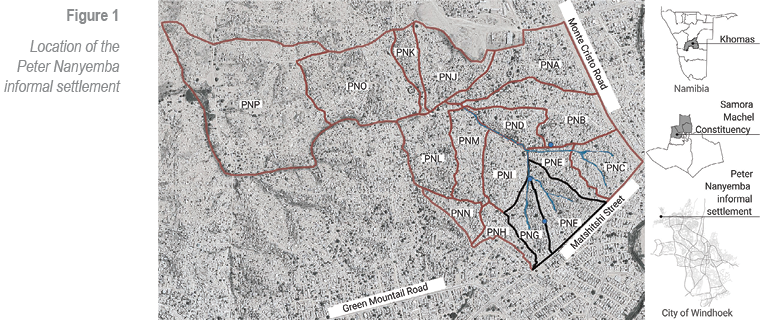
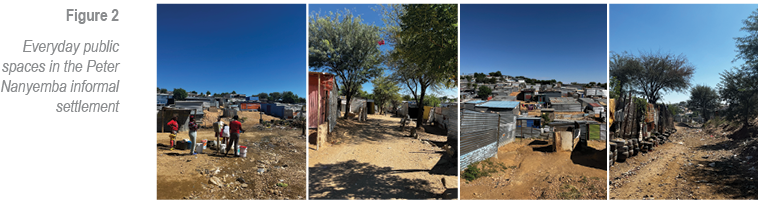
Peter Nanyemba, one of the most densely populated informal settlements in the Samora Machel Constituency, has about 15 000 residents and is organized into 16 administrative blocks by the City of Windhoek (Integrated Land Management Institute, 2021). This study focuses on the PNG and PNF blocks (Figure 1), located along dry riverbeds and shaped by steep topography, conditions that intensify flood risk and require continuous local adaptation (Figure 2).
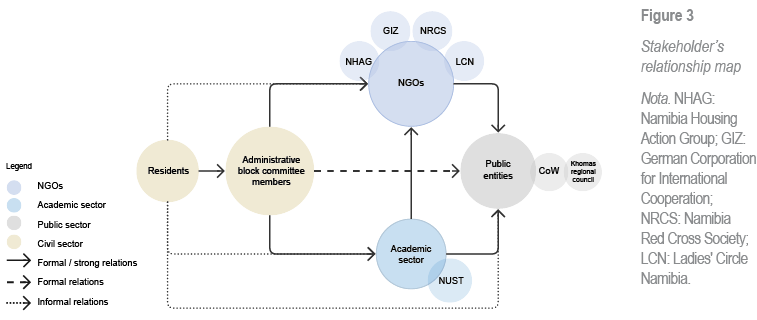
Within this challenging environment, residents have developed a range of adaptive practices. These include both structural responses, such as elevating houses, redirecting surface water, and reinforcing pathways, and non-structural responses, including collective action, knowledge sharing, and forming neighborhood initiatives (Yepez, 2024). Adaptive capacity gradually builds community resilience through the key phases of community resilience—resisting, recovering, adapting, and transforming (Yepez, 2024). Importantly, these adaptive responses do more than mitigate flood risks. They also shape public space and strengthen community organization within the settlement. The community has developed a governance structure that is largely based on informal means but intersects with formal capacities. This includes the election of a community leader by the residents, whose role is recognized and supported by local authorities. Figure 3 illustrates the structure, which is organized through a committee composed of representatives from each administrative block. These representatives maintain direct contact with residents and act as key intermediaries between the community and external actors, including NGOs, public entities, and the academic sector.
This research therefore sees the community’s adaptive responses as spatial and non-spatial measures that contribute to the formation of the public realm in Peter Nanyemba.
METHODOLOGY
The research takes Peter Nanyemba, an informal settlement located in Windhoek, as its case study. The case offers significant insights as it is exposed to flash flooding, demonstrates both structural and non-structural community responses, and is currently undergoing an upgrading process, providing an opportunity to integrate these insights into ongoing interventions.
Field access was facilitated through collaboration with the Namibia Housing Action Group and the Shack Dwellers Federation of Namibia within the SDG GoGlocal project. Residents not only self-provide housing and infrastructure but also continuously shape the public realm. Since responses to natural hazards do not primarily aim to produce public space or the community’s organizational transformation, both can be understood as a side effect. Accordingly, this research asks: How do spatial and non-spatial measures, as responses to flash floods, contribute to forming the public realm? It further addresses the following sub-questions: how do spatial and non-spatial measures physically shape public space? And how do spatial and non-spatial measures support community organization?
The research employs a qualitative methodology as outlined by Creswell and Creswell (2018). The two months of fieldwork included qualitative data collection methods such as site observations, 21 resident interviews, eight expert interviews, mapping, and a community feedback workshop. The sample comprised residents of Peter Nanyemba Blocks G and F over the age of 18, as well as experts from different sectors: three from academia in urban planning, one in geology and water security, three practitioners from NGOs, and one public sector representative working on informal settlement issues. An initial mapping of flooding measures was validated and adapted during the community feedback workshop. The collected data was analyzed in relation to the effects of the spatial and non-spatial measures on public space and community organization in Peter Nanyemba.
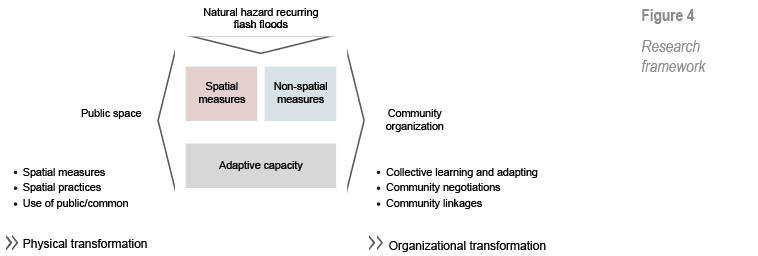
Based on the research questions, the data was analyzed along with the spatial and non-spatial measures and their effects on the public realm across two dimensions: public space and community organization (Figure 4). The analysis considered three interconnected scales: individual and household, neighborhood, and administrative block. Findings are structured by type, related practice, temporality, scale, purpose (as a response to flash floods), and the measure’s effect on public space and community organization. The fifth section discusses how spatial and non-spatial measures form the public realm, supporting community adaptive capacity and shaping broader physical and organizational transformations in Peter Nanyemba.
However, limitations included spatial and temporal access to the area, resulting in the strategic selection of two representative administrative blocks. Potential bias might result from the need to rely on NGO mediation with the local community. Validating the mapping process through the workshop with residents was necessary to confirm findings; however, the limited number of participants, despite their being community representatives, might pose some limitations on their responses.
RESULTS
The results show how spatial and non-spatial measures operate across multiple scales, varying in practice, materiality, and organization. While they emerged as responses to flash floods, their effects are manifold, gradually transforming public space and the community’s organizational structure.
Spatial Measures Shaping Public Space
Spatial measures initially aimed at reducing impacts of flash flood occur across multiple scales—household, neighborhood, and administrative block—and evolve through different resilience phases: resisting, recovering adapting, and transforming. While often intended for private protection, most reshape public space, generating both positive and negative effects. This section examines these measures by purpose, scale, resilience phase, and their effects on public space.
Household Scale
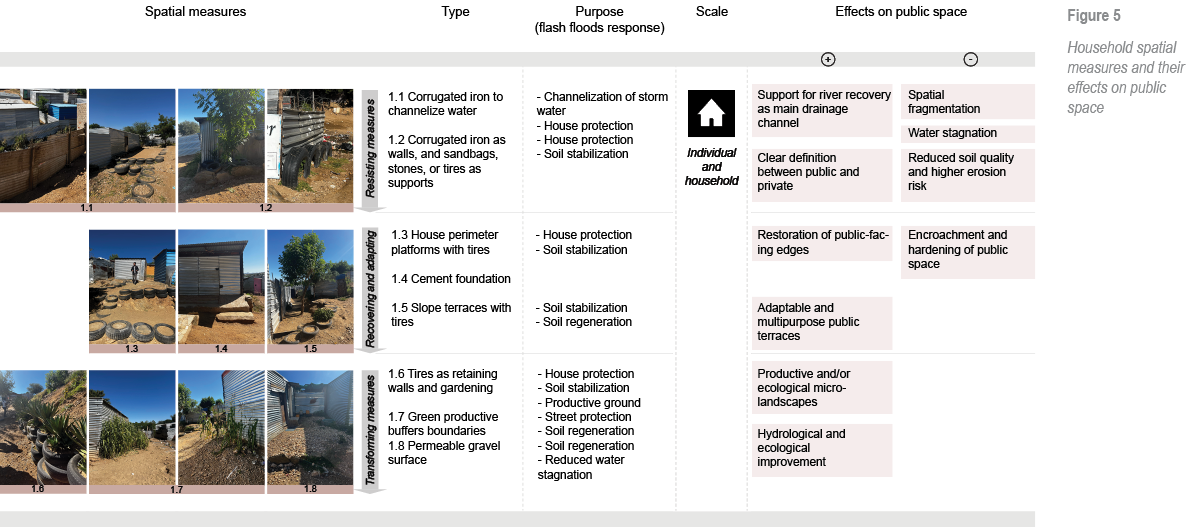
At an individual and household scale, measures include house protection and stabilization strategies, water management, and regenerative practices, affecting immediate surrounding and neighborhood public spaces. Residents implement immediate and recovery strategies to reduce the impacts of flash floods on their properties: “We try to protect our house by putting up these walls and these tires to prevent water from entering the house” (Resident 1, personal communication, 2024). Corrugated iron sheets channel runoff, while iron walls reinforced with stones, sandbags, or tires protect homes and occasionally aid drainage. Subsequent measures include elevated perimeter platforms using tires and cement foundations. While these interventions define boundaries and restore street edges, they also harden and encroach upon public spaces, fragmenting continuity. Figure 5 illustrates how such strategies transfer flood risk downstream, turning localized solutions into settlement-wide challenges.
Beyond immediate protection, residents adopt adaptive strategies that integrate water management and soil regeneration. As one interviewee states, “this is not a plantable ground” (Resident 2, personal communication, 2024), terraced slopes built with tires, retaining walls converted into small gardens, and green buffers delineate plots while improving drainage and slope stability. Permeable gravel surfaces enhance infiltration and reduce runoff. These interventions transform residual spaces into multifunctional public terraces and ecological micro-landscapes, supporting hydrological balance and contributing to the gradual ecological recovery of the settlement.
Neighborhood Scale
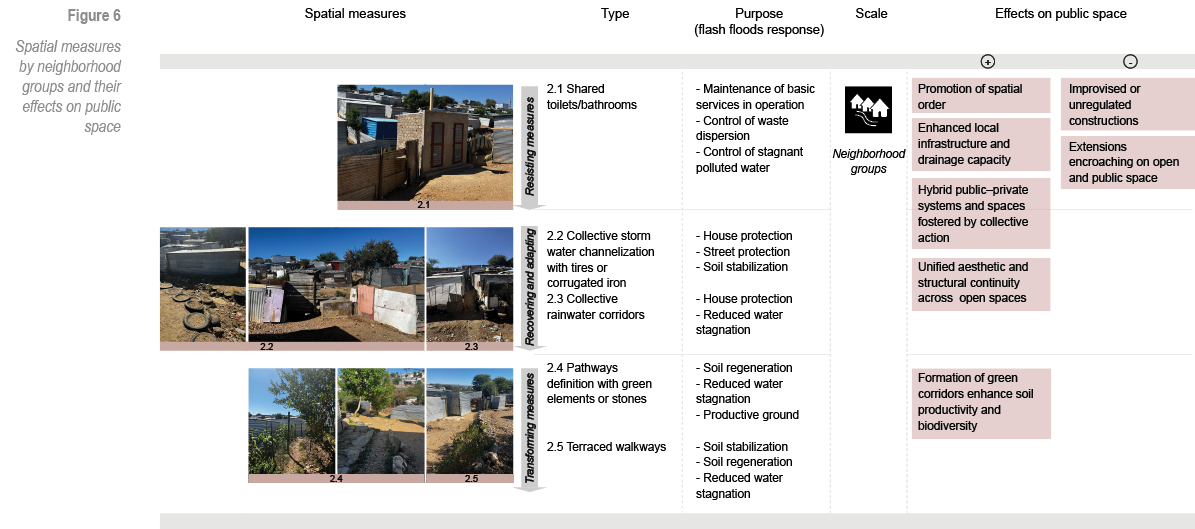
At the neighborhood scale, collective actions reshape public space through shared infrastructure that supports daily life and flood management. These include shared toilets and bathrooms, often located adjacent to the river. Through these collectively built interventions, basic services are maintained and stagnant water is reduced, but they also contribute to river pollution. Stormwater channels are built from tires or corrugated iron, with intentional gaps left between houses to allow water to pass: “We are not blocking, but we just let it open, so that the water will pass. Then we clean up the rest of the place” (Resident 11, personal communication, 2024). Therefore, they guide runoff and create linear corridors that organize circulation and enhance spatial order. These interventions generate hybrid public–private spaces and improve visual continuity. However, improvised or unregulated constructions may encroach on shared spaces and conflict with formal planning, highlighting tensions between bottom-up spatial practices and regulation. Collective spatial practices at this scale typically emerge when individual efforts are insufficient to address flood impacts.
In the transforming phase, some neighborhoods display emerging practices that link circulation and landscape as adaptive spatial responses. Pathways outlined with stones or vegetation promote soil regeneration and reduce water stagnation, while terraced walkways support slope stabilization and infiltration. Although still uncommon, these interventions introduce small green corridors that improve micro-ecological conditions and visual continuity in public areas. However, their maintenance and durability remain uncertain, as they depend on community initiative and resource availability (Figure 6).
Administrative-Block Scale
Basic service provision plays a central role at the administrative-block scale, where residents depend on shared infrastructure supplied by the City of Windhoek. In Peter Nanyemba, the communal water system consists of only three taps for the settlement and surrounding areas, providing essential but limited access. Despite its constraints, this basic provision remains crucial for strengthening resilience to flash floods, reducing everyday vulnerabilities, and allowing residents to focus on other challenges during and after flood events. At the same time, these taps function as active public nodes, shaping daily encounters and the use of shared space (Figure 7).
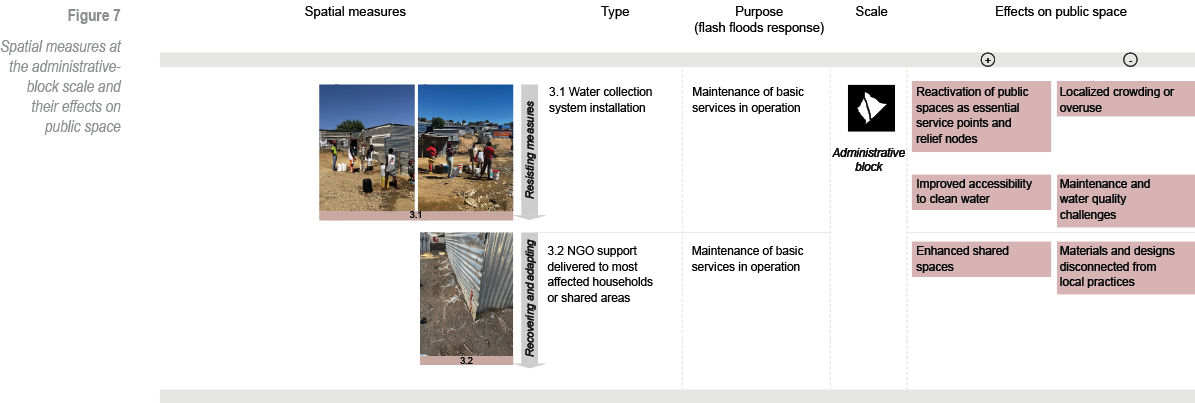
Beyond basic service provision, NGO-supported interventions also contribute to reshaping shared spaces. One such example is the placement of sandbags to reinforce walls and redirect surface water. While well-intentioned, this temporary measure is not aligned with existing community practices of using tires, which are more durable and widely understood locally. These mismatches illustrate how external interventions, when disconnected from local practices and knowledge, may lead to unintended outcomes or conflicts. Overall, these dynamics highlight how community initiatives and external support shape public space as a dynamic arena of cooperation and adaptation.
Non-Spatial Measures Contributing to Community Organization
Non-spatial practices operate across scales, emphasizing knowledge exchange, collective learning, and coordinated action. They build trust, strengthen social ties, and support collective decision-making, though they can also create inequalities or coordination challenges. This section examines how these practices shape public organization, reinforce community cohesion, and sustain collective resilience.
Household Scale
Individual and household actions include immediate responses, learning and adaptation, and the reinterpretation and integration of responses. Immediate actions focus on protecting homes by rearranging belongings and cleaning domestic and surrounding areas. Although individual, these practices extend into the public realm by fostering imitation and shared awareness, strengthening community preparedness. However, prioritizing household assets can reinforce individual interests over collective well-being, highlighting tensions between private protection and communal resilience.
Many of these practices unfold through everyday experimentation, with learning and adaptation occurring incrementally. Households adjust layouts and select materials based on experience and durability. Because flash floods recur, knowledge circulates within the community and across generations, nurturing an adaptive culture, strengthening collective knowledge, and fostering proactive attitudes toward risk. However, without coordination, individual adjustments can unintentionally redirect water or increase others’ exposure, resulting in localized maladaptation.
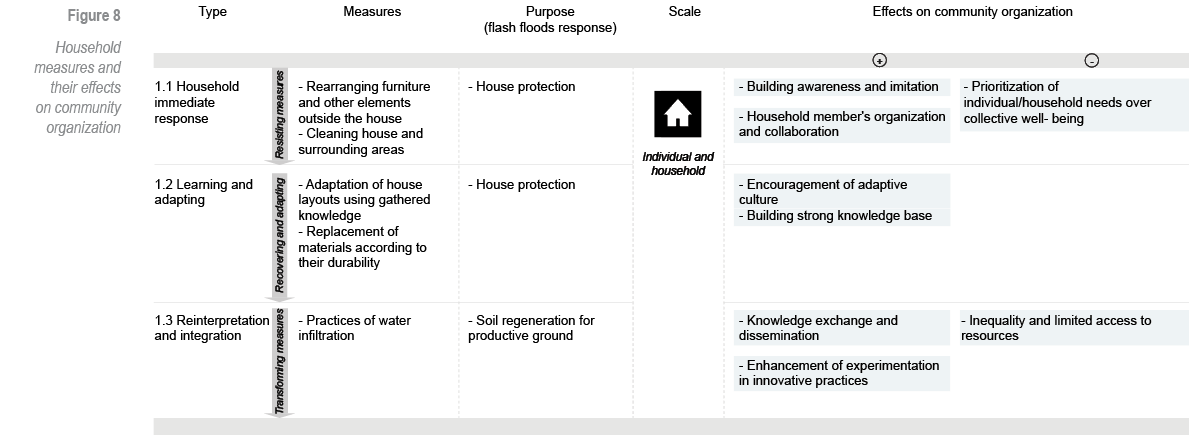
Reinterpretation and integration responses include practices such as water infiltration that regenerate soil and sustain productive ground. These household initiatives encourage knowledge exchange and experimentation, making resilience practices visible and shared. Community resilience thus emerges across spatial-ecological, preventive, and social dimensions. However, differences in time, capacity, and knowledge often lead to uneven participation and access to resources, revealing social and spatial inequalities in recovery across the settlement (Figure 8).
Neighborhood Scale
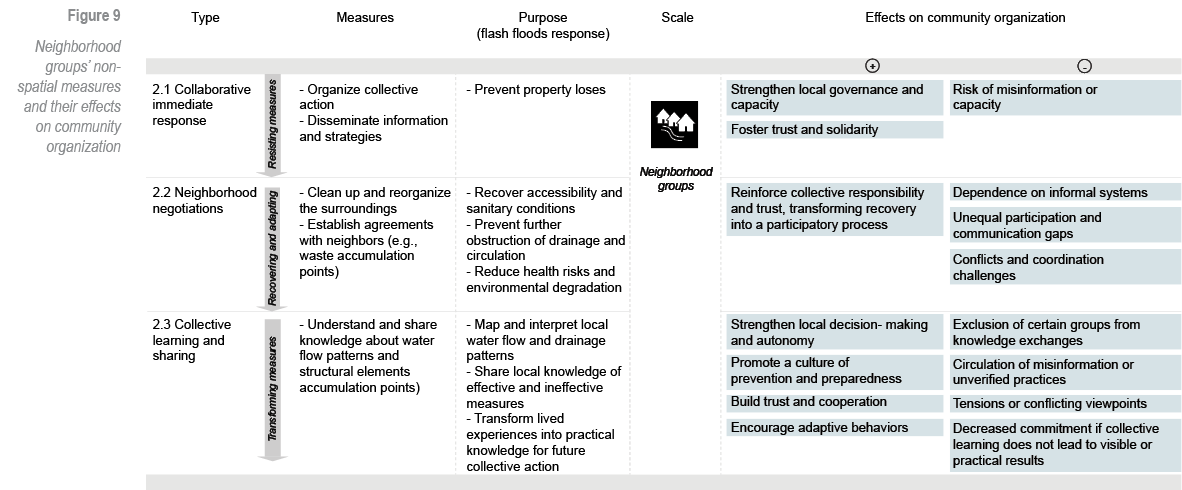
Neighborhood-scale responses include collaborative immediate actions, negotiations, and collective learning. Immediate responses focus on shared action and information to prevent flash flood-related property losses. These practices strengthen local governance, trust, and solidarity, reinforcing collective preparedness and resilience. However, inconsistent or misinterpreted technical knowledge can lead to unsafe or incoherent interventions, exposing limits of coordination. In the recovery and adaptation phases, neighborhood negotiations occur, involving collective actions such as cleaning shared surroundings and establishing agreements with neighbors, for example, on waste collection points. These practices restore accessibility, maintain sanitary conditions, prevent blockages, and reduce health and environmental risks. They also foster joint decision-making and shared responsibility, turning recovery into a community process. Yet, informal organizational structures can also create inequalities, as willingness to participate varies. Divergent interests can lead to groups formation, emerging power hierarchies, and potential exclusion, generating conflicts and coordination challenges.
As part of the transforming phase, collective learning and knowledge-sharing actions take place, shaping how residents understand and manage their environment. Mapping water flows and exchanging experiences transforms lived events into practical knowledge that guides future actions: “If you are moving, the neighbors tell you, ‘You don’t put your shack here because the water is coming that way’” (Resident 11, personal communication, 2024). These practices strengthen decision-making, promote a culture of prevention, and reinforce community cohesion, influencing the organization of public space. At the same time, they may reveal participation inequalities, spread unverified information, or create conflicting risk interpretations, highlighting underlying social tensions (Figure 9).
Administrative-Block Scale
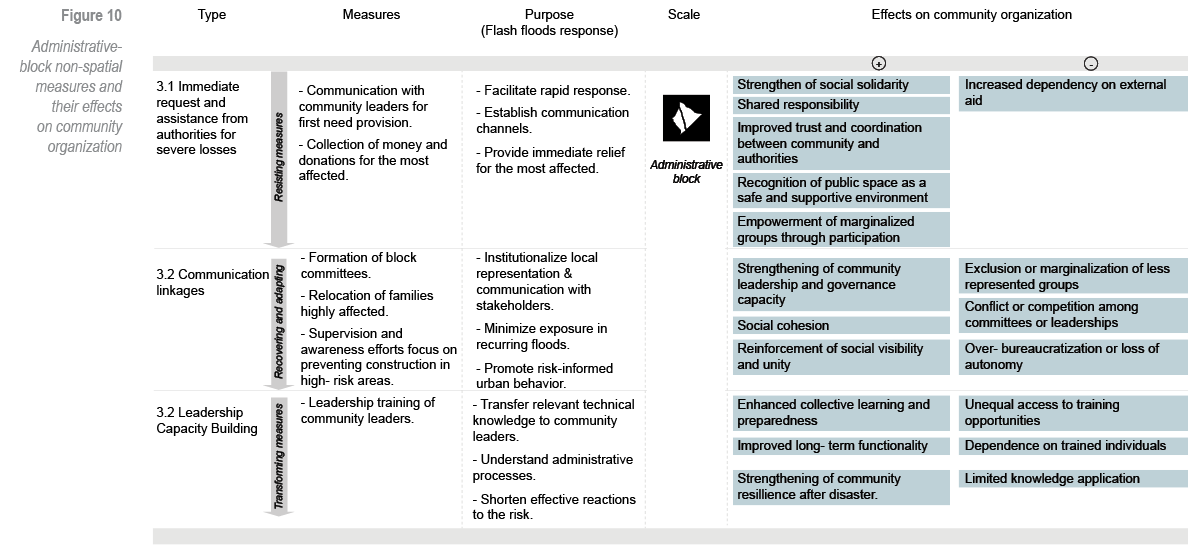
The first response at the administrative-block scale is to request assistance from authorities in cases of severe losses. An interviewee describes a common sequence of support: “First thing you ask the help from the neighbors, after neighbors you are going to ask help from the councilor, Red Cross” (Resident 22, personal communication, 2024). This involves communication with community leaders to provide immediate assistance, such as collecting money or donations for most affected households. These practices facilitate rapid relief, establish communication channels, and meet urgent needs efficiently, while strengthening solidarity, shared responsibility, and trust between authorities and residents. The community leader acts as a mediator supporting informal–formal integration. Such practices reinforce public spaces as environments where participation empowers residents. However, these interventions can also create dependency on external aid, highlighting the tension between immediate relief and long-term self-reliance.
The recovery and adaptation measures under “community linkages” include forming block committees, relocating highly affected families, and supervising constructions in high-risk areas, aimed at reducing exposure and promoting risk-informed behavior. Block committees, comprising a chairperson, vice chairperson, secretary, treasurer, and one additional member, emerge through an informal–formal process initiated by the City of Windhoek to maintain communication and updated population data, formalizing local representation and enabling engagement with external stakeholders. Since meetings occur in public spaces, these spaces become nodes for coordination, monitoring, and awareness, strengthening community organization, governance capacity, social cohesion, and visibility. However, the process may exclude less represented groups, such as recently arrived residents in peripheral areas, and generate conflicts between committees or over-bureaucratization, constraining community autonomy.
Leadership training provided by the City of Windhoek, Namibia University of Science and Technology, and NGOs is a transformative measure shaping social organization and communication. It equips community committees with technical knowledge, administrative skills, and strategies for timely flood response, strengthening collective learning, preparedness, and the long-term functionality of community structures. These trainings enhance community resilience through improved planning, monitoring, and maintenance of shared infrastructure. However, unequal access, dependence on a few individuals, and limited application can reduce effectiveness (Figure 10).
THE INTERLINKAGE OF SPATIAL AND NON-SPATIAL MEASURES FORMING THE PUBLIC REALM AND ENHANCING THE COMMUNITY’S ADAPTIVE CAPACITY
As the findings show, spatial and non-spatial measures shape the public realm, both physically and organizationally. Initially emerging as a response to recurring flash floods, they enhance the overall adaptive capacity of the community. The research finds that both spatial and non-spatial measures are part of an interlinked, multi-scalar system, and that the public realm is continuously shaped by everyday actions. Community organization and public space are both a product and a process within a formal–informal interplay (Figure 11). In this section, these findings are discussed in relation to the literature reviewed and the ongoing discourse on community organization and public space in informal settlements.
Building on this, the findings show that spatial and non-spatial measures form an interlinked system whose effectiveness and reach rely on mutual reinforcement: spatial interventions gain meaning and durability through social coordination, while non-spatial practices—such as learning, cooperation, and organization—gain visibility and continuity when expressed physically. Together, they form a feedback system that produces and redefines the public realm. This relates to Kamalipour’s (2023) description of flexible spaces that respond to changing needs. These dynamics highlight the need for stakeholders to address both measures simultaneously, ensuring coordinated interventions that strengthen, rather than fragment, resilience and community outcomes.
The multi-scalar nature of the processes in Peter Nanyemba underscores the importance of studying informal settlements as interconnected systems. At the household scale, protective and drainage measures are reinforced by awareness and imitation, spreading shared practices across neighborhoods. At the neighborhood scale, collective agreements and learning translate into spatial improvements such as greener paths, restored edges, and improved drainage, showing how cooperation shapes both physical and social resilience. At the administrative-block scale, coordination with authorities and community training activates public space as a platform for relief and collaboration. Therefore, interventions at the household scale can ripple across neighborhoods, while collective arrangements at the administrative scale often depend on accumulated experience of individual actors. Figure 11 clarifies how incremental changes contribute to broader urban transformations and connects them to informal–formal actor dynamics (Figure 3). Public space emerges as the arena where multiple scales intersect, underscoring the need for stakeholders to anticipate wider effects and build upon existing community dynamics. This aligns with Ley’s (2019) emphasis on prior organization within the community and networking beyond the locality, highlighting public space as a catalyst for social interaction. Beyond this, the case exemplifies how spatial and organizational interconnections across scales shape everyday urban practices, providing a foundation for examining similar dynamics in other contexts facing comparable challenges and demonstrating the broader relevance of multi-scalar approaches to informal settlement research (Figure 12).
Within this dynamic, public space as well as community organization emerge not as fixed or residual settings but as living structures continuously reshaped by everyday actions. They embody the tension between cooperation and fragmentation, and adaptation and maladaptation. When spatial practices are guided by coordination and shared learning, they can enhance accessibility, ecological recovery, and community cohesion; isolated actions may redirect risk or degrade shared areas, revealing the limits of individual responses.
Amoako’s (2018) reflection on “socio-political alliances and collaboration” highlights the complex networks that emerge through the engagement of different stakeholders (p. 471). Similarly, the processes in Peter Nanyemba are shaped by the formal–informal interplay. External interventions that disregard local knowledge or impose rigid frameworks can unintentionally undermine these adaptive systems. Recognizing locally learned strategies and their capacity to scale up through community networks is therefore essential. This aligns with Amoako (2018), who shows that community-level capacities and initiatives, developed through incremental learning processes, provide valuable insights for public and private organizations in the design of policies and programs.
The public realm, understood in this sense as community organization and public space, is both a product and a process—an evolving field where spatial and non-spatial dimensions meet, and where resilience, cohesion, and everyday life are continuously negotiated. Appreciating this complexity is crucial for researchers and practitioners seeking to engage with informal settlements as dynamic environments.
This research shows that community adaptive capacity relies on the continuous transformation of the public realm in the Peter Nanyemba informal settlement. In this context, the public realm consists of both physical and relational space, understood as either shared spaces that support everyday life, without necessarily being formally designated as public, or community organization produced through social relations and interactions. Flood responses are evolving practices that produce space at different scales through incremental processes of learning, shaped by an ongoing understanding of hazards and everyday constraints (Amoako 2018). Through the interaction of spatial and non-spatial measures across scales, these dimensions of the public realm are continuously activated and reinforced, affecting the community adaptive capacity. This study reveals that the community adaptive capacity relies on the ongoing improvement and further development of the public realm in the Peter Nanyemba informal settlement.
CONCLUSION
This study highlights the interlinkage between public realm and adaptive capacity in the Peter Nanyemba informal settlement. Shaped through spatial and non-spatial measures and their interaction across scales, the public realm emerges as shared public space and community organization, continuously produced through everyday practices and collective action. While flash floods trigger these processes, the research reveals the multi-layered nature of the ongoing transformation of the public realm. It positions informal settlements as dynamic environments in which the public realm is not predefined but constituted through use, coordination, and learning.
By examining the interaction between spatial and non-spatial measures, this study contributes to a more nuanced understanding of how public space and community organization co-produce the public realm, enabling communities to anticipate challenges, strengthen long-term effectiveness, and develop context-specific approaches.
Future research could explore the effects of additional drivers on physical and organizational transformation within the community. Recognizing these processes is essential for research and practice that engage with informal contexts and seek to support adaptive capacity and collective urban life.
REFERENCES
Adama, O. (2020). Abuja is not for the poor: Street vending and the politics of public space. Geoforum, 109, 14-23. https://doi.org/10.1016/j.geoforum.2019.12.012
Amoako, C. (2018). Emerging grassroots resilience and flood responses in informal settlements in Accra, Ghana. GeoJournal, 83, 949-965. https://doi.org/10.1007/s10708-017-9807-6
Arnold, A. (2022). Fostering functional public open space within low-income, post-apartheid environments. The Journal of Public Space, 7(1), 175-198. https://doi.org/10.32891/jps.v7i1.1551
Ashraf, S. (2024). Stakeholders’ negotiations in formal and informal commercial activities [Unpublished master’s thesis]. Ain Shams University.
Bravo, L., & Guaralda, M. (2016). An open access forum for the discussion and advancement of research about public space. The Journal of Public Space, 1(1), 1-4. https://www.journalpublicspace.org/index.php/jps/article/view/221
Bravo, L., Toffa, T., & Malonza, J. M. (Eds.). (2022). Public space and placemaking in African cities. The Journal of Public Space, 7(1). https://www.journalpublicspace.org/index.php/jps/issue/view/83
Charalambous, N., & Knierbein, S. (2023). Mapping urban injustices in public space: Challenges and opportunities. The Journal of Public Space, 8(3), 1-6. https://doi.org/10.32891/jps.v6i3.1609
Chilaule, R., & Mottelson, J. (2025). Informal infrastructure provision: Self-organized street paving in Maputo, Mozambique. Habitat International, 161, Article 103405. https://doi.org/10.1016/j.habitatint.2025.103405
Cobbinah, P. B. (2023). City in Africa I: Urbanism and informality. Journal of Urban Affairs, 45(3), 297-301. https://doi.org/10.1080/07352166.2023.2171616
Creswell, J. W., & Creswell, J. D. (2018). Research design: Qualitative, quantitative, and mixed methods approaches (5th ed.). SAGE Publications.
Dovey, K., van Oostrum, M., Chatterjee, I., & Shafique, T. (2020). Towards a morphogenesis of informal settlements. Habitat International, 104, Article 102240. https://doi.org/10.1016/j.habitatint.2020.102240
Eakin, H., Enqvist, J., Hamann, M., Methner, N., Sibanda, M. N., Sullivan, J. L., van Wyk, E., & Ziervogel, G. (2025). Negotiating informality and urban resilience: Implications for equity. Ecology and Society, 30(2), Article 20. https://doi.org/10.5751/ES-16059-300220
Eshalomi, H. O. (2022). Seeing the city through traffic hawking and merchandise differentials: Urban and suburban differentials in Lagos megacity. The Journal of Public Space, 7(1), 199-216. https://doi.org/10.32891/jps.v7i1.1549
Ewing, K. (2021). Spaces of transformative practice: Co-producing, (re)making and translating fractional urban space in Gugulethu, Cape Town. Urban Forum, 32, 395–413. https://doi.org/10.1007/s12132-021-09436-6
Hati, B. (2025). Polymorphic grassroots networks and implications for disaster resilience in popular settlements in Sierra Leone, India and Kenya. Environment & Urbanization, 37(1), 159-182. https://doi.org/10.1177/09562478251318230
Herrle, P., & Ley, A. (2015). From local action to global networks: Housing the urban poor. Routledge. https://doi.org/10.4324/9781315583402
Hou, J. (2010). Insurgent public space: Guerrilla urbanism and the remaking of contemporary cities. Routledge.
Huchzermeyer, M. (2011). Cities with ‘slums’: From informal settlement eradication to a right to the city in Africa. UCT Press. https://doi.org/10.58331/UCTPRESS.32
Kamalipour, H. (2023). Shaping public space in informal settlements: A case study. Sustainability, 15(4), Article 3781. https://doi.org/10.3390/su15043781
Kamalipour, H., & Dovey, K. (2020). Incremental production of urban space: A typology of informal design. Habitat International, 98, Article 102133. https://doi.org/10.1016/j.habitatint.2020.102133
Kamalipour, H., & Iranmanesh, A. (2021). Morphogenesis of emerging settlements: Mapping incremental urbanism. Land, 10(1), Article 89. https://doi.org/10.3390/land10010089
Kamalipour, H., & Peimani, N. (2025). Public space and informal urbanism in the Global South. In J. Dolley, K. Hardy, & T. Matthews (Eds.), Public space and the Sustainable Development Goals (pp. 105–114). Edward Elgar Publishing. https://doi.org/10.4337/9781035322411.00014
Kirabo, B., & Olweny, M. R. O. (2022). Spatial orders in informal settlements: A study of the Kasokoso neighbourhood in Kampala, Uganda. The Journal of Public Space, 7(1), 77–92. https://doi.org/10.32891/jps.v7i1.1530
Lefebvre, H. (1991). The production of space. Blackwell.
Ley, A. (2019). Community resilience and placemaking through translocal networking. Learning from Thailand and the Philippines. The Journal of Public Space, 4(2), 165–178. https://doi.org/10.32891/jps.v4i2.1208
Mapani, B. S., Shikangalah, R. N., & Mwetulundila, A. L. (2023). A review on water security and management under climate change conditions, Windhoek, Namibia. Journal of African Earth Sciences, 197, Article 104749. https://doi.org/10.1016/j.jafrearsci.2022.104749
Integrated Land Management Institute. (2021). Community-led informal settlement upgrading. Namibia University of Science and Technology. https://illh.nust.na/sites/default/files/Annex-A-NUST%20ILMI%20Portfolio%20Community-led%20Informal%20Settlment%20Upgrading-compressed.pdf
Roji, A. (2022). Rethinking public spaces in Africa: The necessity for the Centre on African Public Spaces. The Journal of Public Space, 7(1), 3–6. https://doi.org/10.32891/jps.v7i1.1804
Satterthwaite, D. (2011). Editorial: Why is community action needed for disaster risk reduction and climate change adaptation? Environment & Urbanization, 23(2), 339–349. https://doi.org/10.1177/0956247811420009
Satterthwaite, D., Archer, D., Colenbrander, S., Dodman, D., Hardoy, J., Mitlin, D., & Patel, S. (2020). Building resilience to climate change in informal settlements. One Earth, 2(2), 143–156. https://doi.org/10.1016/j.oneear.2020.02.002
Watson, V. (2009). Seeing from the South: Refocusing urban planning on the globe’s central urban issues. Urban Studies, 46(11), 2259–2275. https://doi.org/10.1177/0042098009342598
Watson, V. (2014). African urban fantasies: Dreams or nightmares? Environment & Urbanization, 26(1), 215–231. https://doi.org/10.1177/0956247813513705
Yepez, E. (2024). Community resilience to flash floods. Structural and non-structural responses in Peter Nanyemba informal settlements, Windhoek, Namibia [Unpublished master’s thesis]. University of Stuttgart.