Urban Waterfronts as Devices of
Neoliberal Desire: Architectural
and Urban Planning Narratives on
ArchDaily Brazil
Frentes ribereños urbanos como dispositivos
del deseo neoliberal: narrativas arquitectónicas
y urbanísticas en ArchDaily Brasil
Gianluca Perseu
Technische Universität Berlin, Germany
https://orcid.org/0000-0002-0427-8611
Celma Paese
Universidade Federal do Rio Grande do Sul, Brazil
https://orcid.org/0000-0002-3160-0610
Lucas CHICONI Balteiro
Universidade de São Paulo, Brazil
https://orcid.org/0000-0003-3460-928X
Received: June 8th, 2025
Accepted: November 18th, 2025
doi: https://doi.org/10.26439/limaq2026.n017.7982
This article explores how urban waterfront projects in Brazil embody and operate within a framework of neoliberal urbanization. By conducting a qualitative analysis of architectural and urban planning narratives featured on the ArchDaily Brazil platform, this study highlights how alluring representations of modernity and monetization contribute to a neoliberal matrix in the creation of urban spaces. Focusing on three case studies—the Guaíba Waterfront Park in Porto Alegre, the Conde Waterfront in Rio de Janeiro, and the Futuro Park in Belém—the research examines the underlying economic, social, and aesthetic themes inherent in these projects. Ultimately, this article aims to problematize how urban planning can either reinforce or challenge prevailing paradigms of urbanization.
ArchDaily, architectural discourse, digital narratives, landscape, neoliberal planning, urban waterfronts
Este artículo explora cómo los proyectos de frentes ribereños urbanos en Brasil operan dentro de un marco de urbanización neoliberal y lo encarnan. A través de un análisis cualitativo de las narrativas arquitectónicas y urbanísticas publicadas en la plataforma ArchDaily Brasil, se pone de relieve cómo las atractivas representaciones de la modernidad y la monetización contribuyen a una matriz neoliberal en la creación de espacios urbanos. A partir de tres estudios de caso —el Parque Costero Guaíba, en Porto Alegre; el Boulevard Olímpico/Orla Conde, en Río de Janeiro; y el Parque Futuro, en Belém—, se examinan aspectos económicos, sociales y estéticos subyacentes a estos proyectos. El artículo busca problematizar cómo la planificación urbana puede reforzar o cuestionar los paradigmas predominantes de urbanización.
ArchDaily, discurso arquitectónico, narrativas digitales, paisaje, planificación neoliberal, frentes ribereños urbanos
This is an open access article, published under the terms of the Creative Commons Attribution 4.0 International (CC BY 4.0) license.
INTRODUCTION
Proximity to water has long shaped human settlement patterns, offering essential conditions for life as well as a locus for contemplation and existential reflection. Transitional zones between land and water continue to function as pivotal hubs of trade, industry, and cultural exchange (Muir et al., 2015; Perseu, 2021; Perseu & Caron, 2021). These areas function as catalysts for processes such as population mobility and encounter, and as natural or artificial boundaries that complicate expansion.
In the context of contemporary capitalist societies, urban waterfronts have emerged as privileged sites for urban development over the past few decades (Tommarchi, 2025). These large-scale transformations shape not only the physical fabric of cities but also influence their socio-economic dynamics, symbolic imaginaries, and institutional frameworks. As Rolnik (2019) notes, central urban spaces such as waterfronts frequently become targets of real estate speculation, private investment, and public-private partnerships—hallmarks of neoliberal urbanism. From the proliferation of skyscrapers to high-end mixed-use districts, waterfront areas, which are often the focus of strategic planning practices, manifest a complex network of contemporary globalized urbanization (Brenner & Keil, 2014) within the perceived landscape.
The commodification of public space and the aestheticization of inequality are integrally intertwined within these processes. Landscapes characterized by spectacle and privilege coexist alongside spaces defined by exclusion and dispossession. This aesthetic logic transcends mere visual representation. It possesses a political dimension that constructs a consensus around market-oriented urbanization, thereby legitimizing spatial inequality through alluring representations of modernity and progress. The interplay between these two dynamics—the economic and the aesthetic—serves as a pivotal analytical axis of this study, shaping both its theoretical framework and methodological approaches.
The relationship between landscapes of spectacle and precariousness—or, in the terms articulated by Santos (1994), luminous and opaque spaces—extends beyond intra-urban dynamics and must be understood within the broader context of the planetary urban network. This network is characterized by regional configurations of power and spatial opportunity, which significantly influence the life conditions and social positions of entire populations. Within this global framework, the concept of the Global South (and by contrast, the Global North), emerges not only as a geopolitical distinction but also as a political proposition, as discussed by anthropologist Arturo Escobar (1995) and sociologist Boaventura de Sousa Santos (2016). This formulation aims to de-stigmatize, mobilize, and connect marginalized populations worldwide, particularly those most vulnerable to planning paradigms that align with the interests of global capital, often to the detriment of socio-spatial context and justice.
Neoliberal power, conceptualized as an informational and contemporary phase of capitalism (Castells, 2013), corresponds to its current stage, as defined by David Harvey (2008), which emphasizes how neoliberal paradigms prioritize market-oriented policies such as privatization, deregulation, and economic efficiency. The author highlights that such an approach often undermines social welfare and environmental sustainability. Within this context, dominant agents and institutions increasingly portray urban waterfronts as inclusive public realms that promote diversity and urban vitality. However, these spaces are frequently reimagined and repurposed as strategic assets for financial speculation, investment, and capital accumulation, with consequences such as gentrification, displacement, and the erosion of local cultural identities (Muñoz, 2003; Rolnik, 2019).
From a social psychology perspective, neoliberalism aligns closely with Foucault’s concept of societies of control, in which power operates through diffuse and internalized mechanisms of subjectivation. These mechanisms collectively shape how individuals perceive, relate to, and inhabit their world (Foucault, 1982). In this context, neoliberal urban planning functions as a hegemonic discursive apparatus that actively produces landscapes and worldviews grounded in economic rationality and aesthetic seduction. Consequently, the aestheticization of inequality emerges not as an accidental byproduct but as an essential feature of neoliberal urbanism, in which concepts such as beauty, order, and sustainability serve to legitimize exclusionary development practices.
Driven by a desire to understand how these dynamics unfold in the Global South, this article analyzes the narratives surrounding urban waterfront development projects in Brazil, as articulated by architectural and urban design firms. We examine how these projects are presented and legitimized on ArchDaily Brazil, a prominent digital platform that serves as an online repository and amplifier of architectural discourse, significantly influencing both public and professional perceptions of urban transformation.
This study analyzes the discursive strategies embedded in urban planning narratives to expose the underlying ideologies and assumptions that shape contemporary practices, particularly concerning the commodification of public space and the aestheticization of inequality. The central research question is: How do urban waterfront projects in Brazil articulate neoliberal rationality through architectural narratives?
To answer this question, the study employs a qualitative methodological approach rooted in landscape theory, critical urban planning debates, and discourse analysis. It examines three emblematic case studies: (i) the Guaíba Waterfront Urban Park in Porto Alegre, (ii) the Luiz Paulo Conde Waterfront Promenade in Rio de Janeiro, and (iii) the Futuro Park in Belém. The research interprets these projects as discursive constructions that not only reflect but also potentially enact hegemonic regimes of landscape production within the architectural field. Through this lens, the study uncovers tensions among economic imperatives, socio-environmental inclusivity, and the prospects for more just and democratic alternatives in architecture, urbanism, and planning.
THEORETICAL FRAMEWORK
This section examines three interrelated frameworks that significantly shape our understanding of urban planning: (i) conceptualizing landscape as a sensory and cultural phenomenon that shapes social relations within geographical spaces, (ii) analyzing the logics of capitalist production of landscapes, and (iii) investigating the role of urban waterfronts in urban planning as instruments of neoliberal desire. Together, these perspectives establish a critical foundation for analyzing how neoliberal urbanization manifests in contemporary waterfront developments. Within these dynamics, commodification and aestheticization function as mutually reinforcing mechanisms that reproduce inequality.
Landscape as a Sensory and Cultural Phenomenon
The concept of landscape transcends its physical manifestation, revealing a complex interplay of sensory, cultural, and symbolic dimensions. This framework serves as a methodological approach in the current study of space, emphasizing the roles of experience and subjectivity in the material production of our world, and vice versa (Perseu & Caron, 2022). Thus, investigating social reality through the lens of landscape phenomena allows for exploration of how life processes unfold on Earth’s surface and how they transform over generations. It examines how construction methods are intricately linked to modes of inhabiting and considers the extent to which our perceptions, significations, and communications of Earthly experiences shape (and are shaped by) the configurations of the planetary built environment created by humanity.
Building on Tim Ingold’s (1993) work, we assert that landscapes are not static entities; they continually emerge through dynamic spatial and temporal interactions between individuals, collectives, and their environments. This perspective underscores the embodied and lived character of landscapes, illuminating their significant roles in shaping social relations and cultural identities. Augustin Berque (1998) notably emphasizes the dual nature of landscapes, recognizing them as both material entities and cultural constructs. This understanding reveals that landscapes are deeply embedded in historical narratives, political discourses, and aesthetic values that shape their perception, representation, and transformation.
The process of shaping landscapes is inherently influenced by dominant practices, ideologies, economic imperatives, and planning rationalities that determine what gets preserved, modified, or erased. In neoliberal urban contexts, actors often instrumentalize the sensory and cultural dimensions of landscapes to advance market-driven agendas. This leads to the selective preservation of historical or natural elements that coincide with economic interests, while marginalizing or erasing aspects that do not conform to the prevailing narrative of progress and development. Caron (2017) observes that landscapes frequently become reframed as consumable spectacles, which diminishes their cultural depth to mere visual appeal and marketability.
Waterfront development projects illustrate a significant phenomenon, as they often frame urban revitalization in terms of reconnecting cities with their natural environments while advancing real estate interests. These designs frequently incorporate elements such as promenades, green spaces, and public art installations to enhance sensory appeal, leveraging a consensus around recognized “good practices” in urban planning. However, this emphasis on aestheticization can obscure important social and environmental conflicts. For example, the romanticization of water as a symbol of nature and renewal often conceals the displacement of local communities and the privatization of formerly public spaces. Additionally, it diverts attention from critical issues related to water policies and the necessary measures for addressing incidents such as floods and droughts.
The cultural construction of landscape plays a vital role in shaping collective identities. Waterfronts, in particular, often hold historical and social significance linked to labor movements, indigenous histories, and working-class neighborhoods (Perseu, 2021; Misoczky de Oliveira, 2020). When development projects prioritize financial interests at the expense of cultural memory, they risk erasing or rewriting these histories to align with neoliberal urban imaginaries. This jeopardizes the potential for citizens to experience a sense of belonging in public space (Jacques, 2008). The process of “sanitization”—which involves removing elements deemed undesirable or incompatible with market-driven aesthetics—further contributes to the erosion of place-based identities and community connections.
Future-oriented practices, including urban interventions and planning policies, must not only address the visual and functional aspects of landscapes but also engage with their deeper socio-cultural meanings. These practices should ensure that project and planning processes remain inclusive, participatory, and sensitive to their specific contexts. A critical approach to landscape interpretation emphasizes the importance of reclaiming urban spaces as sites of lived experience rather than viewing them merely as commodities.
To foster genuine coexistence on Earth, it is essential to transcend the perceived surface of the world and pursue socially and environmentally committed alternatives. Landscapes serve as tools for accessing the political dimensions of the visual world, prompting a critical examination of the ongoing (re)production of space through human agency. This approach seeks to denaturalize regimes of power and highlights the aesthetic practices that spatially and symbolically legitimize inequality.
The Capitalist Production of Landscapes
If, as Harvey (2008) argues, neoliberalism fundamentally restructures urban morphology according to free-market principles, it often leads to the commodification of public spaces, transforming the experience of urban environments into one centered around consumerism. This transformation extends beyond the physical environment, affecting the sensory dimension and positioning the city itself as a branded commodity (Muñoz, 2003). Urban imagery becomes appropriated and instrumentalized for marketing and branding strategies, reconfiguring the city as a consumable product rather than a shared social space. Consequently, citizen engagement within the city shifts from active participation and a sense of belonging to a more passive mode referred to as ‘user experience,’ in which urban life is mediated through consumption and spectacle. The capitalist production of landscapes represents a set of deeply embedded processes of subjectivation that redefine how urban experiences are structured, controlled, and understood.
Neoliberal policies typically prioritize real estate speculation, large-scale infrastructure projects, and the privatization of public lands (Swyngedouw et al., 2002). These dynamics drive urban restructuring that shapes landscapes to cater to the demands of investors and global capital flows, at the expense of local communities. As Rolnik (2019) notes, these policies favor landscapes for profit over those that support communal life. Consequently, urban space increasingly serves as a tool for uneven capital accumulation, reinforcing existing social and spatial inequalities while excluding marginalized populations from access to or benefits from redeveloped areas. This exclusion is often concealed by narratives of economic revitalization and urban renewal, which obscure the displacement and social fragmentation caused by such projects (Smith, 2002).
Brazilian geographer Milton Santos (1994) provides a critical conceptual framework for analyzing the dynamics of urban development through the notions of ‘verticalities’ and ‘horizontalities.’ Verticalities encompass hegemonic practices often originating from distant geographical locations that exert control through technical, economic, and political mechanisms. This imposition destabilizes the local, continuous social organization encapsulated within horizontalities. This conceptualization reveals the mechanics of this phenomenon that Santos (2000) characterizes as ‘perverse globalization,’ in which neoliberal urban planning functions as a tool of power, subordinating local realities to the demands of global capital, eroding the national territorial base upon which the modern state was founded (Arantes et al., 2013). These frameworks elucidate how neoliberalism operates not only through economic logics but also through the subjective and aesthetic creation of urban environments.
The commodification of landscapes within capitalist urbanism unfolds through several interconnected mechanisms. First, developers transform land into financial assets, increasingly driven by speculative logics rather than by social utility or public need (Aalbers, 2016). Second, aestheticization serves as a strategic tool; urban planners meticulously curate and market urban spaces to attract global investors and affluent consumers, prioritizing visual spectacle and symbolic capital over social functionality and inclusivity (Lehrer & Laidley, 2008). Third, this process inevitably triggers displacement and gentrification, as original residents are priced out by soaring property values and escalating rental costs—further exacerbating socio-spatial inequalities and reinforcing landscapes designed primarily for profit rather than for community and life processes (Rolnik, 2019).
Paese et al. (2022) analyze how the capitalist production of landscape creates a bifurcated urban reality. On one side, they identify a spectacularized urban environment that aligns with prevailing economic narratives of progress and modernity. Conversely, they highlight the lived experiences of precarization and exclusion encountered by populations systematically displaced from these transformed spaces. This contradiction becomes particularly evident in waterfront redevelopment projects, which often promote a rhetoric of inclusivity and urban renewal. However, in practice, these initiatives typically result in limited access and perpetuate exclusion.
Neoliberal urbanization actively erases historical and social contexts, leading to a homogenized, globalized urban aesthetic (Ribeiro, 2020). Global capital penetrates diverse geographic and cultural contexts, thereby smoothing over local specificities and creating standardized urban forms. Cities with distinct cultural identities get repackaged into sanitized, consumer-friendly environments that primarily serve tourists, affluent residents, and corporate interests. This phenomenon is well captured by Muñoz’s (2003) concept of urbanalization, which illustrates how cities around the world increasingly converge toward a uniform model of development shaped by global capital and neoliberal policy frameworks.
In this context, the aestheticization of inequality serves as an urban technology that transforms uneven development into an appealing image, reframing socio-economic asymmetries as characteristics of desirable urbanity. The waterfront, characterized by choreographed views and monumental infrastructure, functions as a stage where design effectively renders exclusion invisible.
Urban Waterfronts as Global Financial Archetypes
The concept of waterfronts as global financial archetypes actively reflects broader processes of urban restructuring under neoliberalism. Worldwide, cities pursue ambitious waterfront redevelopment projects inspired by iconic examples from the Global North—such as London’s Docklands, New York’s Hudson Yards, and Barcelona’s Port Vell—which have established a precedent for high-end, consumption-driven urbanism (Swyngedouw et al., 2002). In the Global South, urban strategies increasingly emulate these archetypes, prioritizing luxury residential enclaves, flagship cultural facilities, and tourism economies (Smith, 2002). This alignment of urban policy with the demands of international capital underscores the pervasive influence of neoliberal ideals in shaping urban environments.
This transformation makes urban space a financial asset, a process that public-private partnerships often facilitate and justify through discourses of modernization, revitalization, and global competitiveness (Rolnik, 2019; Perseu, 2021). In these initiatives, cities actively brand themselves, reconfiguring their central areas—especially waterfronts—to attract investment rather than address the needs of local populations. Consequently, redevelopment frequently excludes local residents from its benefits, while subordinating public space to private interests based on perceived superior images imported from the Global North.
In Brazil, these dynamics intersect with entrenched socio-spatial inequalities. While gentrification poses challenges in Northern cities, it manifests in even more severe forms in the Global South, exacerbated by the legacies of slavery, authoritarianism, and colonialism. Lúcio Kowarick (1979) aptly describes the displacement and marginalization caused by such projects as urban spoliation, highlighting the violent restructuring of urban life driven by global market rationality. This trend has intensified since the 1980s, fostering precarious employment and undermining the stability that workers once enjoyed through labor movements and syndicalism. At the same time, the proliferation of gated communities has also changed the use of urban space (Kowarick, 2009).
Tommarchi’s (2025) review highlights a significant reconfiguration of the “port out, city in” logic of redevelopment to align with market-driven objectives. Although some projects adopt branding that emphasizes sustainability or participatory planning, the prevailing paradigm continues to prioritize privatization and commodification. The Belgrade Waterfront serves as a notable example, demonstrating how waterfront megaprojects advance the interests of global investors, frequently supported by the state with minimal democratic oversight. Additionally, Vives Miró (2011) critiques the “entrepreneurial turn” of municipal governments in Palma, Majorca, illustrating how public resources are mobilized to facilitate speculative real estate development, ultimately undermining spatial justice and inclusivity.
This trend manifests prominently in Latin America, where Puerto Madero in Buenos Aires serves as a canonical reference point. The Mapocho River corridor in Santiago, anchored by the iconic Costanera Center, and the recently developed Pinheiros River in São Paulo, play a pivotal role in transforming the landscape of their respective financial centers (Fix, 2007). Moreover, the Durban Point Waterfront in South Africa exemplifies how cities in the Global South not only adopt but also adapt this urban development model to enhance their positioning within global circuits of capital and visibility. This trend highlights the strategic efforts of these cities to establish themselves as competitive players in the international economic arena. This is what Aalbers (2016) refers to as financialized urbanism, in which space is viewed not as a collective resource but as an investment opportunity.
Waterfronts serve as critical sites for examining how neoliberal urbanism reshapes cities. Many contemporary developers prioritize financial logics, create landscapes of exclusion, and consolidate urban
governance around the interests of capital rather than citizenship (Harvey, 2008; Rolnik, 2019; Brenner et al., 2012). Additionally, waterfronts play a vital role in understanding how the aestheticization of inequality legitimates the commodification of urban life, transforming spatial injustice into an emblem of urban success.
METHODOLOGY
This study employs a qualitative research approach to investigate how architectural discourses shape waterfront projects in Brazil, emphasizing the depth of the phenomena and the interpretation of various subjective realities (Sampieri et al., 2013). Following an exploratory level of analysis as outlined by Gil (2008), this research aims to “develop, clarify, and modify concepts and ideas, in order to formulate more precise problems or researchable hypotheses for future studies” (Gil, 2008, p. 27). To support this approach, this study utilizes a comparative case-study strategy to gain a broader understanding of the associated social phenomena.
Data Collection and Processing
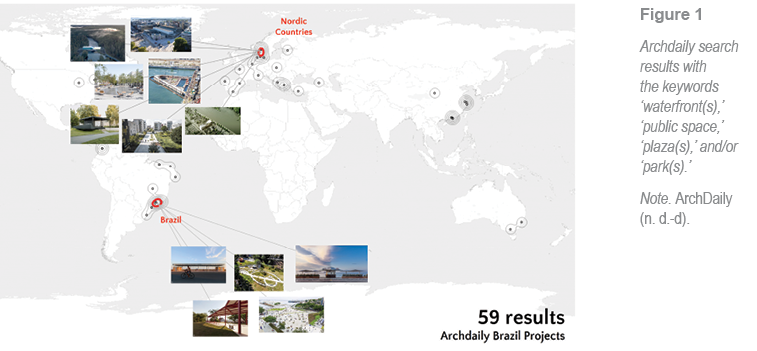
A keyword search on the Archdaily Brazil platform employing the term “orla” (waterfront) and its semantic variations yielded a total of 942 entries. The researchers then filtered these entries based on their relevance to public space design, ultimately resulting in a refined corpus of 59 architectural projects, as illustrated in Figure 1.
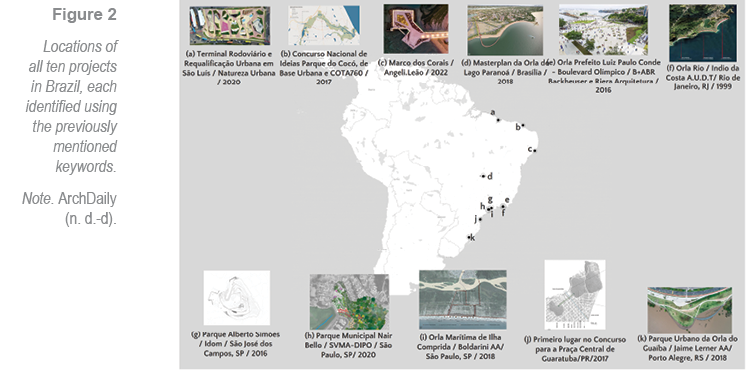
This analysis identified 11 projects located in Brazil that actively engage with waterfront redevelopment narratives. Figure 2 maps these projects, illustrating their geographic distribution across the country.
This group includes three case studies selected for in-depth analysis due to their prominence in architectural and urban planning debates, their visibility on the platform, and their representative significance concerning the research question on neoliberal rationalities in urban redevelopment. The selected projects are:
- Guaíba Waterfront Urban Park (Porto Alegre, 2018);
- Luiz Paulo Conde Waterfront Promenade (Rio de Janeiro, 2016);
- Futuro Park (Belém, 2018).
3.2 Narrative Interpretation
In this study, the interpretation method adopted engages with narrative assembly as both an epistemological stance and a formal procedure. By emphasizing fragmentary and non-linear forms of knowledge, the analysis actively explores intertextualities and aims to generate new legibilities (Benjamin, 1987, 2017; Didi-Huberman, 2007, 2015) through the juxtaposition of meanings derived from multiple narratives. Two conceptual constructs guide this interpretive work: first, arguments—understood as the structure of intrigue in Paul Ricoeur’s hermeneutics (Ricoeur, 2002)—serve as an analytical framework that traces explicit narrative configurations within each case. Second, the notion of themes, as developed by Barthes et al. (2011), helps uncover implicit intersections and shared semantic fields across the analyzed texts. Together, these constructs facilitate a layered reading of the architectural narratives, mobilizing both explicit and tacit knowledge.
DISCUSSION
This section offers a critical analysis of the selected case studies, emphasizing how their narratives reflect and reinforce neoliberal rationalities in urban waterfront redevelopment. Instead of examining the physical projects directly, this discussion prioritizes the ways in which these interventions are discursively constructed and legitimized through the platform ArchDaily Brasil.
Guaíba Waterfront Urban Park, Porto Alegre/Brazil
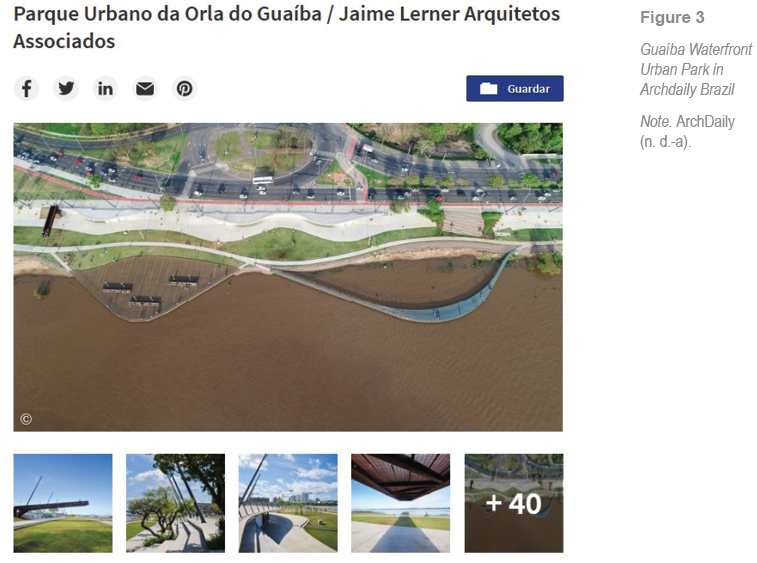
The Guaíba Waterfront Urban Park, officially known as the Moacyr Scliar Waterfront, represents the initial phase of the New Guaíba Waterfront Urban Park do Guaíba project in Porto Alegre. Designed by Jaime Lerner Arquitetos Associados and inaugurated in 2018, the project utilizes the elevation differences between the waterfront and Avenida Edvaldo Pereira Paiva to seamlessly integrate bleachers oriented toward the Guaíba River, along with commercial units, public restrooms, and storage facilities. It encompasses leisure and recreational areas connected by organically designed pathways, public seating spaces, and metal walkways extending over the water. Notable features include a river transport station and a circular restaurant that extends over the river.
The Archdaily article presents the site as if its prior degradation and underutilization were inherent conditions, rather than a constructed narrative designed to cultivate favorable public perception (Perseu, 2021). The justification for the project relies on its purported post-implementation benefits, including the reconnection of the city to the Guaíba River, which is a frequent theme in global waterfront urbanism. Other purported advantages include enhanced quality of life for the general populace, increased real estate value, and environmental restoration.
Recurring themes of urban renewal, heritage visibility, and the rehabilitation of supposedly degraded areas underlie these claims. The discourse asserts that such interventions restore urban spaces so they are more attuned to market expectations while simultaneously promoting local identity and fostering a sense of belonging. Narratives of regeneration and transformation emphasize that the city improves by incorporating spaces that are both accessible and marketable, thus enhancing their appeal to investors and developers. Concurrently, the proposal and construction of high-end skyscrapers and luxury restaurants in the surrounding area greatly affect the population’s access to these spaces.
While the public widely celebrates these changes, they often overlook the underlying commodification of public space, which reinforces neoliberal imperatives of profitability and urban governance (Misoczky de Oliveira, 2020). The project’s emphasis on “quality of life” and “environmental regeneration” implicitly reflects the value ascribed to urban spaces primarily in terms of their economic utility. Furthermore, stakeholders frame the transformation of abandoned or “onerous” areas not only as progress but also as a form of redemption. This framing influences public perceptions of urban landscapes and reinforces a vision of the city that aligns with dominant economic logics.
Luiz Paulo Conde Waterfront Promenade, Rio de Janeiro/Brazil
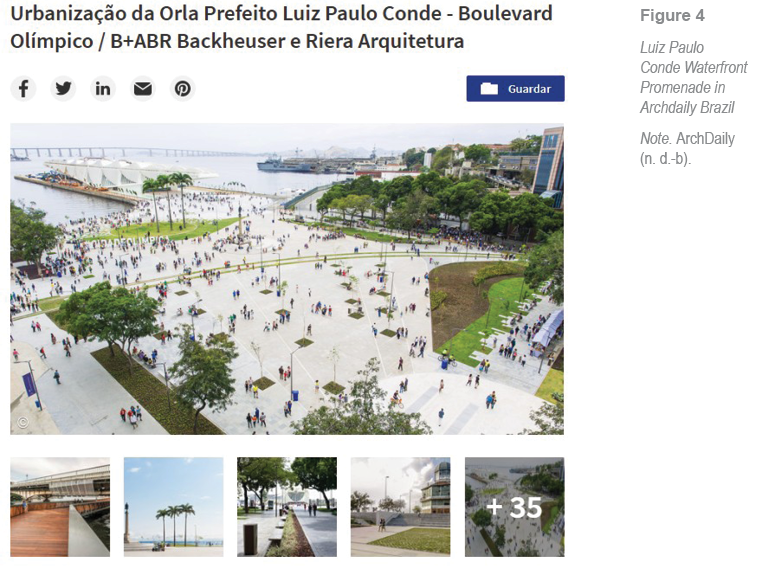
This project serves as a transformative intervention that reshapes the city’s relationship with its waterfront, an area historically overshadowed by an elevated expressway and characterized by industrial decline, leading to a fragmented and underutilized urban fabric. The promenade is a key component of the Porto Maravilha Urban Operation, which falls under the jurisdiction of the Brazilian City Statute Federal Law. This law facilitates public-private partnerships to invest in strategically targeted areas where private interest exists, yet essential public infrastructure is insufficient (Ribeiro, 2020).
The urban void in this area is particularly troubling due to the site’s profound historical significance. The Port of Rio de Janeiro served as one of the primary entry points for enslaved Africans in the Americas (Balteiro & Souza, 2023). A key landmark within this context is the Valongo Wharf, constructed in 1811. It functioned for two decades as a major landing and trading site for enslaved Africans. Today, Valongo Wharf constitutes a central element of Pequena África (Little Africa), a cultural and historical district dedicated to preserving both the tangible and intangible heritage of Rio’s Black communities. As a UNESCO World Heritage Site, Valongo Wharf embodies a critical space for memory, resistance, and identity. Additionally, the area includes Morro da Providência, which houses Brazil’s first favela—a powerful symbol of the country’s deep-rooted social inequalities and a significant landmark of urban struggle in Latin America.
The project narrative establishes a renewed connection with the Bay of Guanabara and positions the intervention as a crucial step in transforming the immediate surroundings and catalyzing broader revitalization of the urban landscape. This initiative actively frames its actions as the recovery of public space—territory that was once surrendered to industrial expansion and previously encroached upon by an elevated expressway. By reappropriating the waterfront, the project integrates itself into a larger urban renewal process that extends beyond its geographic confines, indicating that revitalization will resonate throughout the entire city.
This discourse emphasizes “visibility” as a strategic element in urban development. The project represents a reclamation of space that has been previously ignored or marginalized, with the restoration of public access to the waterfront framed as both a symbolically significant and materially impactful act. This gesture of reconnection reinforces the narrative of the city “returning” to its waterfront, enhancing the area’s appeal for investment and tourism while addressing the growing demand for high-quality public spaces.
This transformation manifests as more than a mere spatial or environmental intervention. It serves as an economic strategy, grounded in real estate development and market visibility. Furthermore, the regeneration of this particular stretch of the city hints at a broader ambition aimed at revitalizing the entire central area of Rio de Janeiro, especially within the framework of the Operação Urbana Porto Maravilha. By breathing new life into the waterfront, the project serves as a catalyst for further interventions—an initiative expected, in line with neoliberal reasoning, to stimulate local economies and elevate the city’s image on the global stage.
The renewed connection between the city and the Bay of Guanabara symbolizes both environmental and economic recovery, thereby reinforcing a vision of urban space driven by profitability and spectacle. In this context, and in line with Balteiro and Souza’s (2023) propositions, the project engages in a discourse that prioritizes economic and environmental revitalization. It implicitly equates the transformation of public space into sites of real estate potential with progress itself. This transition from a neglected industrial zone to a landscape of opportunity. This is articulated through a symbolic “return” to the water that captures a broader trend in contemporary urbanism, where urban space functions not only as a commons but also as capital.
Futuro Park, Belém/Brazil
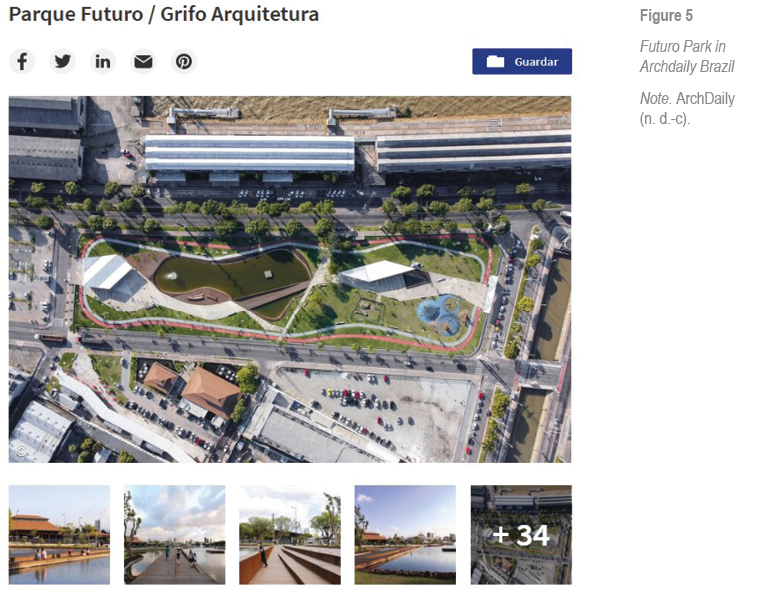
Belém is located in Guajará Bay, which is part of the world’s largest river basin. More than 57% of its population resides in favelas and faces serious sanitation issues, with less than 20% having access to functioning sewage systems (Instituto Brasileiro de Geografia e Estatística, 2022). This project is intended to be a transformative intervention that reclaims a previously underutilized site and transforms it into a vibrant, multifunctional public space. The project’s narrative reimagines what was once a neglected and disconnected area into a hub for leisure, recreation, and community engagement. The initiative addresses a broad spectrum of local demands, portraying the newly developed park as an amenity that improves daily life and fosters social interaction among city residents.
The architectural discourse surrounding the project positions it as an example of “good architecture,” highlighting essential attributes such as spatial clarity, formal coherence, and functional versatility. The design actively prioritizes inclusivity, aiming to serve a diverse public through a deliberate arrangement of green areas, pathways, seating, and spaces for events and play. This narrative indicates that the spatial strategy not only strives for accessibility but also to enhance the quality of life for city residents, framing the park as a successful integration of social, environmental, and aesthetic considerations. In his examination of reclaiming nature in the city, Juliano Ponte (2006) critiques the conversion of “nature” into a landscape primarily for visual consumption, particularly within the realm of self-proclaimed “sustainable” projects carried out in waterfront areas. Further, Ponte (2025) evaluates the implications of the 30th United Nations Climate Change Conference (COP 30), arguing that capitalist-driven modernization projects exacerbate social inequalities by increasing property prices, contributing to deforestation, and neglecting urgent poverty and sanitation issues.
These descriptions reflect a broader rhetoric of contemporary urbanism that links the revitalization of public spaces to social cohesion and urban well-being. In this context, the park functions not only as a site of leisure but also as a symbol of civic improvement—a proactive step toward fostering a more participatory and equitable city. However, these assertions necessitate critical examination, particularly concerning how the concepts of “inclusivity” and “quality of life” are defined and for whom they are intended. The park extends the port waterfront, establishing a vital connection to the Ver-o-Peso Market, Estação das Docas, and the Ver-o-Rio tourist complex. Surrounding neighborhoods feature luxury skyscrapers that cater exclusively to the upper classes, such as those in Umarizal.
Analyzing the project’s self-representation reveals that the narrative aims to position Parque Futuro as a model of progressive urban design. However, like many such interventions, this framing raises critical questions about the underlying assumptions urban planners and city officials make regarding space, publicness, and value within the sphere of contemporary architectural production.
Explicit Arguments and Project Rationales
In narratives of urban transformation, urban planners and architects frequently employ a well-known before-and-after formula. They initially portray the space as problematic—underutilized, degraded, or obsolete—and subsequently reimagine it as revitalized, contributing to enhancements in economic, social, and environmental dimensions. This linear progression implies a consensus around the notion of improvement and suggests universal benefits while often overlooking persistent conflicts and structural inequities that underlie these changes.
Beneath these explicit claims, however, several implicit themes emerge that reveal the ideological substratum sustaining and legitimating dominant forms of urban transformation. These themes transcend individual projects and actively shape public perceptions, representations, and valuations. They articulate a form of aestheticized neoliberalism, whereby urban form, visual coherence, and environmental imagery serve as vehicles for economic rationality and the commodification of public space.
- Obsolescence: The pre-intervention landscape is commonly presented as outdated, decaying, or functionally inert. The depiction of the “before” image conveys a pervasive sense of negativity, portraying the site as a space in decline. Consequently, stakeholders frame their transformation as a necessary and inevitable progression. This rhetorical strategy simplifies the rich social, historical, and cultural complexities of urban spaces, rendering the intervention as an unassailable benefit. The narrative of decay and renewal translates social inequality into a visual representation, framing deprivation as an aesthetic challenge to be addressed through design.
- Devolutions: Numerous narratives present the project as an act of restitution—a “return” of the space to the public. This language of giving back implies that prior claims or misuses of the area necessitated its restoration as a public good. However, this framing often obscures the underlying power dynamics and economic interests that influence urban redevelopment, simplifying intricate negotiations surrounding space into a narrative of civic generosity.
- Connection with Nature: Water bodies and natural landscapes function as powerful symbols of environmental renewal. By restoring connections to rivers, bays, and coastlines, stakeholders frame this process as a “return” to nature, thereby providing the public with access to serene, pristine, and ostensibly timeless environments. While this imagery possesses significant aesthetic and symbolic value, it risks depoliticizing nature by detaching it from lived histories and contested uses, ultimately recasting it as a neutral backdrop for leisure activities and investment opportunities. This phenomenon of eco-aestheticization operates as a branding strategy that aligns environmental imagery with the valorization of real estate.
- Post-Industrial Landscapes: Scholars and commentators frequently depict former industrial or port areas as “empty,” “abandoned,” or “wasted” before any intervention occurs. They characterize the redevelopment of these sites as a necessary transition toward new, allegedly more productive uses, often focused on consumption, tourism, and real estate. However, such narratives actively erase the labor histories, material cultures, and social fabrics that previously defined these spaces, ultimately closing off possibilities for alternative, community-driven forms of reuse.
- Heritage: When scholars and urban designers discuss heritage, they often reframe it through environmental or aesthetic lenses—focusing on ecological restoration, greening, or sustainability. This tendency displaces critical dimensions of heritage, including memory, identity, and social significance, thereby reducing it to a mere tool for beautification and environmental branding. Heritage, in this context, transforms into a component of the marketing apparatus, aesthetically tailored to coincide with the consumable image of a sustainable city.
- Commodification: Urban transformation increasingly positions itself as an economic imperative. Narratives highlight rising property values, increased investment, and job creation as primary outcomes, while framing public space more as an asset to be managed and monetized rather than a collective right. This framing prioritizes market logic and marginalizes critical issues of social equity, public participation, and environmental justice. In this context, commodification and aestheticization converge, and beauty serves as evidence of value, which subsequently justifies exclusion.
Together, these themes expose the neoliberal logic that underlies much of the discourse on contemporary urban transformation. The focus on economic growth, aesthetic renewal, and environmental performance frequently sidelines a more profound engagement with the social, political, and cultural complexities inherent in urban spaces. By presenting narratives as linear and consensual, they obscure the tensions, exclusions, and resistances that inevitably accompany processes of spatial reconfiguration. Furthermore, these narratives aestheticize inequality, transforming structural asymmetries into visually appealing landscapes that naturalize privilege and displacement, all under the pretense of modernization and care.
CONCLUSION
This study investigates how waterfront redevelopment projects in Brazil are framed within the dominant discourses of neoliberal urbanization—discourses that prioritize economic growth and aesthetic appeal while neglecting the socio-political complexities involved. The architectural narratives presented on ArchDaily Brasil reinforce market-oriented paradigms by portraying these transformations as unequivocal improvements, employing the rhetorical device of a linear, before-and-after trajectory.
By emphasizing aesthetics as both form and ideology, these narratives contribute to what can be termed the aestheticization of inequality—a process that renders uneven urban development palatable, even desirable, through the language of design, sustainability, and beauty. The commodification of public space aligns with this aestheticization. Spaces become visually democratized while simultaneously being materially privatized. Together, these dynamics illustrate how neoliberalism becomes manifest in the built environment—not merely as policy and economics but also as affect, representation, and collective imagination.
Future research should expand this inquiry by conducting comparative analyses of waterfront developments across various global contexts, actively interrogating how architectural narratives mediate and naturalize neoliberal urban strategies. These investigations should also explore counter-narratives and alternative planning models that effectively resist the homogenizing forces of market-driven development.
This exploration illuminates the potential of architecture and urbanism to function not only as instruments of capital accumulation but also as tools for fostering collective agency, social justice, and spatial democratization. Consequently, the role of architecture in the production of landscape thus becomes inherently double-edged. It has the capacity to reproduce and legitimize hegemonic economic paradigms while simultaneously articulating alternative imaginaries—forms of practices rooted in plurality, equity, and ecological stewardship.
The challenge involves actively engaging with the assumptions underlying neoliberal urbanism and mobilizing architectural and planning practices that expose and counteract the aestheticized invisibility of inequality. Ultimately, this research aims to promote a deeper reflection on the political stakes of design and to explore architecture as a practice of resistance and reimagination within the contested urban landscape.
REFERENCES
Aalbers, M. B. (2016). The financialization of housing: A political economy approach. Routledge. https://doi.org/10.4324/9781315668666
Arantes, O., Vainer, C., & Maricato, E. (2013). A cidade do pensamento único: desmanchando consensos (8th ed.). Vozes.
ArchDaily. (n. d.-a). Guaíba Orla Urban Park/Jaime Lerner Arquitetos Associados. Retrieved May 14, 2025, from archdaily.com/907900/guaiba-orla-urban-park-jaime-lerner-arquitetos-associados
ArchDaily. (n. d.-b). Luiz Paulo Conde Waterfront Promenade/B+ABR Backheuser e Riera Arquitetura. ArchDaily. Retrieved May 14, 2025, from archdaily.com/806630/luiz-paulo-conde-waterfront-promenade-b-plus-abr-backheuser-e-riera-arquitetura?ad_source=search&ad_medium=projects_tab
ArchDaily. (n. d.-c). Parque Futuro / Grifo Arquitetura. ArchDaily Brasil. Retrieved May 14, 2025, from archdaily.com.br/br/980559/parque-futuro-grifo-arquitetura
ArchDaily. (n. d.-d). Homepage. Retrieved September 2, 2023, from archdaily.com.br
Balteiro, L. C., & Souza, C. H. (2023). O capital no espaço urbano e suas incongruências: os casos da avenida Berrini e do Porto Maravilha. Revista de Geografía, 40(2), 59-78. https://doi.org/10.51359/2238-6211.2023.254210
Barthes, R., Greimas, A.J., Bremond, C., Eco, U., Gritti, J., Morin, V., Metz, C., Todorov, T., & Genette, G. (2011). Análise estrutural da narrativa (7th ed.). Vozes.
Benjamin, W. (1987). Magia e técnica, arte e política: ensaios sobre literatura e história da cultura. Editora Brasiliense.
Benjamin, W. (2017). Rua de mão única: Infância berlinense: 1900. Autêntica Editora.
Berque, A. (1998). Paisagem marca, paisagem matriz: elementos da problemática para uma geografia cultural. In R. L. Corrêa & Z. Rosendahl (Eds.), Paisagem, tempo e cultura (pp. 84-91). EdUERJ.
Brenner, N., & Keil, R. (2014). From global cities to globalized urbanization. Glocalism: Journal of Culture, Politics and Innovation, (3). https://doi.org/10.12893/gjcpi.2014.3.3
Brenner, N., Marcuse, P., & Mayer, M. (2012). Cities for people, not for profit: Critical urban theory and the right to the city. Routledge.
Caron, D. (2017). El estudio del paisaje como clave interpretativa del territorio a través de las narrativas para la planificación urbana y territorial: Paraty, Río de Janeiro/Brasil como caso de estudio [Doctoral dissertation, Universitat Politècnica de Catalunya]. LUME Repositório Digital.
Castells, M. (2013). A sociedade em rede. Paz & Terra.
Didi-Huberman, G. (2007). Un conocimiento por el montaje [Interview with Pedro G. Romero]. Retrieved April 27, 2026, from dialnet.unirioja.es/servlet/articulo?codigo=488068
Didi-Huberman, G. (2015). A semelhança informe: Ou o gaio saber visual segundo Georges Bataille. Contraponto.
Escobar, A. (1995). Encountering development: The making and unmaking of the Third World. Princeton University Press.
Fix, M. (2007). São Paulo cidade global. Fundamentos financeiros de uma miragem. Editora Boitempo.
Foucault, M. (1982). The subject and power. Critical Inquiry, 8(4), 777-795. https://doi.org/10.1086/448181
Gil, A. C. (2008). Métodos e técnicas de pesquisa social (6th ed.). Atlas.
Harvey, D. (2008). Neoliberalismo: história e implicações. In O Estado Neoliberal (pp. 75-96). Edições Loyola.
Instituto Brasileiro de Geografia e Estatística. (2022). Censo demográfico 2022. https://censo2022.ibge.gov.br/panorama/
Ingold, T. (1993). The temporality of landscape. World Archaeology, 25(2), 152-174. https://doi.org/10.1080/00438243.1993.9980235
Jacques, P. B. (2008). Corpografias urbanas. Arquitextos, 8(093.07). Vitruvius. Accessed October 2, 2018 from https://vitruvius.com.br/revistas/read/arquitextos/08.093/165
Kowarick, L. (1979). A espoliação urbana. Paz e Terra.
Kowarick, L. (2009). Viver em risco: Sobre a vulnerabilidade socioeconômica e civil. Editora 34.
Lehrer, U., & Laidley, J. (2008). Old mega-projects newly packaged? Waterfront redevelopment in Toronto. International Journal of Urban and Regional Research, 32(4), 786-803. https://doi.org/10.1111/j.1468-2427.2008.00830.x
Misoczky de Oliveira, C. (2020). A produção do espaço urbano na orla de Porto Alegre, Brasil. Revista de Urbanismo, (42), 17-31. https://doi.org/10.5354/0717-5051.2020.54280
Muir, J., McKnight, M., Brontë, J., & Boland, P. (2015). The new waterfront: Who benefits? A report for the RICS Research Trust and the Institute of Spatial and Environmental Planning, Queen’s University Belfast. Royal Institution of Chartered Surveyors.
Muñoz, F. (2003). Urbanalization: Landscapes of post-industrial change. Gustavo Gili.
Paese, C., Perseu, G. M., & Mariano, G. (2022). Construir o Sul, habitar o Norte: Orlas urbanas como forma de expressão de um mundo globalizado. Pixo, 6(21), 402-419. https://doi.org/10.15210/pixo.v6i21
Perseu, G. M. (2021). Cidade, modos de postar: Paisagens de orla de Porto Alegre em narrativas online no século XXI [Master’s thesis, Federal University of Rio Grande do Sul]. LUME Reporitório Institucional. http://hdl.handle.net/10183/234909
Perseu, G. M., & Caron, D. (2021). Mais do Mesmo: Orlas urbanas em contexto neoliberal. In Anais do XI Congresso Brasileiro de Direito Urbanístico. UCSal. https://doi.org/10.29327/166881
Perseu, G. M., & Caron, D. (2022). Para operar o urbano por dentro é preciso uma boa dose de paisagem. Pixo, 22(6), 94-109.
Ponte, J. P. X. (2006). Sustentabilidade, desenvolvimento e planejamento urbano: reconfiguração de margens fluviais em Belém (PA). Revista Brasileira de Estudos Urbanos e Regionais, 8(1), 27-44. https://doi.org/10.22296/2317-1529.2006v8n1p27
Ponte, J. P. X. (2025). Sustentabilidade de fachada: O outro lado da COP30 em Belém [Special interview with Juliano Pamplona Ximenes Ponte with Letícia Fagundes and Patricia Fachin]. Instituto Humanitas Unisinos; Universidade do Vale do Rio dos Sinos. https://ihu.unisinos.br/categorias/159-entrevistas/653556-sustentabilidade-de-fachada-o-outro-lado-da-cop30-em-belem-entrevista-especial-com-juliano-pamplona-ximenes-ponte
Ribeiro, L. C. de Q. (2020). As metrópoles e o direito à cidade na inflexão ultraliberal da ordem urbana brasileira. Observatório das Metrópoles. http://www.observatoriodasmetropoles.net.br/wp-content/uploads/2020/01/TD-012-2020_Luiz-Cesar-Ribeiro_Final.pdf
Ricoeur, P. (2002). Arquitectura y narratividad. Arquitectonics. Mind, Land & Society, (4), 9-29. https://revistes.upc.edu/index.php/ARQUITECTONICS/article/view/11103
Rolnik, R. (2019). Paisagens para renda, paisagens para vida: Disputas contemporâneas pelo território urbano. Indisciplinar, 5(1), 18-43. https://periodicos.ufmg.br/index.php/indisciplinar/article/view/32741
Sampieri, R. H., Collado, C. F., & Lucio, M. D. P. B., (2013). Metodologia de pesquisa. Editora Penso.
Santos, M. (1994). O retorno do território. In M. Santos, M. A. Aparecida de Souza & M. L. Silveira (Eds.), Território: Globalização e Fragmentação. Editora Hucitec e Anpur.
Santos, M. (2000). Por uma outra globalização: Do pensamento único à consciência universal. Editora Record.
Smith, N. (2002). New globalism, new urbanism: Gentrification as global urban strategy. Antipode, 34(3), 427-450. https://doi.org/10.1111/1467-8330.00249
Sousa Santos, B. (2016). Epistemologies of the South: Justice against epistemicide Routledge. https://unescochair-cbrsr.org/pdf/resource/Epistemologies_of_the_South.pdf
Swyngedouw, E., Moulaert, F., & Rodriguez, A. (2002). Neoliberal urbanization in Europe: Large–scale urban development projects and the new urban policy. Antipode, 34(3), 542-577. https://doi.org/10.1111/1467-8330.00254
Tommarchi, E. (2025). Waterfront redevelopment five decades later: An updated Typology and Research Agenda. Ocean and Society, 2, Article 9265. https://doi.org/10.17645/oas.9265
Vives Miró, S. (2011). Producing a “successful city”: Neoliberal urbanism and gentrification in the tourist city—the case of Palma (Majorca). Urban Studies Research, 2011, article 989676., https://doi.org/10.1155/2011/989676