Reduction of Delivery Times
through Supply Chain Tools in a Company
of the Chemical Sector
Ayme K. Anglas Valerio1 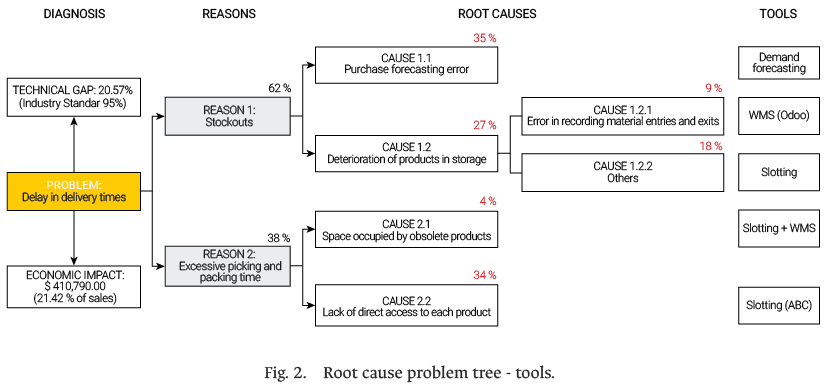 , Milagros K. Rojas Bravo2 , Gustavo A. Luna Victoria León3 ,
Wilson D. Calderón Gonzales4
1[email protected], [email protected], [email protected], [email protected]
1234Carrera de Ingeniería Industrial, Universidad de Lima, Perú
Received: August 15, 2025 / Accepted: September 20, 2025 / Published: 5 June, 2026
doi: https://doi.org/10.26439/ciii2025.8658
ABSTRACT—This article addresses the problem of delivery delays in a Peruvian chemical sector company, where traditional logistics operations and a low level of digitalization have resulted in economic penalties equivalent to 17.14% of its annual sales. Based on a functional and economic diagnosis, the main root causes identified were errors in materials forecasting, product deterioration, and warehouse layout disorganization. To address this issue, an improvement model was designed using Supply Chain Management (SCM) tools, integrating ABC analysis, the Odoo inventory management system, slotting, and demand forecasting. Validation using simulation and performance indicator analysis demonstrated substantial improvements, with the service level increasing from 59% to 92%, picking time reduced by 91%, and economic penalties decreasing by 83%. Furthermore, the warehouse layout redesign led to improved internal flows, reduced unnecessary travel, and more efficient use of storage space. In addition, weekly quality controls were incorporated, together with a barcode-based traceability system for real-time tracking of inventory inflows and outflows. These results confirm the effectiveness of the proposed model and provide applied evidence to optimize logistics processes in medium-sized companies in the chemical sector, contributing to the achievement of Sustainable Development Goals (SDGs) 8, 9, 12, and 13 through a low-cost, highly applicable, and potentially replicable solution in other logistics environments.
Index Terms—ABC classification, demand forecasting, inventory management, logistics, slotting.
- Introduction
The chemical sector in Peru represents a key link in the manufacturing industry, contributing around 1.3% to national GDP and 10% to manufacturing GDP. However, its evolution has been irregular in recent decades, conditioned by high dependence on imported inputs, low levels of technological investment, and stringent regulatory standards that increase operational complexity. In addition, growing market pressure demands improvements in efficiency, reductions in logistics costs, and faster responses to the specific requirements of strategic sectors such as mining, construction, and agribusiness.
Within this context, medium-sized companies in the sector encounter logistical difficulties stemming from manual operations, limited digitalization, and inadequate responsiveness to demand fluctuations.
Several studies and organizations, including the National Institute of Statistics and Informatics (INEI) and the National Society of Industries (SNI), have identified delivery time delays as one of the main problems in the sector. These delays are attributed to factors such as errors in demand planning, warehouse disorganization, and a lack of inventory traceability. At the international level, the scientific literature has explored solutions to these challenges through the application of Supply Chain Management (SCM) tools, highlighting techniques such as ABC analysis, slotting, demand forecasting, and the integration of digital management systems.
Nevertheless, notwithstanding the progress achieved in logistics management, the chemical sector continues to be insufficiently addressed in applied logistics studies, especially in the case of firms engaged in the commercialization of chemical inputs. According to [1], academic research has not yet delved deeply into SCM in this segment, while [2] and [3] highlight specific challenges related to storage, digitalization, and regulatory compliance. The scarcity of applied studies in this area emphasizes the relevance of this work, as it provides empirical evidence and an improvement model adapted to the operational reality of companies engaged in the commercialization of chemical inputs, thus contributing to narrowing the identified knowledge gap.
The company under study, dedicated to marketing specialized chemical products mainly for the mining sector, has an annual average on-time delivery (OTD) rate of only 74.5%, significantly below the sector benchmark of 95% [4]. In addition, the company has incurred economic penalties amounting to 17.14% of its annual turnover, equivalent to USD 328,600, as a result of delivery delays. The main causes identified include errors in demand forecasting, product deterioration resulting from inadequate storage conditions, and disorganization of the warehouse layout, which significantly increases the time required to locate and prepare orders. These deficiencies not only result in financial losses but also impact the company’s reputation with its corporate clients, who demand high levels of contractual compliance.
The main objective of this study is to design and validate an improvement model that reduces delivery times through the implementation of SCM tools. The hypothesis posits that the integration of ABC analysis, an inventory management system, slotting strategies, and demand forecasting techniques will improve the service level, optimize logistics processes, and reduce penalty-related costs. In addition, the intervention is expected to enhance inventory movement traceability, improve operational control, and provide greater visibility into product status at each stage of the logistics process, thereby promoting more efficient management aligned with business environment requirements.
The relevance of this research lies in its contribution of empirical, actionable evidence to the logistics operations of medium-sized companies in the chemical sector, supporting operational efficiency, economic and environmental sustainability, and the achievement of SDGs 8, 9, 12, and 13.
- Methodology
The methodology adopted in this research is applied in nature, with a descriptive–explanatory scope and a quantitative approach. The study was structured into four phases—diagnosis, design, implementation, and validation—under a systematic framework aimed at improving the logistics processes of a company in the chemical sector. Throughout the development, the objective was not only to describe the current situation and its main problems, but also to explain their underlying operational causes and propose concrete and feasible solutions. This is consistent with the approach presented in [5], where the combination of Lean and Six Sigma methodologies within supply chain processes can effectively address complex operational problems and improve overall performance.
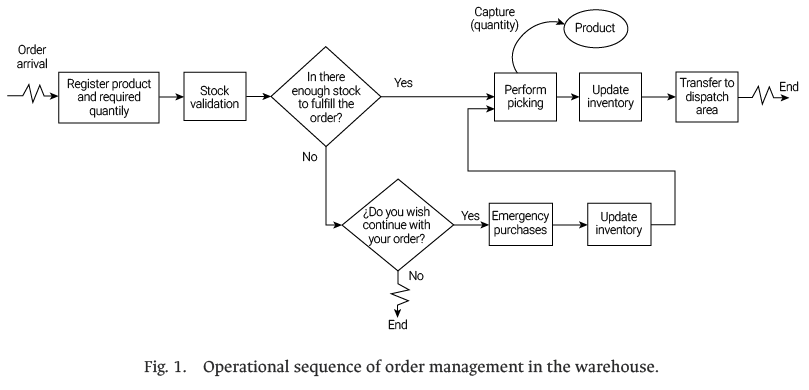
The research focused specifically on the company’s internal logistics process, with particular emphasis on warehouse management and the order fulfillment stage, as these areas exhibited the primary operational inefficiencies and customer service delays. These shortcomings impacted not only the response time, but also inventory control, interdepartmental coordination, and product traceability. Accordingly, the current flow of activities—from order receipt to dispatch readiness—was mapped to identify critical improvement points. This flow is shown in Fig. 1, which details the operational sequence of warehouse order management.
During the diagnosis phase, historical data were collected from the company’s internal records, and current information was gathered using Excel recording formats, in which operational staff recorded product entry and exit times, delays causes, and associated penalties. This approach enabled the creation of a structured, organized, and comparable database for both quantitative and qualitative analysis.
To identify the primary causes of delivery delays, classical root cause analysis tools were applied, such as the Ishikawa diagram, Pareto chart, and interviews with key personnel involved in daily logistics operations. These tools facilitated a comprehensive view of the process and allowed for the comparison of quantitative data with the team’s practical experience. Through these tools, several critical factors were identified, including demand forecasting errors, product deterioration, inadequate warehouse layout design due to poor location criteria, inventory recording errors, and limited product accessibility.
In addition, a systematic literature was reviewed applying the PRISMA method, with the aim of identifying relevant approaches, tools, and results in previous studies related to logistics management.
Based on the systematic literature review, the empirical findings were contrasted with approaches previously applied in related studies, thereby providing conceptual support for the selection of the most appropriate tools and methodologies to address the logistical problems identified in the company. This contrast not only enriched the analysis but also provided a solid foundation for the construction of the problem tree, a tool that enabled the clear and structured organization of the main logistics process deficiencies, along with their root causes and consequences. This visual representation enabled the prioritization of critical aspects and guided the design of improvement proposals aligned with the actual needs of the analyzed operational context.
The case company faces significant challenges related to delivery delays, as evidenced by a low on-time delivery (OTD) level. This indicator was calculated using the following formula:
 (1)
(1)
According to analyzed data, the current OTD rate is only 74.43%, representing a gap of 20.57 percentage points relative to the 95% compliance standard established in [4]. This discrepancy indicates a significant deficiency in the company’s logistics performance and underscores the need for targeted interventions to enhance responsiveness.
The total economic impact is estimated at USD 410,790.00, equivalent to 21.42% of total sales, with penalties accounting for approximately 17% of turnover, while the remaining proportion corresponds to other logistics-related costs.
As shown in Fig. 2, the primary causes identified are stockouts (62%) and prolonged picking and packing times (38%), highlighting the need for improvements in warehouse management and infrastructure.
More specifically, within the 62% attributed to stockouts, 30% is associated with purchase forecasting failures, 27% with the presence of damaged products, and 5% with inventory recording errors or internal communication failures. This distribution reflects not only limitations in physical inventory control but also deficiencies in planning processes and information capture.
Likewise, within the 38% attributed to picking and packing activities, 20% is explained by space occupied by obsolete products and 18% by inefficient item accessibility, indicating a poorly optimized layout design and an inefficient distribution that increases personnel travel times.
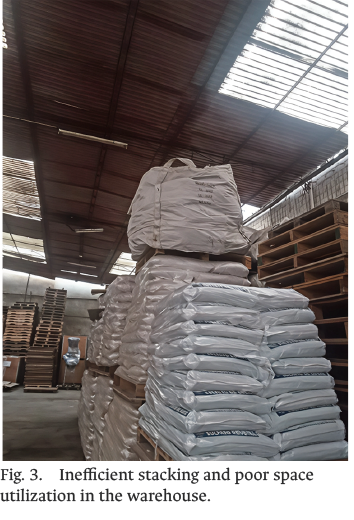
This situation is illustrated in Fig. 3, which shows the disorganized warehouse layout. The image depicts poor stacking practices and inefficient use of vertical space, which not only compromise safety but also hinder rapid access to products and increase the time required to locate and handle materials. These deficiencies reinforce the need for a structured and optimized storage system as part of the improvement model proposed.
As an improvement proposal, a conceptual model consisting of four integrated components was designed to optimize logistics management and reduce idle time in the warehouse.
The first component is ABC analysis, a technique that classifies products according to their turnover and strategic importance. This categorization facilitates inventory reorganization by freeing up space, optimizing picking routes, and concentrating resources on the most impactful items within the logistics operation. Moreover, ABC analysis not only enhances warehouse management but also maximizes space utilization, streamlines workflows, and contributes to the reduction of operating costs, making it a fundamental tool for achieving efficiency in logistics environments [6].
The second component corresponds to the inventory management system, implemented using Odoo as an Enterprise Resource Planning (ERP) platform, in which the Warehouse Management System (WMS) module is integrated along with reorder point–based purchasing policies. Combined, these functionalities enable digitalized operations, ensure more efficient warehouse management, and optimize supply processes.
In its role as a WMS module, Odoo incorporates a recording and virtual mapping system that enables real-time tracking of inventory inflows and outflows through barcode technology. Likewise, as an ERP platform, it directly links the sales and warehouse modules, automating order management and ensuring seamless interdepartmental coordination.
This strengthens product traceability, optimizes space utilization, and reduces risks associated with losses due to deterioration or obsolescence. Consequently, higher record accuracy is achieved, human errors are minimized, and inventory turnover becomes more agile and controlled, as reported in recent studies on ERP integration and sustainability [7].
Additionally, reorder point–based purchasing policies enable the establishment of minimum inventory thresholds per product, triggering replenishment processes when stock levels fall below these limits. This logic prevents stockouts and ensures that inventory levels remain within safe ranges, especially for high-turnover products. Likewise, it is complemented by periodic quality control activities, conducted weekly for three hours, aimed at detecting deteriorated products before they enter the logistics chain.
Finally, the choice of Odoo as the ERP platform is justified not only by its real-time integration and automation capabilities but also by its open-source nature, which makes it an accessible alternative for companies with limited resources. The implementation of open-source ERP systems, such as Odoo, has been shown to enhance organizational performance, underscoring their value as effective and cost-efficient solutions for optimizing logistics and operational processes across diverse business contexts [7].
The third component is the slotting technique aimed at reorganizing the physical arrangement of products in the warehouse to reduce personnel physical workload and travel times. In this reorganization, no individual product was examined; instead, the previously established ABC classification was used as a basis, grouping products according to their turnover and strategic impact. This approach enabled the redesign of the warehouse layout by placing high-turnover products (category A) in fast-access zones near the dispatch areas, while lower-frequency products (categories B and C) were allocated to less prioritized areas. In this way, operator routes were optimized, picking travel time was reduced, and a logical and functional space distribution was achieved without the need for complex or costly solutions. In low-digitalization logistics environments, techniques such as slotting have demonstrated an immediate impact by strategically assigning products within the warehouse to maximize space utilization, streamline material flows, reduce operational costs, and ensure traceability from the outset [8].
Finally, the fourth component integrates slotting with demand forecasting, using a demand forecasting through a linear regression–based forecasting model, enabling the anticipation of future demand, the prevention of stockouts, and the support of strategic decisions related to layout design and inventory replenishment. Moreover, within the Peruvian context, studies have demonstrated that the integration of statistical forecasting methods—such as Holt–Winters and SARIMA—with the economic order quantity (EOQ) model and safety stock policies can yield highly favorable results. This combination resulted in a 75% reduction in stockouts, achieving a Net Present Value (NPV) of USD 9.031, an Internal Rate of Return (IRR) of 92%, and a payback period of only 59 days [9]. These results support the effectiveness of the integrated planning and replenishment models proposed in this study, reinforcing their applicability in resource-constrained environments with high operational efficiency requirements.

Together, these four elements complement each other to increase operational efficiency, reduce logistics costs, and guarantee a continuous product flow within the warehouse, as shown in Fig. 4. Their selection is warranted by their low cost, rapid implementation, and high applicability in low-digitalization logistics environments, positioning them as a practical and effective solution for medium-sized companies. Furthermore, it is acknowledged that although many companies implement ERP systems to streamline their operations, these systems can fail to integrate sustainability metrics throughout all processes. In this regard, the proposal presented in [7], based on Transaction Cost Theory, is particularly relevant, as it enables the quantification of both sustainability probabilities and potential losses by modeling processes as input–output systems, thus providing an analytical framework that complements and strengthens the logic of the implemented model.
Additionally, regulatory guidelines related to occupational health and safety in logistics operations were considered during the model design. In particular, the provisions of 29 CFR 1910.120 issued by the United States Department of Labor were taken into account, as they require employers to develop and implement a written safety and health program that enables the identification, evaluation, and control of risks, as well as the inclusion of emergency response procedures [10].
Likewise, Clause 6.1.2 of the ISO 45001 standard requires the proactive identification of workplace hazards, along with the assessment of associated risks and opportunities, to promote a safer environment and improve the performance of the occupational health and safety management system [11]. Complementarily, under Clause 8.2 of the same standard, organizations must establish, implement, and maintain procedures to identify potential emergency situations, such as fires or chemical spills, and ensure active planning, training, regular drills, and continuous improvement of emergency response [12].
At the national level, these requirements are complemented by Law No. 29783, which mandates companies to adopt occupational risk prevention systems, strengthening preventive management through warehouse reorganization, reduction of workers’ physical strain, and improvement in chemical product traceability [13].
Likewise, Law No. 30222 reinforces this regulatory framework by introducing provisions on sanctions and oversight in occupational health and safety management, which is particularly relevant for activities involving the handling of chemical substances [14].
These regulatory frameworks provided a foundation to ensure that the proposed improvements not only optimize processes but also maintain safe operating conditions in compliance with current regulations for the personnel involved.
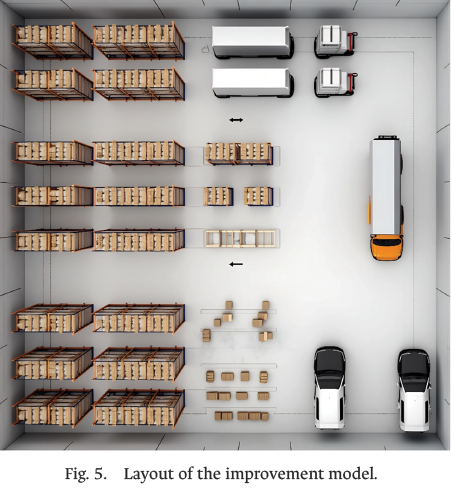
For the implementation phase, a proposed layout was designed, as illustrated in Fig. 5, with the objective of reorganizing storage space by incorporating racks and designated areas for products classified according to the ABC analysis. This redistribution aimed to reduce travel distances, optimize product accessibility, and decrease picking times. The layout design was initially validated through a pilot test conducted on 15 selected products, proportionally distributed among Categories A, B, and C according to their share of annual sales, to ensure the representativeness of products with the greatest impact on logistics operations.
Additionally, qualitative observations from operational staff were collected regarding accessibility, safety, and signage clarity, to adapt the layout to the actual conditions of the warehouse. This process enabled the verification of the operational feasibility of the proposed changes and allowed adjustments prior to full implementation.
In the validation phase, the unit of analysis was the orders managed by the logistics area, considering their processing times and operational incidents. A sample of 357 orders was selected using stratified sampling from the total orders recorded in 2023, ensuring the representativeness of Categories A, B, and C as defined by the ABC analysis.
Based on this, computer simulation using Arena was used to model both the current and proposed scenarios, evaluating indicators such as OTD percentage, picking times, logistics costs, and penalty amounts.
To ensure statistical robustness, 39 replications per scenario were carried out, allowing for the analysis of result variability and supporting the effectiveness of the proposed improvements. The use of Arena as a validation tool is supported by previous research [15], where the simulation of a redesigned truck dispatch layout increased daily throughput by 36% to 45%, depending on the scenario applied.
This highlights Arena’s usefulness as an effective tool to evaluate alternative scenarios and support logistics decisions with quantitative evidence.
To guarantee system sustainability, a continuous improvement module was incorporated, based on statistical monitoring of demand and variability control, with periodic layout updates and automated replenishment policies.
In the initial model developed in Arena, the company’s logistics system was represented using a supply scheme based on monthly purchases. However, to simulate inventory dynamics more realistically, progressive improvements were implemented in a second scenario. To realistically represent the dynamics of the logistics system, stockout events were modeled using decision blocks, while the limited inventory capacity available for each product was represented with specific simulation resources, following the methodology proposed in Simulation with Arena [16]. In addition, three differentiated processing lines were established according to the ABC classification, enabling the application of specific treatments based on turnover levels: high, medium, or low.
In this new scenario, the possibility of emergency purchases was also incorporated, activated automatically in critical stockout situations. Although these purchases allowed operations to continue, they implied an increase in logistics costs and generated additional delays in order preparation, as their arrival could take between one and two days.
To reduce the times associated with picking and stock validation, the measurements taken during the pilot test were used as a reference, in which the impact of the warehouse reorganization was examined under controlled conditions.
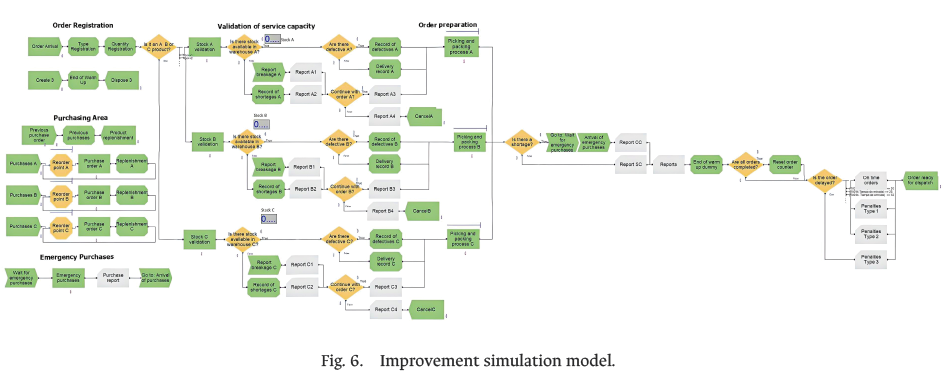
The redistribution of warehouse space, based on product rotation and accessibility criteria, enabled a reduction in staff movements during order preparation, directly decreasing total process time. In addition, the digital recording of product inflows and outflows facilitates verification of available inventory without the need for continuous physical counts.
This basic digitalization, although still limited, contributed to streamlining stock validation and enhancing inventory visibility, demonstrating that even with accessible resources, key warehouse processes can be effectively optimized.
As a complement, an automatic reordering logic was implemented, in which each product was assigned a specific reorder point according to its category (A, B, or C). When available stock fell below this threshold, the system automatically generated a purchase order, eliminating dependence on a fixed monthly supply schedule and enabling more timely and efficient replenishment.
To conclude, a quality control subprocess was integrated, implemented through the failure logic, and executed weekly for a three-hour period. This mechanism simulated the possibility that certain products might not meet the required standards, enabling the identification and isolation of deteriorated items before their inclusion in the logistics chain. Thanks to this control, a more accurate and up-to-date view of inventory availability for order fulfillment was achieved.
- Results
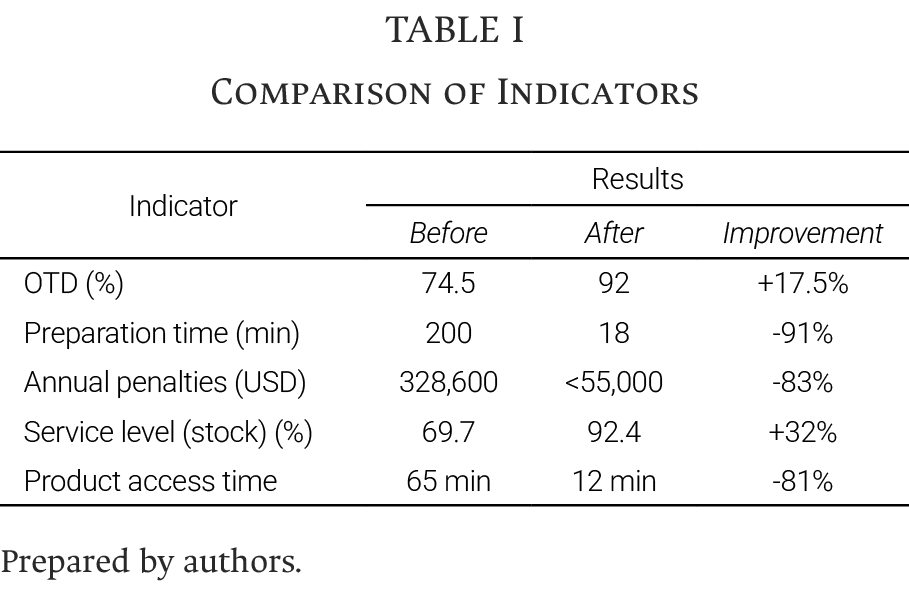
The implementation of the improvement model yielded positive results across all key indicators. First, the OTD level increased from 74.5% to 92%, bringing logistics performance in line with industry standards. This improvement is primarily attributed to warehouse reorganization and the digitalization of inventory control.
Second, the average order preparation time decreased from 200 to 18 minutes, representing a 91% improvement. This result was achieved through slotting, which positioned high-turnover products in accessible areas, and the use of scanning devices integrated with the Odoo system.
From an economic perspective, annual penalties were reduced by 83%, from USD 328.600 to less than USD 55.000. Likewise, logistics costs associated with extra transport time decreased by 30.9% due to the elimination of urgent shipments caused by inventory errors.
Table I summarizes these results and compares key indicators before and after the implementation of the improvement model.
In addition to operational benefits, the model improved traceability, reduced product deterioration, and strengthened logistics sustainability. The integration of real-time data and automatic report generation facilitated strategic decision-making in inventory management.
- Discussions
The results of this study demonstrate that implementing an integrated improvement model based on SCM tools is highly effective in logistics environments with low digitalization. Unlike isolated interventions, the sequential combination of ABC analysis, the Odoo system, slotting, and forecasting simultaneously addressed the operational, technical, and human causes of the problem.
The improvement in OTD, the reduction of penalties, and the optimization of storage space show that the applied tools not only correct operational errors but also enhance productivity, reducing workers’ physical strain, and improving the quality of customer service.
At a theoretical level, this study provides empirical evidence to the scarce literature on applied logistics interventions in companies marketing chemical products, a segment usually ignored by supply chain studies. In this sense, the study not only confirms the effectiveness of the applied techniques but also broadens the scope of previous research by providing a replicable framework tailored to the operational reality of this type of organization.
Finally, the environmental and social benefits derived from logistics optimization—such as reduced paper use, decreased physical strain on staff, and improved control of product deterioration—contribute to the achievement of SDGs 8 (decent work and economic growth), 9 (industry, innovation, and infrastructure), 12 (responsible consumption and production), and 13 (climate action), thereby aligning business objectives with global challenges.
- Conclusion
This study demonstrated that the integration of Lean logistics tools, specifically ABC analysis, demand forecasting, and the slotting technique, alongside policies from an Integrated Management System (IMS), can significantly optimize inventory management and operational efficiency in a chemical company with low digitalization levels.
The proposed improvements effectively addressed critical issues such as stockouts, excess inventory, and inefficient warehouse layout, all without requiring a significant financial investment. The implementation of the improvement model proved highly effective in enhancing logistics performance in a low-tech environment by leveraging accessible, data-driven tools.
In terms of results, significant improvements were observed across all key indicators: the OTD rate increased from 74.5% to 92%, reducing the gap to the industry standard of 95% from 20.5% to 3%, representing an 85.4% improvement compared to the initial state. Order preparation times decreased by 91%, annual penalties fell by 83%, and the service level increased by 32%. In addition, product access time was shortened by 81%.
Beyond operational and economic benefits, the model enhanced traceability, reduced product deterioration, and minimized workers’ physical strain, thereby contributing to improved working conditions. These advances also demonstrated clear alignment with SDGs 8, 9, 12, and 13 by promoting a more responsible, innovative, and sustainable approach to logistics.
Finally, this study provides valuable empirical evidence in a relatively underexplored sector, namely chemical product commercialization. Moreover, it offers a replicable and adaptable model for organizations of similar size and context seeking to enhance logistics performance through low-cost tools, integrated strategies, and data-driven decision-making.
References
[1] J. Juhász, “The role of industrial strategies in chemical production and service supply logistics processes,” Adv. Logist. Syst.–Theory Pract., vol. 18, no. 3, pp. 75–82, Oct. 2024, doi: https://doi.org/10.32971/als.2024.030
[2] Miebach Consulting, “Success factor supply chain management and logistics in the chemical industry 2024,” 2024. [Online]. Available: https://www.miebach.com/us/en/news-and-resources/news-and-publications/global-miebach-chemical-logistics-study-2024
[3] K.-P. Jung, “Chemical logistics study 2024,” CHEManager Int., Sep. 11, 2024. [Online]. Available: https://chemanager-online.com/en/news/chemical-logistics-study-2024
[4] Seller Performance Standards, Walmart, Jun. 26, 2025. [Online]. Available: https://marketplacelearn.walmart.com/guides/Policies%20&%20standards/Performance/Seller-performance-standards
[5] P. Samaranayake, M. W. McLean, and S. K. Weerabahu, “Application of lean and quality improvement methods for improving operational performance in coal supply chains: A case study,” Int. J. Qual. Rel. Manag., vol. 41, no. 6, pp. 1594–1622, Jan. 2024, doi: https://doi.org/10.1108/ijqrm-04-2023-0138
[6] J. Mira Galiana, “Método de clasificación ABC: Qué es y cómo optimizar el inventario [ABC classification method: What it is and how to optimize inventory],” Toyota Material Handling Blog, Nov. 8, 2022. [Online]. Available: https://blog.toyota-forklifts.es/clasificacion-abc-para-optimizar-flujos-inventario#:~:text=La%20clasificaci%C3%B3n%20ABC%20es%20una,de%20%20manipulaci%C3%B3n%20de%20los%20art%C3%ADculos
[7} K. Anjaria, “Enhancing sustainability integration in Sustainable Enterprise Resource Planning (S-ERP) system: Application of Transaction Cost Theory and case study analysis,” Int. J. Inf. Manage. Data Insights, vol. 4, no. 2, art. 100243, Nov. 2024, doi: https://doi.org/10.1016/j.jjimei.2024.100243.
[8] S. Arilla, “Qué es slotting o cómo aprovechar al máximo tu almacén [What slotting is and how to make the most of your warehouse],” SCM Logística Barcelona, Jul. 10, 2023. [Online]. Available: https://www.scmlogistica.es/como-distribuir-almacen-que-es-el-slotting/
[9] A. A. Borja-Gonzales, A. B. Perez-Soto, and A. Flores-Perez, “Stockout reduction using forecasting methods, the EOQ model and a safety stock in a Peruvian SME in the commercial sector,” in Commun. Comput. Inf. Sci., 2024, pp. 65–75, doi: https://doi.org/10.1007/978-3-031-56373-7_6
[10] U.S. Code of Federal Regulations. Title 29, Part 1910.120. (n.d.). Hazardous Waste Operations and Emergency Response (HAZWOPER). [Online]. Available: https://www.ecfr.gov/current/title-29/subtitle-B/chapter-XVII/part-1910/subpart-H/section-1910.120
[11] A. Tang, “ISO 45001 Clause 6.1.2 Hazard Identification and Assessment of Risks and Opportunities,” ISO Templates and Documents Download, Oct. 16, 2024. [Online]. Available: https://iso--docs-com.translate.goog/blogs/iso-45001-standard/iso-45001-clause-6-1-2-hazard-identification-and-assessment-of-risks-and-opportunities?_x_tr_sl=en&_x_tr_tl=es&_x_tr_hl=es&_x_tr_pto=sge#:~:text=Your%20Organization’s%20Processes-,Clause%206.1.,and%20identifying%20opportunities%20for%20improvement
[12] A. Tang, “ISO 45001 Clause 8.2 Emergency Preparedness and Response,” ISO Templates and Documents Download, Oct. 16, 2024. [Online]. Available: https://iso-docs.com/blogs/iso-45001-standard/iso-45001-clause-8-2-emergency-preparedness-and-response
[13] Congreso de la República del Perú, Ley N.º 29783, Ley de Seguridad y Salud en el Trabajo [Occupational Safety and Health Law], Diario Oficial El Peruano, Lima, Peru, 2011.
[14] Congreso de la República del Perú, Ley N.º 30222, Ley que modifica la Ley de Seguridad y Salud en el Trabajo, Ley 29783 [Law Amending the Occupational Safety and Health Law, Law 29783], Diario Oficial El Peruano, Lima, Peru, Jul. 11, 2014.
[15] A. L. Tau, E. I. Edoun, A. Pradhan, and C. Mbohwa, “Product dispatch work process line improvement using Arena simulation and modeling: A case study,” in Proc. 1st Austral. Int. Conf. Ind. Eng. Oper. Manage., Sydney, Australia, Dec. 20–21, 2022, pp. 375–388. [Online]. Available: https://ieomsociety.org/proceedings/2022australia/115.pdf
[16] W. D. Kelton, N. B. Zupick, and N. Ivey, Simulation with Arena, 7th ed. New York, NY, USA: McGraw-Hill, 2024.