Improving a Bakery’s Service Level Using Machine
Learning, Process Standardization, and Packaging
Redesign
Sergio Mercado Fernández Concha1 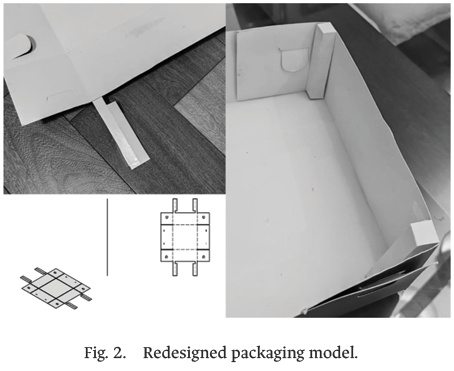 , Santiago A. Vasquez Montero2 , Ezilda M. Cabrera Gil Grados3 , Rafael Chávez-Ugaz4
1[email protected], 2[email protected], 3[email protected], 4[email protected]
1234Carrera de Ingeniería Industrial, Universidad de Lima, Perú
Received: August 15, 2025 / Accepted: October 15, 2025 / Published: 5 June, 2026
doi: https://doi.org/10.26439/ciii2025.8655
Abstract—This paper proposes a model to improve the service level of a pastry shop that faced issues such as incomplete deliveries, product damage, and delivery delays. The proposed solution integrates three components: (i) a machine learning (ML) model for delivery route optimization, (ii) standardization of the order dispatch process through manuals and checklists, and (iii) a packaging redesign incorporating internal supports and waterproof liners. As a result, the fill rate (FR) increased from 89.81% to 94.28%, the damaged delivery rate (DDR) decreased from 5.58% to 3.61%, and late deliveries were reduced from 5.07% to 1.26%. In addition, the proposed model avoided the emission of 574 kg of CO₂ per year. This model is applicable to small and medium-sized enterprises (SMEs) seeking to improve their logistics, reduce operating costs, and increase customer satisfaction through more efficient and sustainable processes.
Index Terms—Confectionery, machine learning, packaging, service level, standardized processes.
- Introduction
The pastry sector has experienced sustained growth at the regional level, driven by an increasingly demanding consumer who values not only the quality of the product, but also its presentation, sustainability and punctuality in delivery [1], [2]. In Latin America, annual growth of 5.8% is projected for the premium segment, associated with increased purchasing power and a growing preference for tailored experiences [3]. This environment has placed increasing pressure on companies’ operational capacity, requiring greater logistical efficiency, assurance of product integrity during transport, and minimization of order-picking errors [4], [5]. Likewise, the need to adopt responsible practices has prompted a re-evaluation of packaging material usage, optimization of resource consumption, and reinforcement of process traceability. The accelerated digitalization of the sales channel has exposed the limitations of traditional distribution schemes, making it essential to incorporate technological solutions that allow predictive planning and the maintenance of consistent service levels in highly competitive contexts [6].
However, many bakeries continue to face structural deficiencies in their logistics operations. The case analyzed exhibits a service level of 89.81%, below the recommended standard of 95%, along with a damaged delivery rate (DDR) of 5.58%, a preparation error rate (PER) of 4.61%, and a delivery inaccuracy (DI) of 5.07%. Unlike previous studies that address isolated solutions, this work integrates technological, operational and structural components to jointly address logistical failures, which represents an original contribution to the artisanal bakery sector.
In response to this problem, a comprehensive solution based on three main components is proposed: an intelligent dispatch system using machine learning (ML), process standardization through visual tools, and the redesign of technical packaging. Previous studies have addressed similar problems in bakery supply chains, primarily focusing on waste reduction or delivery time improvements through specific technological approaches [3], [15]. However, unlike these works, this study addresses a comprehensive operational challenge by integrating logistical precision, real-time traceability, and packaging structural redesign under sustainability criteria. This convergence of logistical, human, and environmental dimensions increases the complexity of the problem and requires multidisciplinary solutions that extend beyond the isolated approaches proposed in the literature [7], [8]. This combination seeks to improve logistical accuracy, reduce transit times, and ensure product integrity. Similar studies have shown that these strategies can reduce waste in bakery supply chains by up to 30% [3], [4], while also increasing customer satisfaction through reduced service variability [5].
The artificial intelligence component was developed using a multiple regression model based on historical data and real-time traffic information, following approaches aimed at route optimization and emission reduction [6], [9]. In parallel, operational standardization—based on visual control mechanisms and role definition—reduces human errors, improves traceability and increases employee performance [10], [11]. Finally, the packaging redesign considered the NTP 209.027:2012 and ISO 18601:2013 standards, prioritizing stackability, structural strength and sustainability, in accordance with guidelines related to the use of active packaging in bakery products [12].
The results were validated through pilot tests and simulations, showing an increase in the fill rate (FR) to 94.28%, a reduction in the DDR to 3.61%, and a decrease in the DI to 1.26%. In addition, the avoidance of 574 kg of CO₂ per year was achieved through waste reduction, demonstrating that the proposed approach is not only operationally viable, but also environmentally sustainable.
- Literature Review
A. Outbound Logistics
Outbound logistics represents one of the greatest challenges in the food industry, particularly for companies handling perishable products such as pastries. Issues such as poor route planning, delivery delays, and inefficient dispatching increase operational costs negatively affect customer satisfaction. Studies indicate that these issues directly affect service quality, highlighting the need for smarter logistics systems [13]. In this context, Bei et al. [14] developed an intermodal transport model for perishable goods that reduces both costs and product deterioration, improving delivery efficiency by up to 18% for temperature-sensitive items.
B. Implementation of Advanced Technologies
The use of technologies such as ML has become essential to make food supply chains more efficient and reliable. These tools assist in predicting delivery times, managing unexpected changes, preventing logistical issues, and optimizing resource utilization [15], [16]. Recent research has also demonstrated how technology can support more sustainable operations. For example, Nannar et al. [17] created a model that combines efficiency measurement with sustainability goals, improving logistics performance and resource use by up to 20% in perishable food systems. Likewise, Nikseresht et al. [18] reviewed over 150 studies and found that ML models combining prediction and optimization can reduce emissions and process variability by up to 25%, demonstrating their strong potential to link efficiency with sustainability.
C. Quality of Service
The quality of service in the food sector is a key factor for competitiveness. It is determined not only by the quality of the final product but also by the accuracy of order preparation, delivery punctuality, and the condition in which products reach the customer. Standardization of operational processes is a fundamental strategy that reduces variability, minimizes errors and ensures consistent service levels, positively impacting customer perception and loyalty [19].
D. Food Waste
Food waste represents a critical problem in the bakery and pastry industry. A significant portion of these losses results from product damage during handling and transport, primarily due to inadequate packaging or suboptimal handling processes. Research emphasizes the importance of implementing strategies such as packaging redesign to provide greater protection during distribution, as well as improving logistics practices to mitigate both economic and environmental losses [20].
E. Sustainability
Sustainability plays a key role across all company activities, influencing both operations and their environmental and social impact. Optimizing routes, reducing product damage, and improving packaging not only save costs but also reduce CO₂ emissions, lower material usage, and minimize waste—supporting business models aligned with the Sustainable Development Goals (SDGs) [21]. Likewise, Prayitno and Wicaksono [22] introduced a framework that uses artificial intelligence to enhance collaboration among logistics partners in cities, showing that AI-based coordination can reduce CO₂ emissions by nearly 30%, while improving transparency and flexibility in shared logistics systems.
- Methodology
This study applied a continuous improvement methodology, combining industrial engineering techniques, data science and product redesign, with the aim of increasing the service level in a pastry shop. The proposal was structured around three main axes as shown in Fig. 1:
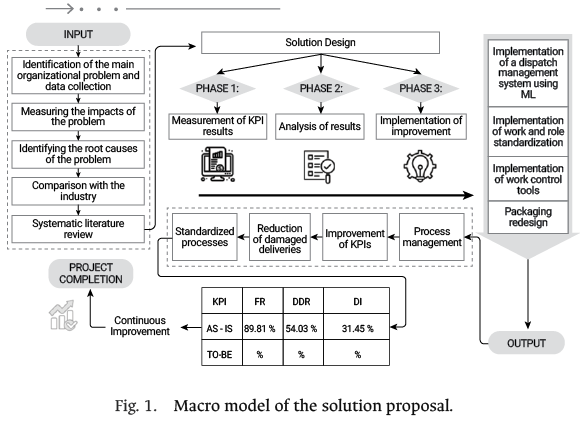
Logistics optimization using ML for delivery time prediction and route sequencing.
- Standardization of operational processes in order preparation and dispatch activities.
- Redesign of packaging, aimed at reducing damage to the product and improving logistics efficiency.
Each axis included the analysis of operational data, the technical design of the solution and its implementation under an engineering approach tailored for SMEs.
A. Logistics Optimization Through ML
The ML model was developed with the aim of reducing delivery times and improving accuracy in logistics planning. The CRISP-DM (Cross Industry Standard Process for Data Mining) methodological model was followed, structured into six phases: business understanding, data understanding, data preparation, modeling, evaluation and implementation.
1) Data Collection and Analysis: Historical operational data from the company’s management system were used, considering the following variables:
- Destination store
- Departure date and time
- Charging time
- Download time
- Transit time
- Day of the week
- Traffic condition
2) Predictive Model: A supervised regression model using Random Forest was applied to predict transit times based on multiple factors. The model was trained on a structured dataset containing 1,153 records.
3) Representation of the Predictive Function: Although the Random Forest model does not generate an explicit equation, conceptually the prediction follows the function:
Ttransit = ƒ (Destination, H, Day week, T, Load)
Where:
- ƒ = Function generated by decision trees
- Destination = Destination store
- H = Departure times
- Day = day of the week
- T = Traffic
- Load = Operational load
4) Optimal Route Sequencing: Transit time prediction was integrated into a comprehensive search algorithm that calculates all possible permutations of stores to visit. The optimal sequence corresponds to the one that minimizes the total travel time subject to the constraint of point-to-point routes (departure from and return to the plant):

B. Standardization of Operational Processes
The second axis of improvement consisted of the standardization of critical processes related to order preparation and dispatch.
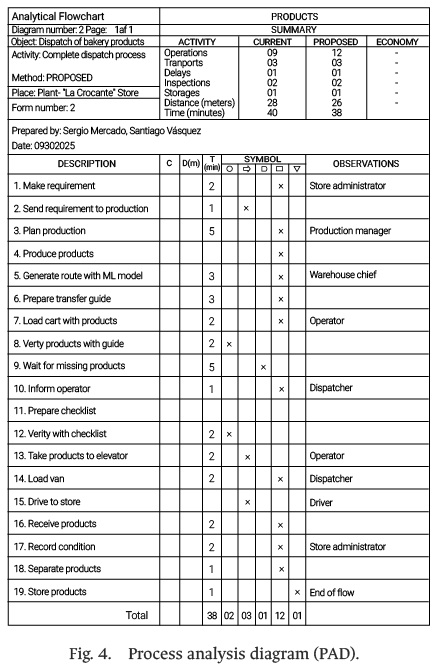
1) Analysis of the Current Process (AS-IS): A detailed mapping of the AS-IS process was carried out, identifying tasks with high operational variability and risk of errors, mainly in:
- Armed with requests
- Product verification
- Vehicle charging
2) TO-BE Process Design: Standard operating procedures were defined for the following activities:
- Standard order assembly sequence
- Quality control and dispatch checklist
- Standardization of in-vehicle load criteria
Visual tools were implemented and tasks were redistributed to ensure operational traceability.
3) Ergonomics and Operational Safety: Criteria were applied according to NTP 399.010:2004 and ISO 11228, prioritizing the reduction of physical efforts in handling and loading tasks.
C. Packaging Redesign
The packaging redesign focused on reducing the DDR and improving transportation efficiency.
1) Diagnosis of Damage: The following were identified as the main causes of product damage:
- Internal movement of products during transport
- Strong vibrations on the road
- Insufficient material impermeability
2) Technical Packaging Design: The new packaging was designed according to three fundamental criteria:
- Structural protection: Lateral reinforcements and internal dividers.
- Waterproofing: Incorporation of laminates resistant to moisture and grease.
The new packaging structure includes internal reinforcements and a waterproof layer that protects the product from movement and moisture during transport. The unfolded layout (bottom left) illustrates how the structure was adapted to enhance stability and facilitate stacking.
D. Calculation of Operational Indicators
The following indicators were defined to quantify operational performance:
- Fill rate (FR)

- Damaged delivery rate (DDR)

- Preparation error rate (PER)

- Delivery inaccuracy (DI)

E. Environmental Assessment
Environmental evolution was carried out considering three main factors: emission reduction, waste minimization, and material savings.
1) Reduced Emissions Calculation: The CO₂ emissions avoided by the reduction in vehicle operating hours were estimated.

Where:
- H before = Total delivery hours before upgrade
- H after = Total hours of delivery after upgrade
- Consumption vehicle = Liters of fuel per hour
- Factor CO2 = Kg CO2 emitted per liter of fuel
2) Reduction of Waste Generated: The reduction of damaged units was calculated
Waste reduced = Units damaged before
− Units damaged after
3) Savings in Packaging Materials: Material savings resulting from the more efficient packaging redesign were estimated:
Material savings = (M before − M after) × added units
Where:
M before and M after represent the weight of packaging material per unit before and after.
- Results and Validation
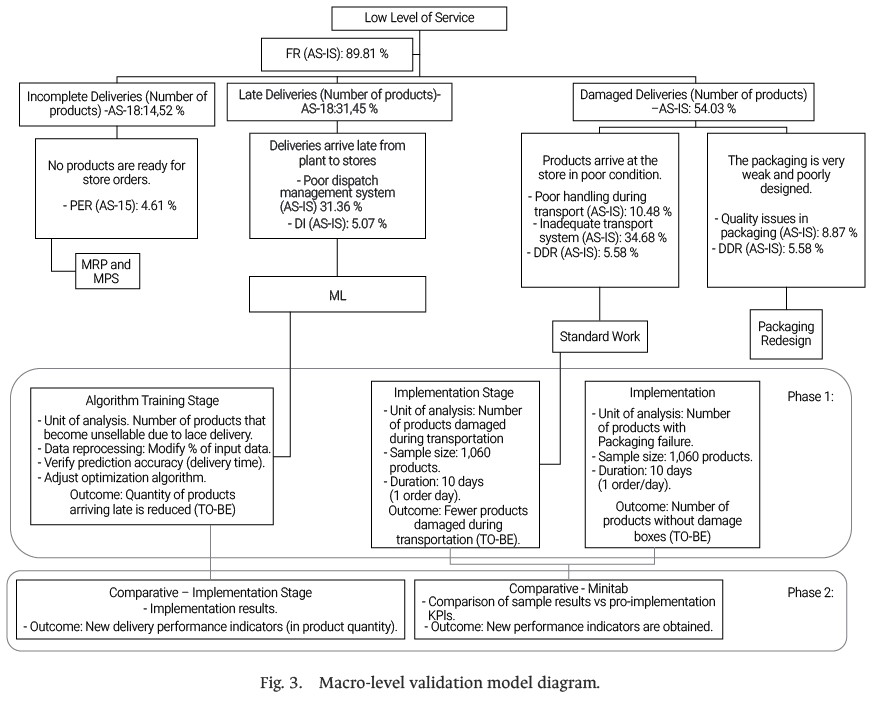
The validation of the proposal was carried out as shown in Fig. 3, through pilot tests in real operations over four weeks, as well as simulations using historical data. The results demonstrate significant improvements in the primary service level indicators.
A. Results
The results listed in Table I were obtained through a 10-day implementation in the company’s real operations, complemented by simulations using historical data from the management system. Operational indicators, including FR, DDR, PER, and DI, were measured before and after implementing the proposed improvements. Each value corresponds to the average observed during the test period, verified through field records and daily monitoring reports.
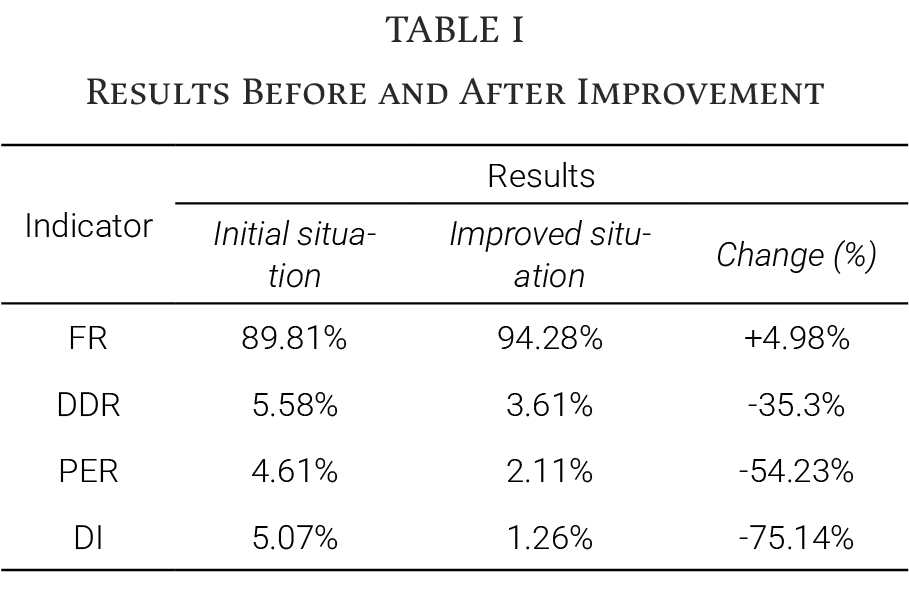
The improvement in the FR and the significant reduction in the DI reflect the positive impact of the ML model applied to logistics optimization. On the other hand, the reduction of DDR and PER demonstrates the effectiveness of process standardization and packaging redesign.
B. Validation of the ML Model
The Random Forest–based predictive model achieved a coefficient of determination (R²) of 0.91 and a root mean square error (RMSE) of 3.74 minutes, demonstrating high accuracy in predicting transit times by considering variables such as traffic, departure time, day of the week, and operational load.
The application of the model, combined with the exhaustive route-sequencing algorithm, reduced total daily travel time by 17.8% and decreased variability in delivery times.
C. Process Standardization Validation
The validation of the standardization was carried out through an operational pilot test, with the following results:
- PER was reduced by 54.23%.
- Assembly and dispatch times improved by 12%.
- Recurring errors in the verification, loading, and assembly processes were eliminated through the implementation of checklists, visual controls, and task redistribution.
D. Packaging Redesign Validation
The packaging redesign was validated through the same pilot test, focusing on transport resistance and the ability to protect the product. The results were as follows:
- Reduced the DDR from 5.58% to 3.61%, equivalent to a 35.30% improvement.
- Elimination of damage caused by vibration, shock, or internal displacement.
- Discussion
The results indicate that the improvement proposal significantly reduced the main operational failures affecting the bakery’s service level. The combined implementation of three initiatives—logistics optimization via ML, standardization of operational processes, and packaging redesign—enabled a comprehensive approach to addressing DIs, product damage, and partial order fulfillment.
The increase in the FR, from 89.81% to 94.28%, confirms that the comprehensive solution significantly improved the company’s ability to fulfill orders in quantity and timeliness, approaching the 95% standard recommended for efficient logistics operations in the sector [18].
The DI, reduced from 5.07% to 1.26%, demonstrates the effectiveness of logistics optimization via the ML model. This result surpasses the 22% waste reduction reported by Aljohani [13], who applied route optimization techniques without integrating real-time traffic or validating with actual data. Instead, our approach used supervised prediction with Random Forest, incorporating real-time traffic, which resulted in a 17.8% reduction in total daily travel time.
The PER decreased from 4.61% to 2.11%, representing a 54.23% improvement. This result aligns with the findings of Quiroz-Flores et al. [14], who reported a 13% service level improvement through task standardization, although their approach did not include an ergonomic task redistribution phase as proposed in this study. The combination of checklist, visual control and task distribution improved assembly times and eliminated recurring errors, reinforcing the findings of Burgess et al. [19] on the importance of traceability in food supply chains.
The DDR decreased from 5.58% to 3.61%, representing a 35.30% improvement. This result confirms the effectiveness of the new packaging design and aligns with the recommendations of Qian et al. [12], who emphasize that packaging with active elements can prevent damage from moisture and vibrations. Unlike Qian, our redesign incorporated internal support elements and waterproof sheets within the same current material, achieving an improvement without the use of external or specialized materials.
At a comprehensive level, the study proposes a multidisciplinary solution impacting five key dimensions: logistics precision, operational ergonomics, environmental sustainability, organizational standardization, and customer experience. Unlike studies such as Lahane et al. [11], which address barriers to technological adoption theoretically, this proposal demonstrates how these barriers can be overcome in a real SME through gradual implementation, internal training, and monitoring using accessible tools such as Minitab and Python.
Finally, validation through pilot testing confirmed that the improvements are viable and sustainable under real operating conditions. This positions the proposal as a replicable model for SMEs in the food sector facing similar problems.
- Conclusions
The implemented proposal managed to significantly improve the service level of the pastry shop through three key actions: ML, standardization of processes and redesign of the packaging.
The ML model reduced the DI from 5.07% to 1.26%, improving logistics accuracy. Process standardization decreased the PER from 4.61% to 2.11%, while packaging redesign reduced the DDR from 5.58% to 3.61%. As a result, the FR increased from 89.81% to 94.28%.
In conclusion, the integration of these tools is effective and replicable in SMEs facing similar challenges, provided it is accompanied by training and continuous operational monitoring.
References
[1] S. M. Chaerudin and A. Syafarudin, “The effect of product quality, service quality, price on product purchasing decisions on consumer satisfaction,” Ilomata Int. J. Tax Account., vol. 2, no. 1, pp. 61–70, Jan. 2021, doi: 10.52728/ijtc.v2i1.202.
[2] A. E. Rivas, G. G. Rivas, J. M. A. Iran, and J. A. R. Balagno, “There’s a whisk, there’s a way: The customer satisfaction on the bakery business in Lantapan,” Int. J. Sci. Manag. Res., vol. 6, no. 12, pp. 108–126, Jan. 2023, doi: 10.37502/IJSMR.2023.61209.
[3] Markets and Markets, “Latin America Premium Bakery Market – Forecast to 2032,” Markets and Markets, 2023.
[4] S. Hadi, Y. R. Satato, and M. N. Wawo, “Service quality strategy in increasing customer satisfaction at Ice Bakery Tanjung Redeb Berau Regency,” in Proc. Int. Conf. Digital Adv. Tourism, Manage. Technol. (ICTMT), vol. 1, no. 2, pp. 674–678, Dec. 2023, doi: 10.56910/ictmt.v1i2.146.
[5] E. Goryńska-Goldmann, M. Gazdecki, K. Rejman, S. Łaba, J. Kobus-Cisowska, and K. Szczepański, “Magnitude, causes and scope for reducing food losses in the baking and confectionery industry—A multi-method approach,” Agriculture, vol. 11, no. 10, p. 936, Sep. 2021, doi: 10.3390/agriculture11100936.
[6] IAB Peru, “E-commerce Study 2023–2024,” IAB Peru, 2024.
[7] R. Manzini and R. Accorsi, “The new conceptual framework for food supply chain assessment,” J. Food Eng., vol. 115, no. 2, pp. 251–263, Mar. 2013, doi: 10.1016/j.jfoodeng.2012.10.026.
[8] D. Ivanov, “Viable supply chain model: Integrating agility, resilience and sustainability perspectives—Lessons from and thinking beyond the COVID-19 pandemic,” Ann. Oper. Res., vol. 319, no. 1, pp. 1411–1431, Dec. 2022, doi: 10.1007/s10479-020-03640-6.
[9] M. Rodrigues, V. Miguéis, S. Freitas, and T. Machado, “Machine learning models for short-term demand forecasting in food catering services: A solution to reduce food waste,” J. Clean. Prod., vol. 435, Jan. 2024, doi: 10.1016/j.jclepro.2023.140265.
[10] G. P. Pacheco-Moreira and Y. Ramos-Alfonso, “Evaluación de la calidad del servicio y la satisfacción del cliente interno en una cooperativa de ahorro y crédito [Evaluation of service quality and internal customer satisfaction in a savings and credit cooperative],” Polo del Conocimiento, vol. 5, no. 7, pp. 722–735, Jul. 2020.
[11] S. Lahane, V. Paliwal, and R. Kant, “Evaluation and ranking of solutions to overcome the barriers of Industry 4.0 enabled sustainable food supply chain adoption,” Cleaner Logist. Supply Chain, vol. 8, Sep. 2023, doi: 10.1016/j.clscn.2023.100116.
[12] M. Qian et al., “A review of active packaging in bakery products: Applications and future trends,” Trends Food Sci. Technol., vol. 114, pp. 459–471, Aug. 2021, doi: 10.1016/j.tifs.2021.06.009.
[13] K. Aljohani, “Optimizing the distribution network of a bakery facility: A reduced travelled distance and food-waste minimization perspective,” Sustainability, vol. 15, no. 4, Feb. 2023, doi: 10.3390/su15043654.
[14] H. Bei, M. Yu, T. Yang, and R. Murcio, “Optimization of intermodal transportation routes for perishable goods considering customer satisfaction,” Res. Transp. Bus. Manag., vol. 59, Mar. 2025, doi: 10.1016/j.rtbm.2024.101261.
[15] A. L. V. Rodrigues, G. Gomes, and M. Bouzon, “Lean logistics 4.0: Concepts and key performance indicators,” Braz. J. Dev., vol. 9, no. 7, pp. 22172–22197, Jul. 2023, doi: 10.34117/bjdv9n7-071.
[16] M. L. Deng and P. Feng, “A food traceability system based on blockchain and radio frequency identification technologies,” Journal of Computer and Communications, vol. 8, no. 9, pp. 17–27, 2020, doi: 10.4236/jcc.2020.89002
[17] S. Nannar, S. Sindhuchao, C. Chaiyaphan, and K. Ransikarbum, “Optimization of the sustainable food supply chain with integrative data envelopment analysis approach,” Int. J. Manag. Sci. Eng. Manag., vol. 19, no. 4, pp. 278–293, Feb. 2024, doi: 10.1080/17509653.2024.2317479.
[18] A. Nikseresht, S. Shokouhyar, E. B. Tirkolaee, S. Shokoohyar, N. Pishva, and V. Simic, “Machine learning and data-driven models in sustainable supply chain management: A systematic literature review with content analysis,” Int. J. Logist. Res. Appl., pp. 1–40, Jun. 2025, doi: 10.1080/13675567.2025.2517639.
[19] P. R. Burgess, F. T. Sunmola, and S. Wertheim-Heck, “A review of supply chain quality management practices in sustainable food networks,” Heliyon, vol. 9, no. 11, Nov. 2023, doi: 10.1016/j.heliyon.2023.e21179.
[20] A. Bhardwaj, R. Soni, L. P. Singh, and R. S. Mor, “A simulation approach for waste reduction in the bread supply chain,” Logistics, vol. 7, no. 1, p. 2, Jan. 2023, doi: 10.3390/logistics7010002.
[21] J. A. Valencia Granados, “Importance of measuring the level of service or fill rate in modern logistics,” Realidad Empresarial, vol. 10, pp. 75–78, Dec. 2020, doi: 10.5377/reuca.v0i10.10579.
[22] K. A. Prayitno and H. Wicaksono, “Optimizing the sustainability of collaborative logistics in urban area through ontologies and causal artificial intelligence: A conceptual framework,” Procedia CIRP, vol. 130, no. 10, pp. 1070–1076, Jan. 2024, doi: 10.1016/j.procir.2024.10.208.