Construction Project Delays: Application of Lean
Construction for Process Optimization and On-Time
Delivery Validated through Simulation
Gustavo Almeida1 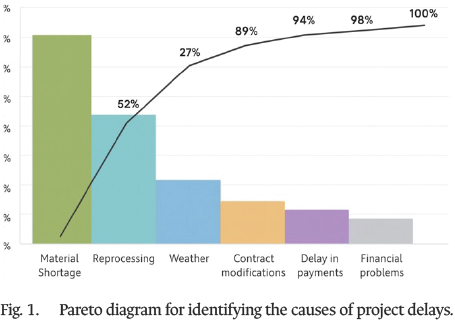 , Stefano Monier2 , Silvia Ponce3 , Edilberto Avalos-Ortecho4
1 [email protected], [email protected], [email protected], [email protected]
1234Carrera de Ingeniería Industrial, Universidad de Lima, Perú
Received: August 15, 2025 / Accepted: September 10, 2025 / Published: 5 June, 2026
doi: https://doi.org/10.26439/ciii2025.8652
Abstract—Construction projects in Peru often face delays that result in economic and contractual penalties. This study identifies the primary causes of project delays and proposes a process optimization model based on Lean Construction tools, applied to a road maintenance company. The methodology combines exploratory and experimental phases using operational data from 2022–2023. Pareto analysis and the 5 Whys technique identify material shortages (52%) and requisition rework (31%) as the most critical contributors to delays. To mitigate these issues, the Last Planner System, Standard Work, and Kaizen are implemented. Validation using discrete-event simulation in Arena demonstrates a 24.69% increase in project physical progress, a 39.27% reduction in accumulated delay days, and a 65.96% decrease in canceled requisitions. These results demonstrate that Lean tools can significantly improve planning reliability, reduce rework, and promote a continuous improvement culture in public works.
Index Terms—Delay analysis, Last Planner System, Lean construction, material supply disruptions, planning management, simulation modeling, Standard Work.
- Introduction
The construction industry faces recurring challenges related to delays in project delivery, resulting in economic, contractual, and social losses in both public and private works [1]. A case study revealed that, in a residential project, up to 132 days of extensions were granted, of which 75 days were directly attributed to the effects of the 2011 revolution, highlighting the tangible impact of external factors on project schedules. Studies conducted in Malaysia indicate that inadequate site management and changes during execution are among the primary causes of project delays [2], [3].
One of the current tools with the greatest impact in project management is Building Information Modeling (BIM). Its application improves transparency, coordination among stakeholders, and resource allocation efficiency, especially in public works projects. A BIM-based partnership framework has been proposed in [4], highlighting that its integration facilitates collaborative decision-making, reduces contractual conflicts, and improves planning throughout the project life cycle. Although advances using tools such as the Last Planner System (LPS) and Kaizen have been documented, the literature shows limitations regarding their integrated application and quantitative validation in Peruvian public companies.
In response to this problem, Lean methodologies such as the LPS have been adopted. LPS enables collaborative planning, prerequisites management, and improved schedule reliability. However, in contexts where LPS is not yet systematically applied, it has been reported that on average only 54% of weekly planned tasks are completed as scheduled, revealing a critical gap between planning and execution [5]. In contrast, the literature documents that, despite approximately 50% of tasks being completed ahead of schedule, one company was able to sustain a Percent Plan Complete (PPC) between 80% and 90%, owing to its capability to adequately prepare tasks and resolve operational constraints during the execution week [6].
Other Lean tools, such as Standard Work, have been applied to reduce operational variability through the standardization of critical tasks. The literature highlights that its implementation, when combined with collaborative practices, improves operational efficiency [7]. Likewise, a case study reported that its application reduced the work cycle by 31.6 seconds, resulting in a 6.5% increase in productivity. These results demonstrate that operational standardization contributes to improved management performance without requiring major technological investments.
According to the continuous improvement approach, the Kaizen philosophy has shown positive results in construction contexts. The study [8] documents its successful application in social housing projects where, after implementing actions through the “seven forms” tool, quantifiable improvements were achieved: an 18% reduction in scaffolding activities, 11% in internal formwork, and 50% in concrete pouring. These results reflect a direct impact on time, cost, and labor load, evidencing Kaizen’s potential to optimize processes and establish a culture of continuous improvement in construction works.
This research aims to identify the most significant causes of delays in construction project execution in Peru and to propose a Lean-based process optimization model, emphasizing collaborative planning, operational standardization, and continuous improvement. The article is organized into four sections. Section I introduces the problem and presents the theoretical framework. Section II describes the methodology employed. Section III presents and discusses the results. Finally, Section IV provides the conclusions derived from the analysis. Therefore, this research poses the following question: What Lean construction-based management tools can be applied to reduce delays and improve reliability in public construction projects?
- Methodology
A. Initial Diagnosis
This study is framed as applied exploratory research, with a quantitative approach followed by an experimental phase, using data collected from the road maintenance company regarding its performance during the 2022–2023 period.
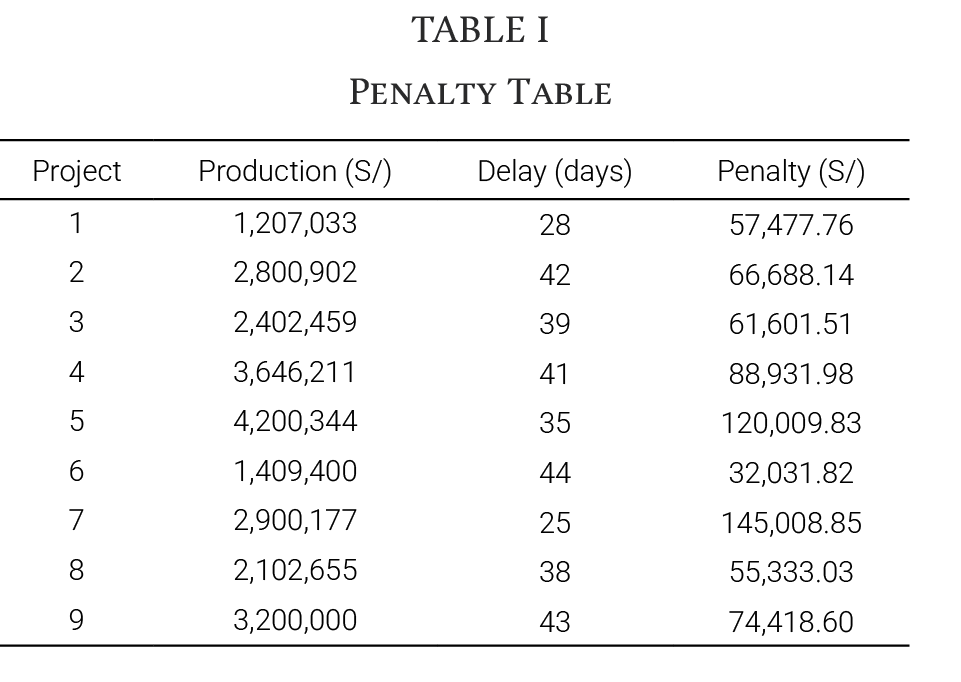
The company under study experiences recurrent net profit losses due to low efficiency in meeting client-established deadlines. To address this issue, an initial diagnostic analysis was conducted using tools such as a Pareto diagram and the 5 Whys technique, enabling a focused examination of the primary problem drivers. As shown in Table I, penalties associated with delayed deliveries significantly affect the company’s financial performance, underscoring the urgent need to improve project scheduling and execution processes [9].
A Pareto diagram, shown in Fig. 1, was developed to identify the key factors contributing to the high rate of project noncompliance. This analysis was based on quantitative data collected from personnel with at least six months of experience working in construction sites, logistics, warehousing, and procurement.
The main results identified material shortages (52%) and rework in material requisitions (31%) as the most critical factors. The application of this tool provides a reliable basis for an in-depth analysis of the most urgent requirements for effective project execution [10]. In most cases within the sector, these issues are typically attributed to inadequate project planning and management practices [11]. However, it is essential to identify the underlying root causes behind these incidents.
In the case of material shortages, a process flowchart was created to identify the reasons underlying the scarcity of construction materials. This tool enabled a visual and structured identification of errors, allowing the determination of their root causes.
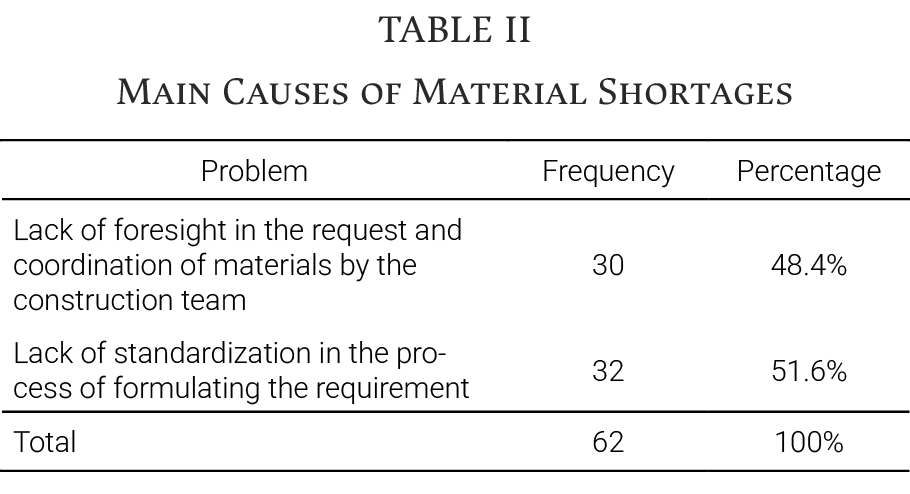
The main causes of material shortages underscore the urgent need to improve planning and provisioning processes. More than 50% of the issues are related to field personnel, suggesting the necessity of implementing a management system that enhances forecasting and coordination among teams, as shown in Table II.
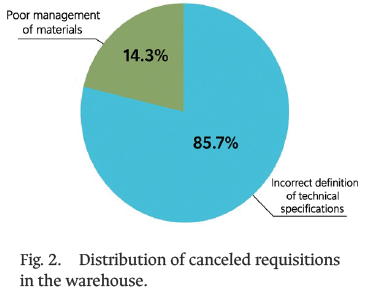
Based on the analysis of historical records of canceled requisitions, it was inferred that the tools selected for solution design should focus on enhancing field management and standardizing the material requisition process.
Regarding the identification of root causes for material requisition rework, records of 129 logistical requisitions generated in 2023 were analyzed using the 5 Whys technique. The main finding was the absence of a standardized requisition format, as requests were frequently submitted using technical language that was not clearly understood by other departments involved in the workflow, as shown in Fig. 2.
Based on the above findings, it was determined that, rather than merely improving existing processes, the company requires a new management model that fosters effective interdepartmental interaction. To this end, the implementation of Lean Construction tools was selected, as their application has been shown to have a positive overall impact on project planning and execution, as illustrated in Fig. 3 [12].
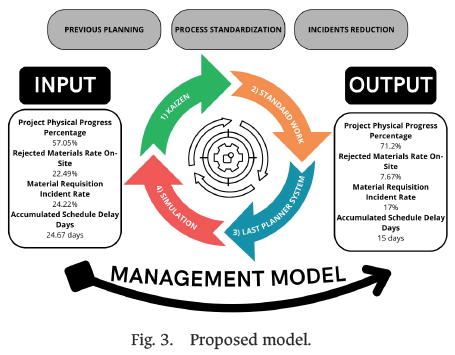
The KPIs to be influenced were calculated using historical reports provided by the company and will be the primary metrics considered to measure the impact of the implementation, as shown in Fig. 4.
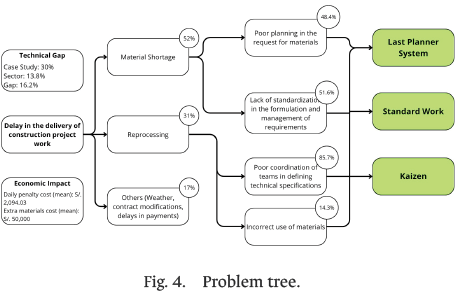
B. Solution Design
The management model should be implemented progressively and accompanied by continuous monitoring, as the Lean Construction philosophy often encounters barriers such as resistance to change and limited engagement stemming from an incomplete understanding of the long-term added value it generates [13]. The tools used were as follows:
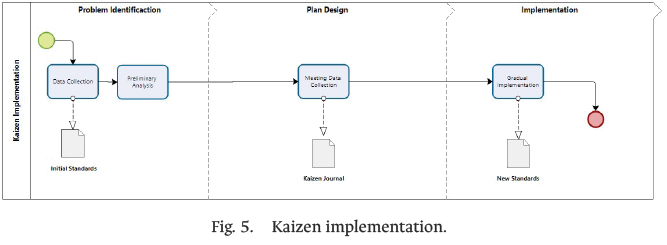
1) Kaizen: Weekly meetings were held among the involved departments to encourage the reporting of problems, incidents, and recommendations related to specific process activities, thereby fostering transparent communication and enabling the early detection of potential negative impacts on the implementation of other tools involved in the case study. As reported in [8], regular interdisciplinary meetings facilitate the identification and resolution of process inefficiencies, contributing to enhanced project outcomes and collaboration in construction projects, as shown in Fig. 5.
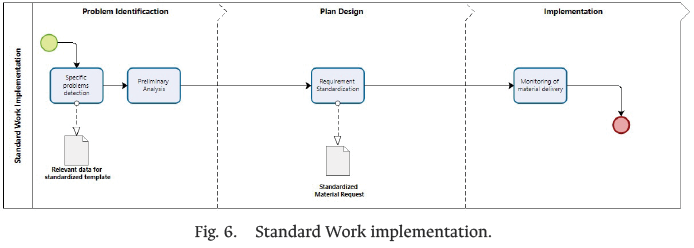
2) Standard Work: Operational standards were established for the preparation and approval of logistical requisitions to reduce technical errors and variability in documentation quality. These standards included structured forms and clearly defined validation sequences, aiming to significantly reduce rework rates. This aligns with [14], which emphasizes that standardizing logistics documentation—particularly in international contexts—reduces verification time, minimizes errors, and simplifies cargo handling procedures. The study further highlights that the lack of standardization remains a major obstacle due to system fragmentation, multilingual requirements, and the involvement of multiple intermediaries across the supply chain, as shown in Fig. 6.
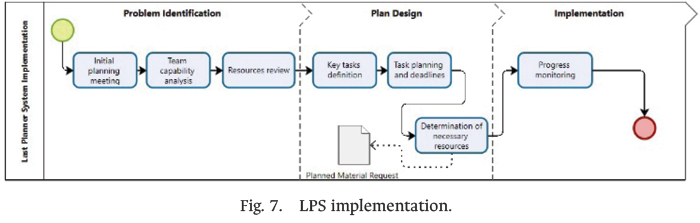
3) Last Planner System (LPS): Through a combination of collaborative planning, constraint management, and progress monitoring using indicators, this tool aims to continuously improve the performance of construction projects, as shown in Fig. 7.
- Results
A. Arena Simulation
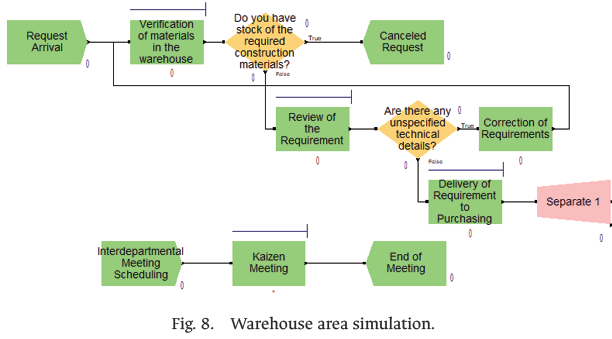
The improvements introduced by the management model were validated to determine their impact on the KPIs. The key areas involved in the management flow and the transformation of material requirements were modeled within the simulation environment. Specifically, the warehouse area is represented in Fig. 8, the procurement and logistics area in Fig. 9, and the construction execution in Fig. 10.
The KPIs to be evaluated were simulated using modules, variables, and other complementary outputs, which enabled the automatic generation of the aforementioned KPIs in the results report produced by the Arena software, as shown in Table III.
Additionally, three hypothetical scenarios were developed representing different levels of implementation impact, with the aim of analyzing the model’s robustness to variations and capturing the inherent uncertainty of real execution conditions.
1) Expected: Tools implemented in the baseline scenario, influencing in accordance with the projected outcomes.
2) Optimistic: The implementation is positively adopted by the affected areas, enabling the tools to achieve their maximum performance.
3) Pessimistic: Due to risk factors inherent to the construction sector, the measured impact of the implementation is reduced by 25%.
B. Project Physical Progress Percentage
When comparing the baseline model with the model incorporating the implemented tool, no overlap was observed between the confidence intervals of the evaluated scenarios, indicating a statistically significant improvement—at a 95% confidence level—in the on-site progress of the project.
As a main result, the implementation of the management model reduced the durations of critical tasks which, on average, were delayed 78.63% of the time, as shown in Table IV.
In addition, the number of material requisitions generated per month decreased by 48.54%, as shown in Fig. 12.
C. Accumulated Schedule Delay Days
The statistical analysis shows no overlap between the baseline and improved scenarios, indicating a significant and measurable reduction in the number of delay days relative to the initial state.
In the AS-IS model, an average of 24.7 accumulated delay days was recorded, while in the TO-BE model this decreased to 15 days, representing a 39.27% reduction.
This improvement aligns with the expected benefits of implementing the LPS, which is well documented for enhancing team coordination and optimizing task execution sequencing [15]. By promoting realistic commitments and tracking collaborative progress, the LPS tool contributes to greater reliability in activity scheduling, as shown in Table V.
Additionally, the economic impact associated with the delay was estimated by quantifying the contractual penalty, based on the daily penalty formula used by the client:

This difference represents a direct saving of S/ 20,312.13 per project delivered, attributable to the reduction in accumulated delays. This result highlights the operational profitability of applying collaborative planning systems in medium-scale construction projects.
D. Rejected Materials Rate On-Site
With a 48.54% reduction in the number of on-site requisitions and a 20% decrease in the incidence rate related to technical specifications in the warehouse area, a considerable improvement in this KPI was observed.
In addition, the interruption index—calculated as the proportion of scheduled time lost due to on-site material shortages—showed a significant improvement of 68.59%, as shown in Table VI.
To evaluate the effect of systematic improvement on the duration of on-site activities, the two simulated scenarios were compared. In the improved scenario, an approximate 20% reduction was applied to the duration of value-added (VA) activities, while preserving the sequential logic, which could not be altered, as shown in Table VII.
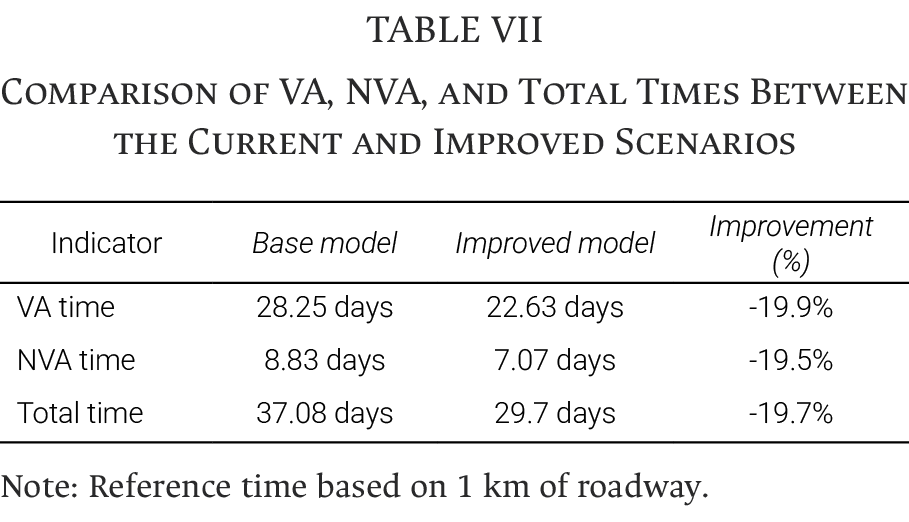
In the current scenario, the total process time is 37.08 days, of which 28.25 correspond to VA activities and 8.83 to non-value-added (NVA) activities. It is important to note that, although NVA activities do not directly transform the final product, they are required to enable the execution of the main tasks.
In contrast, in the improved scenario, the total process time is reduced to 29.70 days, consisting of 22.63 days of VA time and 7.07 days of NVA time. This reduction reflects a positive impact on process timelines, as shown in Fig. 9.
E. Material Requisition Incident Rate
The implementation of Standard Work resulted in a significant decrease in the average value of the analyzed KPI, from 0.242 to 0.170, representing an improvement of 29.75%.
It is crucial to highlight the improvement in the number of canceled requisitions, which decreased by 65.96% following the implementation. Efficient management of material requisitions is a critical pillar for the smooth execution of projects at all stages, as it requires coordination across multiple functional areas. Additionally, a substantial drop in canceled requisitions was observed, corresponding to a 65.96% reduction, as shown in Fig. 10. This metric is particularly relevant, as each canceled requisition represents a loss of operational time, generates administrative rework, and in many cases, directly delays on-site construction activities.
F. Scenario Analysis
In order to evaluate the sensitivity of the proposed model under different adoption conditions, a multi-scenario analysis was conducted, including the improved model, as well as pessimistic and optimistic scenarios.
These configurations represent, respectively, low, expected, and high levels of adherence to the implemented Lean tools, allowing the observation of result variability under different execution conditions, as shown in Table VIII.
From a comparative approach, statistically significant differences were identified across all simulated KPIs when compared to the baseline model. The project physical progress percentage exhibited an increasing trend according to the level of implementation: starting at 57.05% in the baseline scenario, rising from 59.3% (pessimistic), 71.2% (expected), and 72.2% (optimistic). This evolution represents a cumulative relative improvement of up to 26.5% compared to the reference scenario.
Regarding accumulated schedule delay days, a progressive reduction was observed, decreasing from 24.67 days in the baseline model to 16.2, 15.0, and 8.01 days in the three scenarios, respectively. This reflects a reduction of up to 67.5% in the most favorable scenario, demonstrating a high positive sensitivity of the model to improvements in planning and operational control (LPS).
In addition, logistics-related indicators also showed significant decreases. The rate of materials rejected on-site decreased from 22.49% to 11.03%, 7.72%, and 3.63%, corresponding to improved standardization processes and technical control. Simultaneously, the incidence rate of material requisition errors—defined as the percentage of requisitions with technical or administrative errors—declined from 24.22% to 19.78%, 17.0%, and 10.99%, evidencing a reduction of up to 54.64% relative to the baseline model.
Overall, this analysis demonstrates that the proposed model exhibits robust consistency under varying operational conditions and that the magnitude of KPI improvements is directly proportional to the level of implementation achieved.
- Discussion
The results obtained confirm that an integrated Lean model can generate significant improvements in the planning and execution of construction projects in the public-sector construction projects. The implementation of the model led to a 24.69% increase in physical progress and the elimination of 100% of critical tasks, which in the baseline scenario had a delay incidence rate of 78.63%. These results reflect a tangible improvement in operational coordination, consistent with the positive impacts of Lean construction tools on schedule reliability and planning discipline reported in [15].
A physical progress increase of 24.69% exceeds the 18% improvement documented in [8], highlighting the enhanced effect of combining Lean tools into a unified management model.
In terms of delay reduction, this study achieved a 39.27% decrease in accumulated delay days, which surpasses the 25% improvement observed in [15] through the implementation of the LPS in public works.
As discussed in [16], Lean practices improve production control by fostering commitment-based planning and continuous monitoring through PPC metrics. The current study supports these findings by showing reduced rework and better task coordination. However, unlike the task-specific applications addressed in [8], the proposed approach integrates Lean tools at the interdepartmental level, contributing to a 65.96% reduction in canceled requisitions.
The application of Standard Work proved decisive in reducing ambiguities and documentation errors. While [7] described qualitative benefits from standardization, this study adds quantitative evidence, with a 29.75% reduction in requisition incident rate and a 68.59% improvement in the interruption index.
Model validation was conducted using Arena-based probabilistic simulation, with a confidence interval ≤ 5%, confirming the statistical significance of the improvements. Unlike the approach in [16], which used basic simulation for residential projects, the present model incorporates baseline, pessimistic, expected, and optimistic scenarios, improving robustness and capturing performance variability.
Despite the positive outcomes, fluctuations in non-productive time were observed, potentially influenced by external factors such as weather and equipment availability. As indicated in [11], many delays and cost overruns in construction projects stem from causes beyond the contractor’s control, such as logistical interference and supply issues. Therefore, even effective Lean models should be complemented by strategies to mitigate contextual risks.
Resistance to change was observed during implementation, attributable to limited knowledge of Lean construction and a weak collaborative culture. Similar barriers were identified in [17] and [18], where lack of awareness and low leadership involvement hindered adoption in emerging markets. Overcoming such resistance requires structured training and gradual cultural adaptation.
- Conclusions
In conclusion, the integrated model—based on collaborative planning, standardization, and continuous improvement—effectively addresses common challenges such as low productivity, rework, and logistical inefficiencies in public sector projects. Its progressive and non-disruptive implementation strategy proved suitable for organizations with low Lean maturity, enabling cultural alignment and measurable improvements without major investments.
This approach strengthens internal capabilities, fosters continuous improvement culture, and offers a replicable model for other public infrastructure contexts.
Finally, this study provides a practical solution for sector professionals, optimizing resources and processes, and offers empirical evidence on the effectiveness of Lean construction in public-sector environments. It also opens new research avenues in sustainability, scalability, and cultural change, recommending exploration of the model’s evolution and its application in different project types with varying levels of Lean maturity.
References
[1] R. F. Aziz, “Ranking of delay factors in construction projects after Egyptian revolution,” Alexandria Eng. J., vol. 52, no. 3, pp. 387–406, Sep. 2013, doi: 10.1016/j.aej.2013.03.002.
[2] J. B. H. Yap, P. L. Goay, Y. B. Woon, and M. Skitmore, “Revisiting critical delay factors for construction: Analysing projects in Malaysia,” Alexandria Eng. J., vol. 60, no. 1, pp. 1717–1729, Feb. 2021, doi: 10.1016/j.aej.2020.11.021.
[3] S. A. M. Elsherbiny, S. A.-F. Gad, and A. M. A. Alim, “Critical delay factors in construction projects and their proposed solutions from the perspective of total quality management,” Int. J. Eng. Trends Technol., vol. 72, no. 2, pp. 1–8, Feb. 2024, doi: 10.14445/22315381/IJETT-V72I2P101.
[4] A. Porwal and K. N. Hewage, “Building Information Modeling (BIM) partnering framework for public construction projects,” Autom. Constr., vol. 31, pp. 204–214, May 2013, doi: 10.1016/j.autcon.2012.12.004.
[5] Buildots. “Percent Plan Complete (PPC).” Buildots Blog. [Online]. Available: https://buildots.com/blog/percent-plan-complete/
[6] F. R. Hamzeh and O. Z. Aridi, “Modeling the Last Planner System metrics: A case study of an AEC company,” in Proc. 21st Annu. Conf. Int. Group Lean Constr., Fortaleza, Brazil, Jan. 2013, pp. 599–608, doi: 10.13140/2.1.3852.5121.
[7] R. Fulford and C. Standing, “Construction industry productivity and the potential for collaborative practice,” Int. J. Project Manage., vol. 32, no. 2, pp. 315–326, Feb. 2014, doi: 10.1016/j.ijproman.2013.05.007.
[8] J. P. P. Vieira, B. M. B. da Silva Etges, R. A. Pellegrino, M. A. Lins, and L. L. Costa, “Kaizen as an improvement method for concrete walls construction in social housing project,” in Proc. 30th Annu. Conf. Int. Group Lean Constr. (IGLC), Edmonton, AB, Canada, 2022, pp. 354–365, doi: 10.24928/2022/0136.
[9] M. I. Ahmed and S. E. Rezouki, “Application of root causes analysis techniques in the contractor selection for highway projects,” in IOP Conf. Ser.: Mater. Sci. Eng., vol. 901, Sep. 2020, doi: 10.1088/1757-899X/901/1/012031.
[10] S. Shrivastava, M. Jain, and K. K. Pathak, “Pareto analysis of causes of delay and recommendations for training needs,” Int. J. Constr. Project Manage., vol. 13, no. 2, 2021. [Online]. Available: https://www.researchgate.net/publication/362208823
[11] T. Al Amri and M. Marey-Pérez, “Towards a sustainable construction industry: Delays and cost overrun causes in construction projects of Oman,” J. Project Manage., vol. 5, no. 2, pp. 87–102, Jan. 2020, doi: 10.5267/j.jpm.2020.1.001.
[12] E. N. Shaqour, “The impact of adopting Lean construction in Egypt: Level of knowledge, application, and benefits,” Ain Shams Eng. J., vol. 13, no. 2, Mar. 2022, doi: 10.1016/j.asej.2021.07.005.
[13] W. Albalkhy and R. Sweis, “Barriers to adopting Lean construction in the construction industry: A literature review,” Int. J. Lean Six Sigma, vol. 12, no. 2, pp. 210–236, May 2021, doi: 10.1108/IJLSS-12-2018-0144.
[14] D. Mishchenko, I. Shevchenko, D. Babinin, A. Vdovichen, and O. Verstiak, “Standardisation of data in logistics and business operations,” Multidiscip. Rev., vol. 7, p. 2024spe006, Jun. 2024, doi: 10.31893/multirev.2024spe006.
[15] O. Warid and K. Hamani, “Lean construction in the UAE: Implementation of Last Planner System®,” Lean Constr. J., vol. 2023, pp. 1–20, Dec. 2023, doi: 10.60164/96f4a5e0g.
[16] H. Erol, I. Dikmen, and M. T. Birgonul, “Measuring the impact of Lean construction practices on project duration and variability: A simulation-based study on residential buildings,” J. Civ. Eng. Manage., vol. 23, no. 2, pp. 241–251, Feb. 2017, doi: 10.3846/13923730.2015.1068846.
[17] G. Garcés, E. Forcael, C. Osorio, K. Castañeda, and O. Sánchez, “Systematic review of Lean construction: An approach to sustainability and efficiency in construction management,” J. Infrastruct. Preserv. Resil., vol. 6, no. 1, Jan. 2025, doi: 10.1186/s43065-025-00119-1.
[18] S. Moradi and P. Sormunen, “Implementing Lean construction: A literature study of barriers, enablers, and implications,” Build., vol. 13, no. 2, p. 556, Feb. 2023, doi: 10.3390/buildings13020556.