Improvement of Outbound Logistics
in an E-Commerce Company Using
RPA, ABC Analysis, and SLP Tools
Elizabeth S. Castillo Vera1 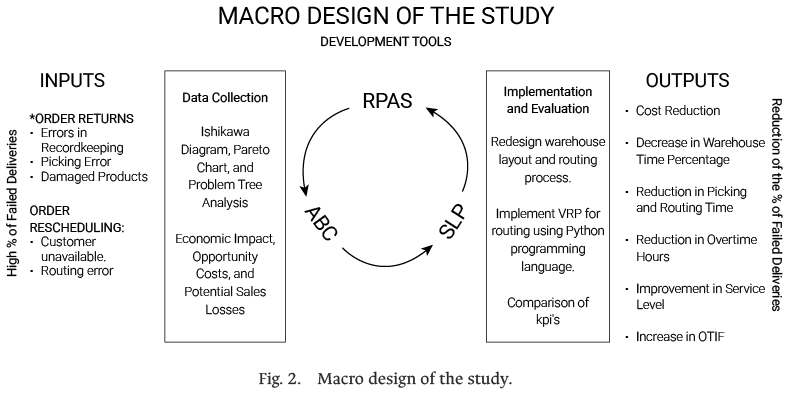 , Gian P. F. Robles Flores2 , José A. Taquía Gutiérrez3 ,
María T. Noriega Araníbar de Lavalle4
1[email protected], [email protected], [email protected], [email protected]
1234Carrera de Ingeniería Industrial, Universidad de Lima, Perú
Received: August 1, 2025 / Accepted: September 23, 2025 / Published: 5 June, 2026
doi: https://doi.org/10.26439/ciii2025.8650
ABSTRACT—This study aims to reduce the high percentage rate of failed deliveries (39.09%) in a Peruvian import-based e-commerce company, whose operations exhibit deficiencies in distribution and storage processes. To address these issues, an integrated solution was designed using three logistics tools: the systematic layout planning (SLP) methodology, employed to reorganize the warehouse according to nine product categories; ABC classification, used to relocate items within racks based on their turnover and demand; and robotic process automation (RPA), applied to routing through optimization algorithms. The proposal complied with current technical and legal regulations and was validated through simulation using Arena software, demonstrating an 83.6% reduction in routing time, a 54.6% improvement in average picking time, and a 20-percentage-point increase in the on-time in-full (OTIF) indicator. The results confirm that the integrated application of these tools significantly improves logistics efficiency in similar operational models within the e-commerce sector.
Index Terms—ABC classification, e-commerce, outbound logistics, robotic process automation, systematic layout planning.
- Introduction
In peru, e-commerce has become a key sales channel for small- and medium-sized enterprises, with sustained growth projected through 2025, particularly in the retail sector [1]. This growth has been driven by widespread internet access, which exceeds 90% in urban areas, significantly accelerating the expansion of digital commerce in the country [2]. Moreover, the evolution of the digital ecosystem has introduced new payment methods, such as mobile wallets, which have gained prominence and influenced both the average purchase value and purchase frequency [3].
However, this growth presents significant logistical challenges. Ensuring effective delivery fulfillment remains one of the main operational hurdles in the sector. According to Gonzales [4], 7.4% of orders fail to be completed each month, resulting in additional costs, customer dissatisfaction, and rework. The average on-time in-full (OTIF) rate in e-commerce operations ranges from 82% to 90%, according to studies on logistics performance in emerging markets [5], indicating that 10% to 18% of deliveries encounter issues. Operationally, the average picking time in e-commerce warehouses ranges between 10 and 16 min per order [6], while urban route planning may take between 30 and 60 minutes, depending on congestion levels and logistics coverage [7]. Additionally, workforce utilization in e-commerce warehouses ranges from 65% to 85%, according to operational efficiency studies [6].
This proposal aims to reduce the percentage of failed deliveries, improve the OTIF indicator, and optimize picking and distribution times, ensuring a more efficient, scala-
ble, and industry-aligned logistics flow.
Robotic process automation (RPA) has proven to be an effective tool for optimizing logistics activities in digital environments. Smith [10] demonstrated that implementing RPA improves the coordination of key activities such as inventory management and order processing, while reducing manual errors and accelerating operational cycles. Ramingwong et al. [11] reported an average 22.3% reduction in logistics costs and improvements in traceability and delivery compliance following process automation. Aguirre and Rodríguez [12] reported a 21% increase in productivity in service and dispatch processes using RPA, without compromising service times. Pasupuleti [13] highlighted that RPA is particularly effective in critical environments, such as hospital and e-commerce logistics, where automating repetitive tasks enhances operational efficiency, reduces human error, and ensures consistency in key processes such as dispatch and planning, all without disrupting service continuity. Finally, Kitsantas et al. [14] highlighted that integrating RPA with artificial intelligence not only automates repetitive tasks but also enables real-time autonomous decision-making, enhancing operational resilience and responsiveness—key aspects of digital distribution platforms. These findings further support the positive impact of RPA on efficiency, accuracy, and compliance indicators in modern logistics operations.
Regarding layout optimization in logistics and e-commerce environments, multiple studies support the effectiveness of systematic layout planning (SLP) in improving operational performance. Hu and Chuang [15] applied SLP combined with a genetic algorithm to redesign an e-commerce warehouse in China, achieving a 27.72% reduction in handling costs and a 39.25% improvement in picking efficiency. Valdivia et al. [16] implemented SLP in combination with Lean methodologies in a spare parts warehouse in Metropolitan Lima, resulting in a 23% reduction in picking distance and a 22% improvement in OTIF compliance. Similarly, Ramírez-Cruz et al. [17] applied SLP in a pharmaceutical warehouse, reducing order effort by 45% and cycle time by 42%, which led to a decrease in picking errors by over 4 percentage points. Likewise, Badharinath et al. [18] demonstrated that applying SLP reduced travel distance on the production floor by 34.9% and doubled output in a mechanical component factory. Finally, Marcelo-Alfaro et al. [19] implemented SLP in a Peruvian small logistics warehouse, reducing product search time by 61.5% and improving shelf space utilization by 10.06%, while also validating a positive impact on delivery performance.
Regarding ABC classification, recent studies support its integration with layout design to improve warehouse performance, especially when adapted to product turnover and demand. Avdeikins and Savrasovs [20] highlight the strategic placement of products to reduce labor costs and increase picking efficiency. Gonzales-Vasquez et al. [21] analyzed warehouse inventory management using ABC slotting, achieving a 43.79% increase in productivity, a 65% improvement in operational efficiency, and, most importantly, a 6.2% reduction in erroneous product returns. Flores et al. [22] applied ABC classification based on sales volume, improving warehouse key performance indicators (KPIs) by increasing turnover and reducing storage time. Enhanced organization also contributed to shorter picking process times. Özhan et al. [23] reported that ABC analysis increased the efficiency of merchandise reception and dispatch processes by 20% and improved shelf space utilization by 30%. Finally, Silva et al. [24] stated that ABC classification represents the most widely used policy for addressing storage location allocation problems.
Lastly, process simulation using specialized software such as Arena has been validated in multiple studies for its ability to model scenarios without disrupting real operations. Research by Valdivia et al. [16], Ramírez-Cruz et al. [17], and Pasupuleti [13] used Arena to model and compare scenarios before and after implementing the proposed tools.
- Methodology
This study corresponds to an applied research project, with a quantitative approach and experimental design, and an explanatory scope. The unit of analysis is the company’s outbound order process, encompassing the picking, packing, and delivery routing activities for customers in Metropolitan Lima. Given that the company handles a broad portfolio distributed across nine categories, the universe of analysis was defined as the set of daily orders containing products from the five highest-volume categories: home, bags and purses, car accessories, jewelry and accessories, and fashion accessories.
The company under study is a Peruvian e-commerce firm specializing in the import and sale of stationery, home goods, and personal care products, among others. It currently manages a catalog of 581 stock keeping units (SKUs), with an average purchase value of S/164 and a monthly average of 6,799 orders. Sales are conducted through digital platforms and social media channels, complemented by cash-on-delivery services to enhance customer trust. However, this modality introduces significant operational risks, as it does not ensure sales confirmation prior to dispatch, leading to costly order cancellations and rescheduling. During the most recently evaluated quarter, the company reported a failed delivery rate of 39.09%, a rescheduling rate of 35.55%, and an on-time in-full (OTIF) performance of only 60.91%, substantially below the industry benchmark of 86% [5].
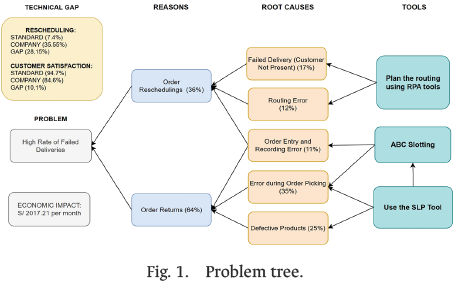
The comparative analysis between the company’s KPIs and e-commerce sector benchmarks, as shown in Fig. 1 (Problem Tree), reveals significant technical gaps. In particular, a 28.15% deviation in rescheduled failed deliveries relative to the national average of 7.4% [4] indicates structural deficiencies in the company’s outbound logistics processes. Regarding customer experience, the recorded satisfaction rate of 84.6% is 10.1 percentage points below the benchmark of over 94% [8]. In addition, the company operates with a storage density of 1,592 units/m², which significantly exceeds the recommended range of 300 to 800 units/m² established by logistics design standards [9], contributing to physical disorder, picking errors, and congestion in the layout. One of the most critical issues lies in routing time, which currently ranges between 60 and 90 min per batch, exceeding the estimated 30 to 60-min average for Metropolitan Lima [7], by up to 30 min. This situation directly affects service levels, increases logistics costs, and jeopardizes the company’s operational sustainability.
On average, the company processes 250 daily orders, of which 80.5% correspond to the five main categories, resulting in an effective population of 201 orders. To estimate the sample size, the classical formula for finite populations was used with a 95% confidence level, an expected proportion of 5%, and a 5% margin of error, resulting in a sample size of 54 orders. These were selected using non-probabilistic convenience sampling, comprising the first 54 orders that contained at least one product from the five main categories.
Regarding the macro-level design (Fig. 2), the system was structured into three main blocks: inputs, processes, and outputs. The input block included generated orders, current product locations, route assignments, and category-based demand. The process block comprised picking, packing, and route assignment operations. The evaluated outputs included picking time (T_picking), routing time, picking and packing personnel utilization rate, failed delivery rate, and the on-time in-full (OTIF) indicator, whose formulation is presented in (1).
 (1)
(1)
The TPICKING indicator was defined as the average time, expressed in minutes, required to collect the products associated with an order. This metric was measured using direct time studies.
To structure the improvement proposal, three complementary tools were used:
- RPA applied to delivery route planning, automating route generation using optimization algorithms based on the vehicle routing problem (VRP), coded in Python
- SLP used to reorganize the warehouse layout based on proximity relationships, interaction frequency, and physical constraints
- ABC classification applied to relocate products within the warehouse according to their turnover and demand, maximizing accessibility for high-frequency items
Given that the company was unable to implement major structural changes due to regulatory, spatial, and budgetary constraints, the proposed improvements were validated through simulation. This approach enabled the modeling and comparison of both the current and proposed systems using Arena simulation software.
- Results
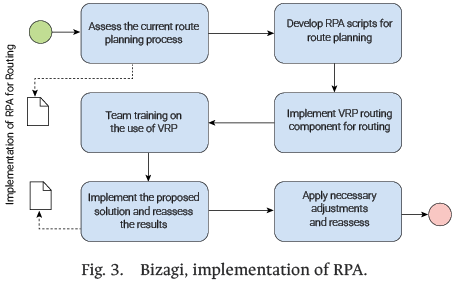
First, an automated routing system was developed following the steps shown in Fig. 3, using the UiPath Community version platform (Fig. 6) integrating Python programming to execute a vehicle routing problem (VRP)–based optimization algorithm.
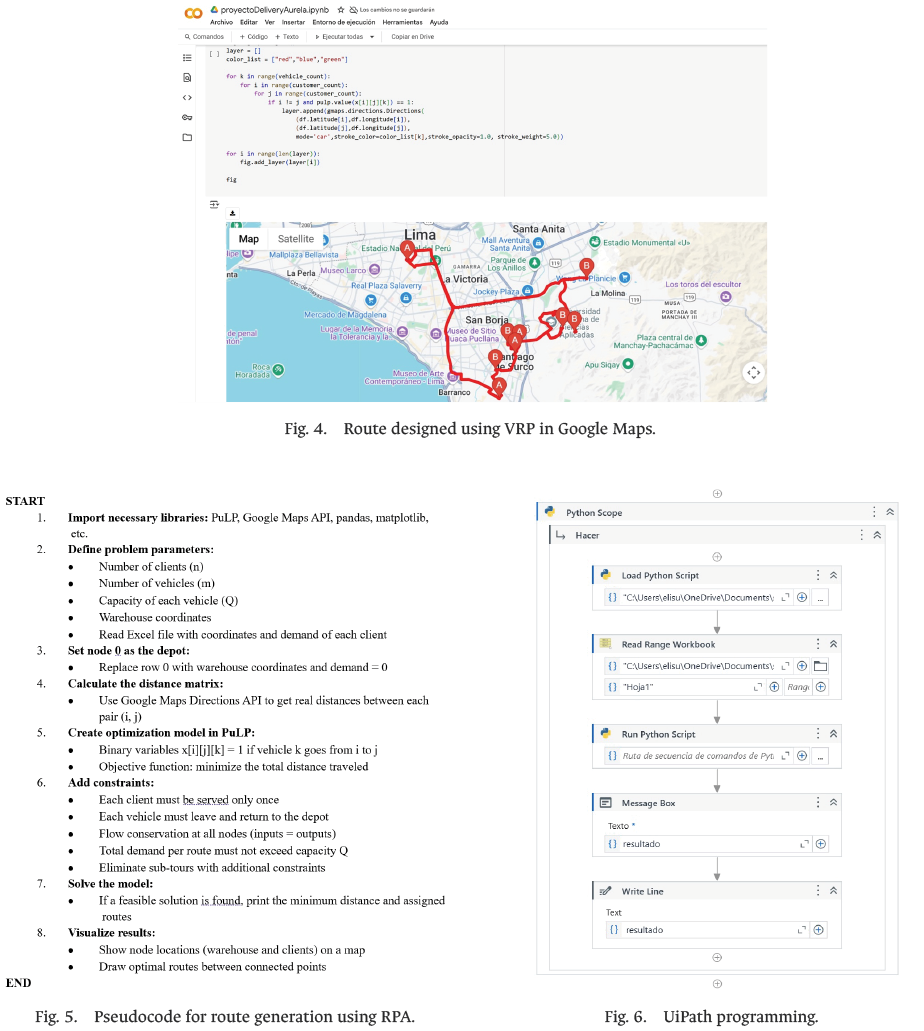
A routing optimization algorithm with capacity constraints was developed using real operational data obtained through the Google Maps application programming interface (API), as shown in Fig. 4. The model was built in Python using integer linear programming and supported by libraries such as PuLP, pandas, matplotlib, and the Google Maps API. The model integrates demand information, geographic coordinates, and vehicle capacity constraints. Fig. 5 presents the pseudocode that describes the general structure and operational logic of the proposed algorithm.
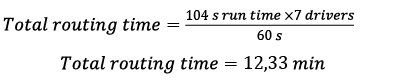
This system replaced the manual route planning process—which required an average of 73.8 min per day—with an automated approach that reduced the time to 12.13 min, representing an improvement of 83.6%. This reduction was calculated by multiplying the total algorithm execution time by the number of delivery drivers dispatched daily by the company, as defined in (2) and (3).
 (2)
(2)
(3)
This automation reduced human errors, optimized zone-based delivery assignments, and directly improved OTIF compliance.
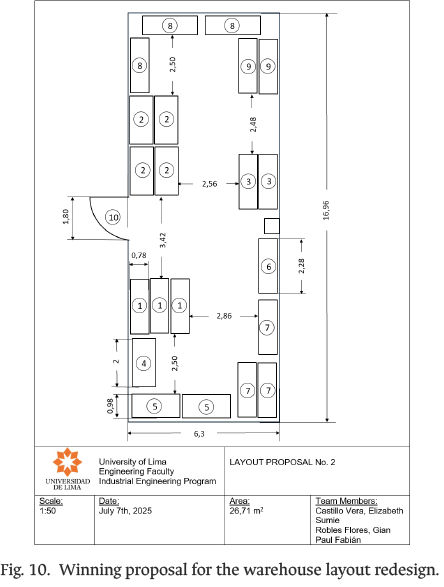
Second, the SLP tool was applied to redesign the warehouse layout, which has a usable area of 26.71 m². The initial configuration showed significant physical disorder, failing to comply with OSHA regulation 29 CFR 1910.22(a)(1), which requires workplaces to be maintained in a clean, orderly condition and free of obstructions. Also, the existing layout did not comply with OSHA regulation 29 CFR 1910.22(b)(1), which requires aisles to have a minimum width of 1.22 m, as shown in Fig. 8.
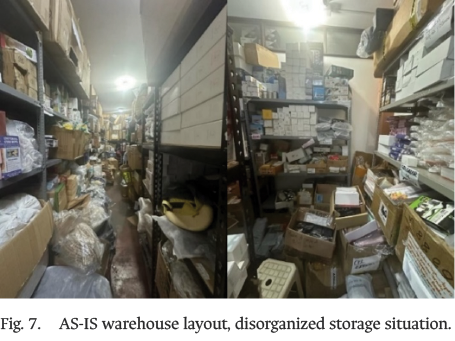
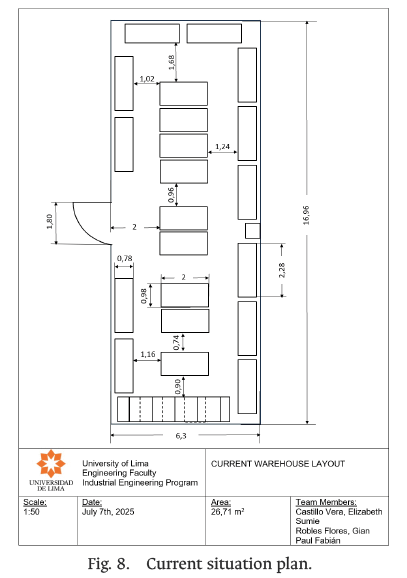
In the initial warehouse layout shown in Fig. 7 and 8, the company lacked a structured and logical product storage organization. Of the total warehouse area, 11.76 m² (55.97%) was occupied; however, 17.43% of this space was underutilized due to the presence of racks storing non-company products and empty boxes, which contributed to the overall disorder.
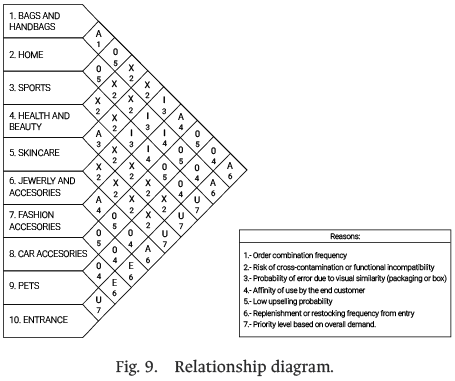
Subsequently, a relationship matrix was developed (Fig. 9), in which products were grouped into nine categories and the importance of their proximity was evaluated based on seven predefined criteria. Based on this analysis, two alternative physical layout proposals were generated, both of which complied with applicable storage and safety regulations.
To select the optimal proposal, five factors were assessed and weighted using a pairwise comparison matrix. The analysis was conducted using a factor ranking methodology. The factors included frequency of product combinations within orders, the risk of cross-contamination or functional incompatibility, aisle accessibility and material flow, space utilization, and ease of supervision and visual control.
Based on this evaluation, Proposal 2 (Fig. 10) was identified as the most suitable alternative, achieving a weighted score of 4.39, compared to 2.84 for Proposal 1.
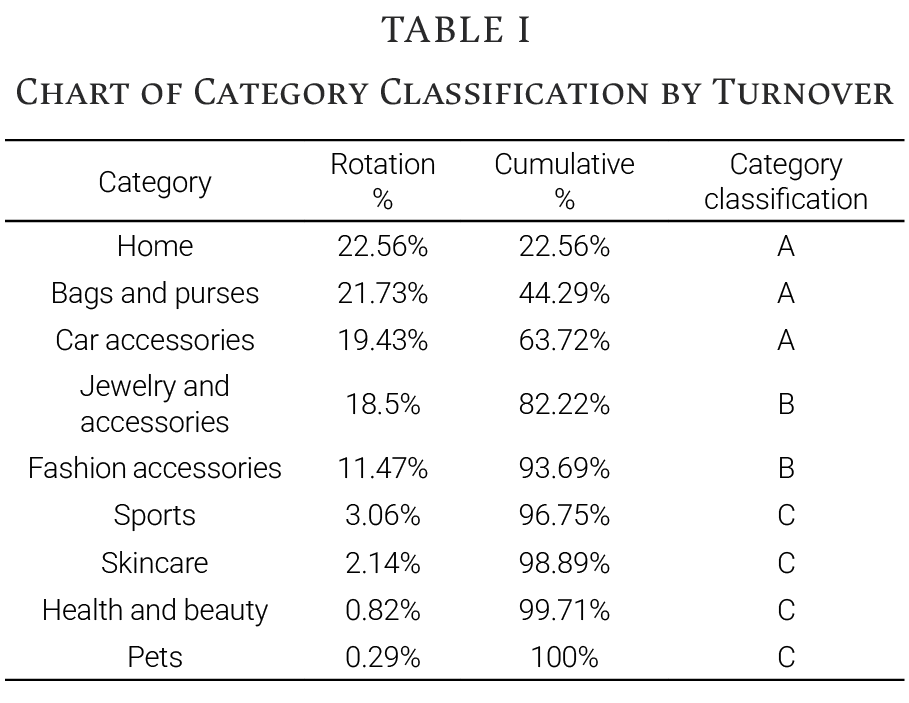
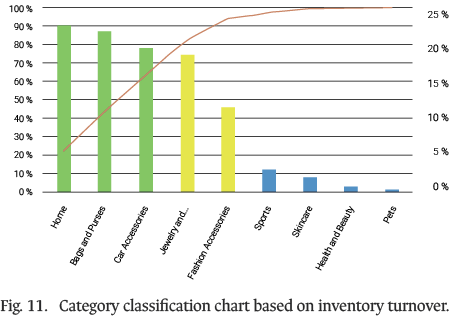
Finally, ABC classification was applied within each rack—that is, the overall location of product categories within the warehouse remained unchanged, while the products stored on each shelf were reorganized according to their turnover. High-turnover items (Category A) were placed at ergonomic heights for easy access; medium-turnover items (Category B) were positioned at intermediate levels; and low-turnover items (Category C) were stored on the upper or lower levels, depending on demand. This reorganization optimized picking routes and improved inventory visibility without altering the overall layout logic established through SLP methodology.
Table I and Fig. 11 present the turnover percentages for each category along with their cumulative percentages. Additionally, the corresponding ABC classification is indicated.
To simulate the implementation of the proposed improvement and enable a comparative analysis with the initial situation, both scenarios were modeled in Arena, as illustrated in Fig. 12. Notably, no activities were added or removed in the improved scenario; instead, the processing times of specific Process modules—such as Picking and Route Assembly—were adjusted to reflect the proposed changes. The comparison between scenarios in Arena yielded the key results presented in Table II.
These results, validated through 42 replications with a 95% confidence interval, confirm that the proposal led to substantial improvements in operational efficiency, delivery timeliness, and human resource utilization. The progressive integration of RPA, SLP, and ABC slotting—with targeted application within the layout—proved to be a robust, replicable, and compatible solution for high-volume, space-constrained logistics operations.
- Discussion
The results obtained from the Arena simulation validate the positive impact of the integrated proposal based on RPA, SLP, and ABC classification on key logistics performance indicators. The observed improvements—namely, a reduction of over 80% in routing time, a 20-percentage-point increase in the OTIF indicator, and improved personnel utilization—are consistent with findings reported in previous studies that evaluated similar tools in e-commerce, manufacturing, and distribution environments.
Regarding routing automation via RPA, this study achieved a reduction in daily route planning time from 73.8 to 12.13 min, representing an 83.58% improvement. This result exceeds the 30% reduction by Ramingwong et al. [11], who implemented automation tools in manufacturing firms in Thailand. This transformation not only reduced the operational workload on personnel but also enhanced service timeliness and consistency.
Regarding warehouse layout redesign using SLP, prior studies—such as those by Ramírez-Cruz et al. [17] and Marcelo-Alfaro et al. [19]—have reported significant improvements in operational efficiency after reorganizing warehouses based on proximity, flow, and frequency criteria. In the present study, the application of SLP reduced the average picking time from 8.19 to 3.72 min, representing a 54.58% improvement. This result exceeds the 42% cycle-time reduction reported by Ramírez-Cruz et al. [17], although it remains below the 61.5% reduction in product search time achieved by Marcelo-Alfaro et al. [19] in a Peruvian SME logistics context.
With respect to the application of ABC classification within each rack, the obtained results are consistent with prior studies that incorporate this tool as a complementary strategy to warehouse layout design. Flores et al. [22] reported a 77.3% reduction in packing time and a 65% increase in operational efficiency following the implementation of turnover-based slotting in a Mexican food company. Özhan et al. [23] reported a 30% increase in shelf space utilization through the combined application of slotting and ABC classification. Similarly, in this study, the internal reorganization of products based on turnover directly contributed to improved personnel utilization, reducing warehouse labor utilization from 49.2% to 31.4%, which represents a 36.18% decrease. Combined with the OTIF increase, these results indicate a structural improvement in the system. Furthermore, the application of the SLP tool enhanced warehouse space utilization by 17.43%.
Together, these findings confirm that the sequential and complementary implementation of RPA, SLP, and ABC classification constitutes an effective strategy for enhancing logistics operations in e-commerce environments. The OTIF improvement from 60.1% to 80.1% represents substantial progress, approaching the optimal industry range of 82% to 90% [5]. This also enhances the customer experience, while the reduction in operational times strengthens responsiveness to demand surges. Simulation-based validation confirms that the proposed tools are feasible in companies with limitations in space, budget, and personnel, and can be scaled to comparable logistics environments.
- Conclusion
The improvement proposal fulfilled the project’s objective by reducing the percentage of failed deliveries through the combined application of RPA, SLP, and ABC classification, resulting in a comprehensive solution that optimizes both digital and operational processes. The use of automation technologies such as RPA not only improved productivity in information management and route planning but also had a direct impact on physical operations by aligning with warehouse redesign and strategic product reorganization. This integration improved logistics flows, reduced distances, optimized space usage, and enhanced operational performance, demonstrating that the synergy between digital and physical tools is key to transforming logistics processes in e-commerce contexts.
References
[1] L. M. Acuña Morales, P. M. Chávarry Pajuelo, R. A. Luna Huamanjulca, and J. J. Sánchez Reyes, “Gestión de innovación y tecnología en el sector e-commerce en el Perú [Innovation and technology management in the e-commerce sector in Peru],” M.S. thesis, Pontificia Universidad Católica del Perú, Lima, Peru, 2021. [Online]. Available: https://www.proquest.com/openview/9ef01c7e8788550a20e16f48a
2d85743/1
[2] M. A. Ortiz-Chávez, J. E. Mendoza-Pumapillo, J. O. Dilas-Jiménez, and C. A. Mugruza-Vassallo, “E-commerce of Peruvian SMEs: Determinants of internet sales before and during COVID-19,” Heliyon, vol. 10, no. 23, Dec. 2024, doi: https://doi.org/10.1016/j.heliyon.2024.e40331
[3] Banco Central de Reserva del Perú, “Reporte del Sistema Nacional de Pagos y del sector fintech en Perú – Marzo 2025 (Report on the National Payment System and the fintech sector in Peru – March 2025),” Banco Central de Reserva del Perú, Lima, Peru, 2025. [Online]. Available: https://www.bcrp.gob.pe/docs/sistema-de-pagos/reportes/2025/informe-sistema-de-pagos-y-fintech-2025-1.pdf
[4] C. A. Gonzales Ruiz, “Propuesta de mejora de la gestión logística para cumplir con el nivel de servicio en un operador logístico [Proposal to improve logistics management to meet the service level in a logistics operator],” Thesis for the degree of Industrial Engineer, Universidad Nacional Mayor de San Marcos, Lima, Peru, 2021. [Online]. Available: https://cybertesis.unmsm.edu.pe/backend/api/core/bitstreams/5918cb6d-bbb8-46fa-a09f-f754a73cb823/content
[5] S. Chopra, Supply chain management: Strategy, planning, and operation, 7th ed. Harlow, U.K.: Pearson, 2021.
[6] E. H. Grosse, C. H. Glock, M. Y. Jaber, and W. P. Neumann, “Incorporating human factors in order picking planning models: Framework and research opportunities,” Int. J. Prod. Res., vol. 53, no. 3, pp. 695–717, 2015, doi: https://doi.org/10.1080/00207543.2014.919424
[7] Y. Wang, L. Ran, X. Guan, J. Fan, Y. Sun, and H. Wang, “Collaborative multicenter vehicle routing problem with time windows and mixed deliveries and pickups,” Expert Syst. Appl., vol. 197, Jul. 2022, doi: https://doi.org/10.1016/j.eswa.2022.116690
[8] M. E. Tavara, “FACULTAD DE DERECHO Y HUMANIDADES ESCUELA PROFESIONAL DE CIENCIAS DE LA COMUNICACIÓN,” 2022.
[9] J. Gu, M. Goetschalckx, and L. F. McGinnis, “Research on warehouse design and performance evaluation: A comprehensive review,” Eur. J. Oper. Res., vol. 203, no. 3, pp. 539–549, 2010, doi: https://doi.org/10.1016/j.ejor.2009.07.031
[10] H. K. Smith, “Impact of robotic process automation (RPA) on e-supply chain coordination efficiency,” Oct. 2024. [Online]. Available: https://www.researchgate.net/publication/384808247
[11] S. Ramingwong, A. Sopadang, K. Y. Tippayawong, and J. Jintana, “Factory logistics improvement: A case study analysis of companies in northern Thailand, 2022–2024,” Logistics, vol. 8, no. 3, p. 88, Sep. 2024, doi: https://doi.org/10.3390/logistics8030088
[12] S. Aguirre and A. Rodriguez, “Automation of a business process using robotic process automation (RPA): A case study,” in Proc. Applied Computer Sciences in Engineering (WEA 2017), Communications in Computer and Information Science, vol. 742, Springer, Aug. 2017, pp. 65–71, doi: https://doi.org/10.1007/978-3-319-66963-2_7
[13] S. Pasupuleti, “Modeling and simulation in robotic process automation: Exploring potential for speed and efficiency in critical systems,” ESP Int. J. Advancements Sci. Technol., 2023, doi: https://doi.org/10.56472/25839233/ijast-v1i2p108
[14] T. Kitsantas, P. Georgoulas, and E. Chytis, “Integrating robotic process automation with artificial intelligence for business process automation: Analysis, applications, and limitations,” J. Syst. Manag. Sci., vol. 14, no. 7,
pp. 217–242, Jun. 2024, doi: https://doi.org/10.33168/jsms.2024.0712
[15] X. Hu and Y. F. Chuang, “E-commerce warehouse layout optimization: Systematic layout planning using a genetic algorithm,” Electron. Commer. Res., vol. 23, no. 1, pp. 97–114, Jan. 2022, doi: https://doi.org/10.1007/s10660-021-09521-9
[16] A. D. Valdivia Alfaro, G. S. Rentería Nuñez, and A. E. Flores Perez, “Implementation of 5S, SLP, standard work, ABC, and minimum and maximum system in a warehouse in metropolitan Lima: Improvement of OTIF orders,” in Proc. 2024 6th Int. Conf. Management Science and Industrial Engineering (MSIE ’24), ACM Int. Conf. Proc. Ser., Assoc. Comput. Mach., Aug. 2024, pp. 351–358, doi: https://doi.org/10.1145/3664968.3665016
[17] C. A. Ramirez-Cruz, L. Salirrosas-Espinoza, and J. C. Quiroz-Flores, “Implementing lean manufacturing and SLP tools to reduce order errors in a pharmaceutical warehouse in Peru,” in Proc. 2023 10th Int. Conf. Industrial Engineering and Applications (ICIEAEU ’23), ACM Int. Conf. Proc. Ser., Assoc. Comput. Mach., Jun. 2023, pp. 192–198, doi: https://doi.org/10.1145/3587889.3588199
[18] E. Badharinath, V. D. Reddy, P. S. Kumar, and A. K. Damodaram, “Optimization of manufacturing plant layout using systematic layout planning (SLP) method,” in Proc. 2nd Int. Conf. Sustainable Technologies and Advances in Automation, Aerospace and Robotics (STAAAR 2023), MATEC Web Conf., vol. 393, p. 01005, Mar. 2024, doi: https://doi.org/10.1051/matecconf/202439301005
[19] E. Marcelo-Alfaro, S. Rodríguez-Escobedo, R. Moore-Torres, and C. Torres, “Storage management model based on lean warehouse management and systematic layout planning,” in Proc. 22nd LACCEI Int. Multi-Conf. Eng., Educ., Technol., Latin Amer. Caribbean Consortium Eng. Institutions, 2024,
doi: https://doi.org/10.18687/LACCEI2024.1.1.1805
[20] A. Avdeikins and M. Savrasovs, “Making warehouse logistics smart by effective placement strategy based on genetic algorithms,” Transp. Telecommun., vol. 20, no. 4, pp. 318–324, Dec. 2019, doi: https://doi.org/10.2478/ttj-2019-0026
[21] R. Gonzales-Vasquez, C. A. Lobato-Tello, and A. Flores-Perez, “Application of ABC, slotting, and EOQ to increase productivity in a trading company: An empirical research in Peru,” in Proc. 4th Asia Pacific Int. Conf. Industrial Engineering and Operations Management, Sep. 2023, doi: https://doi.org/10.46254/AP04.20230202
[22] X. P. Flores Gutiérrez, Y. B. Cota Pardini, and R. Loredo Medina, “Redistribución de inventario con base en clasificación ABC para mejorar el flujo de materiales en una empresa productora de alimentos en Sinaloa, México,” Ing. Ind., no. 44, pp. 65-80, Jun. 2023, doi: https://doi.org/10.26439/ing.ind2023.n44.6244
[23] S. Özhan Doğan, A. Karataş, and N. Bulduk, “System integration with slotting and ABC analysis,” Int. J. Comput. Exp. Sci. Eng., vol. 10, no. 4, pp. 1765-1769, Dec. 2024, doi: https://doi.org/10.22399/ijcesen.784
[24] A. Silva, K. J. Roodbergen, L. C. Coelho, and M. Darvish, “Estimating optimal ABC zone sizes in manual warehouses,” CIRRELT Working Paper, CIRRELT-2021-22, May 2021. [Online]. Available: https://doi.org/10.13140/RG.2.2.15357.28645